
Economics
University of Münster · Münster, Europe
Duration
24 mo
Tuition
No tuition fee
sourcedIntake
Winter semester
English
—
Winter semester intake. Most universities admit on a rolling basis — we confirm the exact application deadline for your profile, free.
Course details verified 09 Sep 2026 — intakes, entry requirements and course facts · official source
Fee sourced Taken from the university's published fees page, not re-checked since — confirm it before you budget. See the university fees page.
About this programme
This consecutive, research-oriented Master’s programme in Economics is designed for students with a solid academic background in Economics or related disciplines. Over the course of four semesters, students receive rigorous training in economic theory and quantitative methods while enjoying the flexibility to tailor their studies to personal interests and career goals. The curriculum begins with core modules in advanced microeconomics, macroeconomics, empirical methods, and industrial organisation. Students then choose from over 40 elective modules, allowing them to specialise in areas such as: Econometrics and Statistics Public Economics Digital and Innovation Economics Energy and Resource Economics Transport Economics Small semester groups and close supervision create an engaging learning environment that fosters individual growth and academic success. A hallmark of the programme is its strong research orientation. Through project work and research-based seminars, students gain data-driven insights in thematic areas such as Innovation, Economic Policy, Globalisation, Sustainability, and Infrastructure. The “Project Studies” module directly prepares students for the Master’s thesis, during which they independently explore an economic issue at a high scientific level. Graduates are well-prepared for international careers in the private sector, government ministries, and international organisations, or for launching their own ventures. The programme also provides an excellent foundation for pursuing a PhD or an academic career. The Master’s programme in Economics is structured over four semesters (120 ECTS) and is designed to combine a sound foundation in economic theory with opportunities for individual specialisation. Programme structure: First Year (Semesters 1 and 2): Core modules (mandatory): Advanced Microeconomics, Advanced Macroeconomics, Empirical Methods, Industrial Organisation Elective modules: Students choose up to six electives from a broad range of courses such as Labour Economics, Public Finance, Energy and Resource Economics, Digital Economy, or Applied Econometrics. Second Year (Semesters 3 and 4): Additional elective courses (up to five modules) to deepen expertise or broaden knowledge Project Studies module: A research-oriented project module designed to prepare students for independent academic work Master’s Thesis: Students demonstrate their ability to independently address a complex economic research question. Throughout the programme, students can build a generalist economic profile or focus on areas such as the following: Econometrics and Data Analysis Environmental and Resource Economics Public Sector Economics Transport Economics The programme also encourages participation in research seminars and provides the opportunity to integrate study abroad periods.
Intakes & deadlines
Winter semester
Dates confirmed for your profile · Open
Summer semester
Dates confirmed for your profile · Open
Entry requirements
-
English
E.G. telc English: telc English C1 IELTS Academic: 7 TOEFL iBT (before 2026): 95 Reading: 24 Listening: 22 Speaking: 25 Writing: 24
-
Prerequisites
All applicants: Bachelor's in Economics or a related field with a minimum of 40 ECTS in Economics and a minimum of 10 ECTS in Mathematics/Statistics/Econometrics Non-EU applicants (who did not receive their Bachelor's in the EU): GRE at least 155 points in the quantitative part and 145 points in the verbal part All admission requirements can be found in the admission regulations and on our homepage.
-
Documents
SOP, LOR & Resume — generate them free in 2 minutes.
Fees & scholarships
No tuition fee tuition (sourced). We confirm the exact costs and the scholarships you qualify for at University of Münster — free, for your profile.
Other programmes at University of Münster
Business Administration
No tuition fee Tuition · sourced 2 years Duration View details MÜ University of MünsterBusiness Development
No tuition fee Tuition · sourced 2 years Duration View details MÜ University of MünsterComparative and Global Law (LLM)
No tuition fee Tuition · sourced 1 year Duration View details MÜ University of MünsterData Science
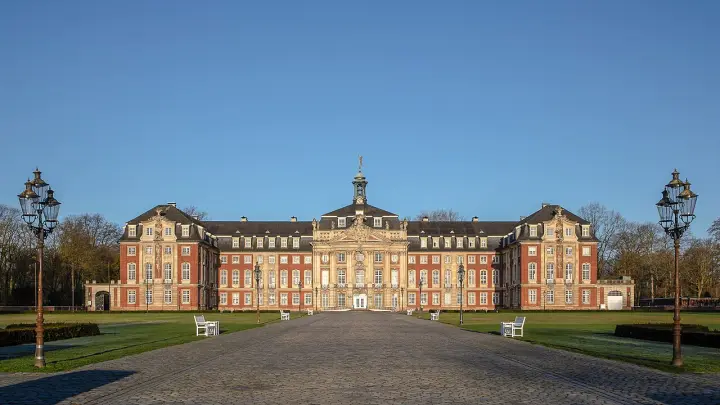
€4,238/yr Tuition · sourced 2 years Duration View detailsCampus photos on this page: Dietmar Rabich (CC BY-SA 4.0) — via Wikimedia Commons.
Economics — FAQs
5 questions
Tuition is No tuition fee. Taken from the university's published fees page, not re-checked since — confirm it before you budget. We confirm the current fee and the scholarships you qualify for — free.
The main intake is Winter semester. Most universities admit on a rolling basis — we confirm the exact deadline for your profile, free.
All applicants: Bachelor's in Economics or a related field with a minimum of 40 ECTS in Economics and a minimum of 10 ECTS in Mathematics/Statistics/Econometrics Non-EU applicants (who did not receive their Bachelor's in the EU): GRE at least 155 points in the quantitative part and 145 points in the verbal part All admission requirements can be found in the admission regulations and on our homepage. English: E.G. telc English: telc English C1 IELTS Academic: 7 TOEFL iBT (before 2026): 95 Reading: 24 Listening: 22 Speaking: 25 Writing: 24.
The programme runs about 24 months full-time.
Yes — shortlisting, SOP, LOR, Resume, application, scholarships and visa guidance are all free. We're paid by partner universities, not by you.
Apply to Economics — free help
A counsellor calls you back during office hours — 9am to 8pm IST, Mon to Sat. We are closed right now, so your request is first in line when we reopen.