Chemical Engineering
Technische Universität Bergakademie Freiberg · Freiberg, Europe
Duration
24 mo
Tuition
No tuition fee
sourcedIntake
Winter semester
English
—
Winter semester intake. Most universities admit on a rolling basis — we confirm the exact application deadline for your profile, free.
Course details verified 10 Sep 2026 — intakes, entry requirements and course facts · official source
Fee sourced Taken from the university's published fees page, not re-checked since — confirm it before you budget. See the university fees page.
About this programme
The Master's degree programme in Chemical Engineering is aimed at foreign graduates who wish to continue their professional career in responsible positions in industry or science, preferably in Germany, after completing their Master's degree. The modules have been carefully selected to ensure graduates will be qualified to take on responsible positions in German industry or academia. This includes modules that will challenge your practical skills in hands-on laboratory/pilot plant work and modules that will provide essential process engineering knowledge at Master's level. During the course, you will be familiarised with German companies and their organisational structure. This Master’s programme will not teach scientific, engineering or process engineering fundamentals at Bachelor’s level. The academic discipline of chemical engineering deals with processes in which substances are changed in their composition, type or properties by mechanical, thermal, chemical or biological processes. Electronic materials in cell phones, tables, laptops and desktop computers were obtained from raw materials with the help of chemical engineering. Plastics, paints, coatings and foams that surround you were produced from chemical raw materials with its help. The food and medicines we consume are produced from natural substances with the help of it. Hydrogen, one of the energy sources of the future, is produced with the help of chemical engineering. The greenhouse gas carbon dioxide can be captured with chemical engineering and stored or converted into chemicals, fuels and products. Municipal and industrial residues (waste), waste water and exhaust air streams are treated, purified and/or utilised with the help of it — the list of applications could go on and on. The degree programme starts in the winter semester. A regular study period of four semesters (two years) is required to complete it. The first semester aims to bring all students to the same level of knowledge in numerical analysis, mechanics of materials, and programming; this is the knowledge on which following semesters strongly build. Additionally, you will improve your German language skills, which will help you to explore the culture of Germany. The second semester focuses on introducing important simulation methods, the accompanying theoretical and numerical concepts, and the advantages and pitfalls of all methods. Advanced aspects of materials science and engineering are introduced in hands-on approaches using dedicated simulation tools. Catch up with the latest developments in Machine Learning and AI-assisted programming and project development. During the third semester, you can additionally choose from a variety of elective courses, covering materials science modules and advanced mechanics modules. Your programming skills will be further developed during the "Personal Programming Project", where you will be required to solve a problem of relevance to materials science, mechanics, or machine learning by using the programming and simulation skills that you acquired during the first two semesters. The fourth and last semester is reserved for the Master's thesis. Thanks to the wide range of optional modules, students have the opportunity to tailor their degree programme to their individual needs. Beyond a sound foundation for all, students can individually put together modules with a focus on one of the following (or combinations thereof): Data Analysis and Artificial Intelligence Continuum Modelling and Simulation Atomistic and Multiscale Simulation Methods Materials Science PDF Download
Intakes & deadlines
Winter semester
Dates confirmed for your profile · Open
Entry requirements
-
English
E.G. TOEFL iBT (before 2026): 90 Reading: 23 Listening: 23 Speaking: 22 Writing: 22 IELTS Academic: 6.5
-
Prerequisites
A first professionally qualifying degree from a university in a degree programme in chemical engineering, process engineering, technical chemistry or in an equivalent degree programme lasting at least six semesters Qualification assessment procedure: further information
-
Documents
SOP, LOR & Resume — generate them free in 2 minutes.
This is an indicative early-career range for the whole Engineering (general) field in Europe, from official graduate-outcome data — not a figure for this programme or university, and not a guarantee of what you will earn. What you actually earn depends on the role, employer, city and your visa.
Source: Profiling Institut - Gehaltsranking nach Studienfach 2026 (StepStone Gehaltsreport 2026), 2026. Market job-board data — less official than a government survey; treat as indicative.
Rupee figure converted at the 18 Aug 2026 mid-market rate; your bank's rate will be worse and currencies move, so use it for planning, not as the amount you will receive.
Fees & scholarships
No tuition fee tuition (sourced). We confirm the exact costs and the scholarships you qualify for at Technische Universität Bergakademie Freiberg — free, for your profile.
Other programmes at Technische Universität Bergakademie Freiberg
Advanced Materials Analysis
No tuition fee Tuition · sourced 2 years Duration View details TBF Technische Universität Bergakademie FreibergApplied Geoscience
No tuition fee Tuition · sourced 2 years Duration View details TBF Technische Universität Bergakademie FreibergComputational Materials Science (CMS)
No tuition fee Tuition · sourced 2 years Duration View details TBF Technische Universität Bergakademie FreibergGeomatics for Mineral Resource Management
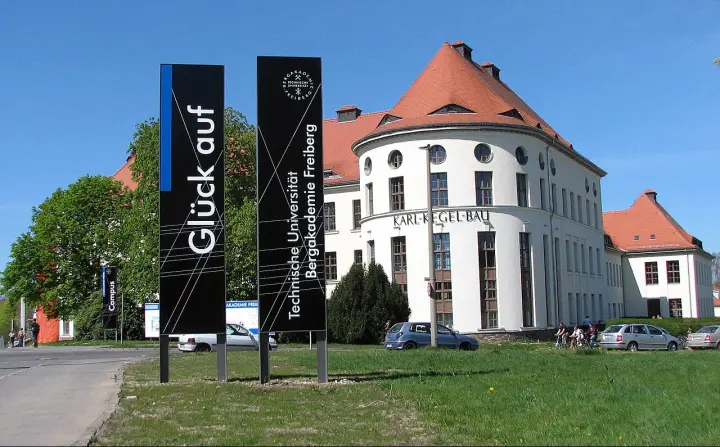
No tuition fee Tuition · sourced 2 years Duration View detailsCampus photos on this page: RobertPorter (Public domain) — via Wikimedia Commons.
Chemical Engineering — FAQs
5 questions
Tuition is No tuition fee. Taken from the university's published fees page, not re-checked since — confirm it before you budget. We confirm the current fee and the scholarships you qualify for — free.
The main intake is Winter semester. Most universities admit on a rolling basis — we confirm the exact deadline for your profile, free.
A first professionally qualifying degree from a university in a degree programme in chemical engineering, process engineering, technical chemistry or in an equivalent degree programme lasting at least six semesters Qualification assessment procedure: further information English: E.G. TOEFL iBT (before 2026): 90 Reading: 23 Listening: 23 Speaking: 22 Writing: 22 IELTS Academic: 6.5.
The programme runs about 24 months full-time.
Yes — shortlisting, SOP, LOR, Resume, application, scholarships and visa guidance are all free. We're paid by partner universities, not by you.
Apply to Chemical Engineering — free help
A counsellor calls you back during office hours — 9am to 8pm IST, Mon to Sat. We are closed right now, so your request is first in line when we reopen.