
Biomedical Engineering
RWTH Aachen University · Aachen, Germany, Europe
Duration
24 mo
Tuition
No tuition fee
sourcedIntake
Winter semester
English
—
Winter semester intake. Most universities admit on a rolling basis — we confirm the exact application deadline for your profile, free.
Course details verified 09 Sep 2026 — intakes, entry requirements and course facts · official source
Fee sourced Taken from the university's published fees page, not re-checked since — confirm it before you budget. See the university fees page.
About this programme
Biomedical Engineering is a dynamic multidisciplinary scientific field that combines Medicine and Engineering with Natural Sciences like Biology, Mathematics, Physics and Chemistry. At RWTH Aachen University, this Master's programme is the only programme that ends with an independent degree in Master of Science in Biomedical Engineering (BME). The major goal of this research-based Master’s programme is to apply engineering principles and design concepts to medicine to solve human health problems through early detection, diagnosis, therapy as well as prevention of diseases. The curriculum is designed to provide not only a general background in Biomedical Engineering but also a specific Aachen profile with regard to the current research in the Biomedical Engineering department. Focal points of this profile are: Medical Imaging Techniques, including the modules Medical Imaging, Image Guided Therapy and Theranostics and Image Processing and Handling Tissue Engineering, including the module Cell Culture and Tissue Engineering Materials Science, including the modules Materials Science and Processing, Advanced Biomaterials – Hard Tissue Implants and Prostheses & 3D Bioprinting Artificial Organs, including the module on Artificial Organs with focus on Heart, Kidney, Lung and Liver An absolutely unique selling point of the Master's programme is the parallel teaching of all four focus areas which offers students a broad spectrum of engineering and medical technology – thereby improving their technical skills. Our international academic environment enables students to get hands-on international, intercultural academic work experience, giving them the opportunity to further develop their soft skills. All these skills enable the graduates to work in medical technology research or development and provides the foundation for a later PhD. The graduates will have a broad in-depth theoretical and practical knowledge of Natural Sciences, Medicine and Engineering. Typical research areas include physiology of molecular and cellular systems, physiology of organ systems, medical imaging techniques, robotics and artificial organs, tissue engineering and materials science. Graduates are not only able to analyse and solve technical and scientific problems, but also to critically question the conception thereof and to handle and document complex problems in research and development independently. They are able to report the results appropriately using current technical language and terminology. The Master's programme is interdisciplinary and involves the following departments: Medicine, Computer and Natural Sciences, Mechanical Engineering, and Electrical Engineering and Information Technology. The BME programme is offered in a group size of approximately 50 students and thus enables individual support of the student as well as optimal teaching transfer and development of the technical content. The interdisciplinary programme has a modular design and is divided into mandatory, elective mandatory and optional modules. This wide range of modules offered by the four participating departments ensures that the individual interests and creativity of each student are promoted in the best possible way. The programme contains three semesters of lectures, seminars, exercises and practical modules. After each semester students are assessed with written or oral exams. Another part of the programme is the full-time six to eight-week internship in the second semester. This internship is an opportunity to put acquired knowledge into practice and gather experience in the professional surrounding of Biomedical Engineering either in an institute or a company. Another important goal of the internship is to practice various skills in a given time (planning and preparation, data collection, analysis, and writing). In the internship, either a concrete scientific problem is dealt with or practical methodological skills are trained and deepened. The Master's thesis is a prede
Intakes & deadlines
Winter semester
Dates confirmed for your profile · Open
Entry requirements
-
English
E.G. PTE Academic: 70 UNIcert® English: UNIcert® III IELTS Academic: 7 TOEFL iBT (before 2026): 100 Reading: 29 Listening: 28 Speaking: 28 Writing: 29 Cambridge English Qualifications: C1 Advanced
-
Prerequisites
Entrance requirement for this study programme is an undergraduate degree from a national or international university – in Medicine, a Bachelor of Science, a Bachelor of Engineering or similar. Undergraduate degrees are only acceptable from universities that are accredited by the state in which the university is located or through officially recognised procedures. The educational requirements of the undergraduate degrees should include knowledge (90 credit points (CP) of the European Credit Transfer System) in the fields of Engineering, Mathematics / Natural Sciences with at least the following CP in these four fields: Mathematics (20 CP): advanced mathematics; linear algebra (vector analysis and tensor analysis), analysis (differential calculus and integral calculus), numeric methods Chemistry (20 CP): advanced chemistry; anorganic chemistry, organic chemistry, biochemistry, physical chemistry Biology (20 CP): advanced biology; human cell biology, genetics, microbiology, molecular biology, human physiology, human anatomy Physics and Engineering Technology (30 CP): advanced physics; mechanics, electrotechnics, thermodynamics, nuclear physics, solid state physics, static and dynamic In each field, students need at least 50% of the mentioned credits. If one or more subjects have less than 50% of the needed credits, the application will be rejected. A student can have up to a maximum of 20 missing credits in total and still will be accepted. This means that if 20 credits are missing, a total of four additional modules must be taken during the Master's degree. This can extend the duration of the programme up to one or two semesters. To fulfil the above-mentioned requirements, we advise students to take the missing modules at their home university in time. As a non-EU applicant, you have to successfully pass the Graduate Record Examination Test (GRE). In the quantitative part you need at least 160 points. Your official GRE report of scores must be received by the RWTH directly from the Educational Testing Service (ETS). The code number for RWTH Aachen is 8504. Please upload the test result directly in RWTH online by 1 March. Your test must not be older than two years at the time of the application deadline. For further information or if you have any questions about the application, please contact us.
-
Documents
SOP, LOR & Resume — generate them free in 2 minutes.
This is an indicative early-career range for the whole Engineering (general) field in Europe, from official graduate-outcome data — not a figure for this programme or university, and not a guarantee of what you will earn. What you actually earn depends on the role, employer, city and your visa.
Source: Profiling Institut - Gehaltsranking nach Studienfach 2026 (StepStone Gehaltsreport 2026), 2026. Market job-board data — less official than a government survey; treat as indicative.
Rupee figure converted at the 18 Aug 2026 mid-market rate; your bank's rate will be worse and currencies move, so use it for planning, not as the amount you will receive.
Fees & scholarships
No tuition fee tuition (sourced). We confirm the exact costs and the scholarships you qualify for at RWTH Aachen University — free, for your profile.
Other programmes at RWTH Aachen University
 RWTH Aachen University
Advanced Computational Methods in Civil Engineering
No tuition fee Tuition · sourced 2 years Duration View details
RWTH Aachen University
Applied Geosciences – Applied Mineralogy and Crystallography (AMC) (MSc)
No tuition fee Tuition · sourced 2 years Duration View details
RWTH Aachen University
Applied Geosciences – Computational Geology and Geophysics (CGG) (MSc)
No tuition fee Tuition · sourced 2 years Duration View details
RWTH Aachen University
Applied Geosciences – Energy & Mineral Resources (EMR) (MSc)
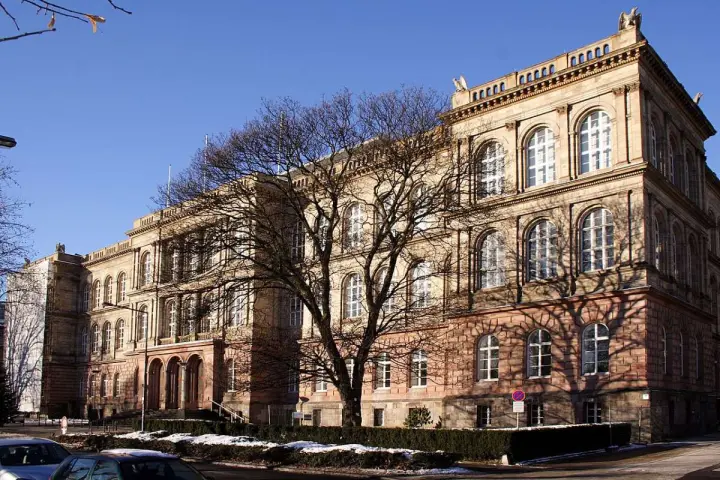
No tuition fee Tuition · sourced 2 years Duration View detailsCampus photos on this page: א (Aleph) (CC BY-SA 2.5) — via Wikimedia Commons.
Biomedical Engineering — FAQs
5 questions
Tuition is No tuition fee. Taken from the university's published fees page, not re-checked since — confirm it before you budget. We confirm the current fee and the scholarships you qualify for — free.
The main intake is Winter semester. Most universities admit on a rolling basis — we confirm the exact deadline for your profile, free.
Entrance requirement for this study programme is an undergraduate degree from a national or international university – in Medicine, a Bachelor of Science, a Bachelor of Engineering or similar. Undergraduate degrees are only acceptable from universities that are accredited by the state in which the university is located or through officially recognised procedures. The educational requirements of the undergraduate degrees should include knowledge (90 credit points (CP) of the European Credit Transfer System) in the fields of Engineering, Mathematics / Natural Sciences with at least the following CP in these four fields: Mathematics (20 CP): advanced mathematics; linear algebra (vector analysis and tensor analysis), analysis (differential calculus and integral calculus), numeric methods Chemistry (20 CP): advanced chemistry; anorganic chemistry, organic chemistry, biochemistry, physical chemistry Biology (20 CP): advanced biology; human cell biology, genetics, microbiology, molecular biology, human physiology, human anatomy Physics and Engineering Technology (30 CP): advanced physics; mechanics, electrotechnics, thermodynamics, nuclear physics, solid state physics, static and dynamic In each field, students need at least 50% of the mentioned credits. If one or more subjects have less than 50% of the needed credits, the application will be rejected. A student can have up to a maximum of 20 missing credits in total and still will be accepted. This means that if 20 credits are missing, a total of four additional modules must be taken during the Master's degree. This can extend the duration of the programme up to one or two semesters. To fulfil the above-mentioned requirements, we advise students to take the missing modules at their home university in time. As a non-EU applicant, you have to successfully pass the Graduate Record Examination Test (GRE). In the quantitative part you need at least 160 points. Your official GRE report of scores must be received by the RWTH directly from the Educational Testing Service (ETS). The code number for RWTH Aachen is 8504. Please upload the test result directly in RWTH online by 1 March. Your test must not be older than two years at the time of the application deadline. For further information or if you have any questions about the application, please contact us. English: E.G. PTE Academic: 70 UNIcert® English: UNIcert® III IELTS Academic: 7 TOEFL iBT (before 2026): 100 Reading: 29 Listening: 28 Speaking: 28 Writing: 29 Cambridge English Qualifications: C1 Advanced.
The programme runs about 24 months full-time.
Yes — shortlisting, SOP, LOR, Resume, application, scholarships and visa guidance are all free. We're paid by partner universities, not by you.
Apply to Biomedical Engineering — free help
A counsellor calls you back during office hours — 9am to 8pm IST, Mon to Sat. We are open now.