
International Political Economy (MSc Double Degree)
Philipps-Universität Marburg · Marburg, Europe
Duration
24 mo
Tuition
No tuition fee
sourcedIntake
Winter semester
English
—
Winter semester intake. Most universities admit on a rolling basis — we confirm the exact application deadline for your profile, free.
Course details verified 10 Sep 2026 — intakes, entry requirements and course facts · official source
Fee sourced Taken from the university's published fees page, not re-checked since — confirm it before you budget. See the university fees page.
About this programme
Programme Description The Master of Science in International Political Economy is a two-year, interdisciplinary programme combining economic analysis with insights from political science. It provides training in both quantitative and qualitative research methods and equips students to analyse complex real-world issues from an economic perspective. The programme is jointly offered by the University of Texas at Dallas and the University of Marburg as a dual degree. Students spend one academic year at each institution and receive degrees from both universities upon successful completion. The programme is designed for graduates with a background in economics or political science (or related fields). Applicants with an economics background are admitted through Marburg, while those with a political science background apply through Dallas. Students develop an advanced understanding of key theories, debates, and recent research in international political economy. They also learn to apply this knowledge to practical problems and to develop feasible, evidence-based solutions. Programme Structure The programme comprises 120 ECTS credits. Students with an economics background begin in Marburg and move to Dallas after two semesters; students with a political science background follow the reverse path. Credits earned at both institutions are mutually recognised. Teaching is organised in modules that include required and elective components. Courses cover economics, political science, and research methods, allowing students to tailor their studies according to their interests. The Master’s thesis is completed in the final phase of the programme over a period of four months under academic supervision. Example Study Path Starting in Marburg Semesters 1–2 (Marburg): Research Methods International Economics Economics Electives Semesters 3–4 (Dallas): Research Methods International Politics Political Science Electives Master’s Thesis Starting in Dallas Semesters 1–2 (Dallas): Research Methods and Economics International Politics Political Science Electives Semesters 3–4 (Marburg): Research Methods International Economics Economics Electives Master’s Thesis Following the Bologna guidelines on European university education, the course is structured so that 30 credit points (ECTS) should be achieved every semester. The different modules in the Master's programme add up to 120 ECTS. The following section gives an overview of the programme structure and its modules. Research Methods (24 ECTS points) To accommodate the increasing demand for economists equipped with methodological skills, students are trained in a variety of analytical tools. This module will also help to prepare students to write their Master's theses and academic essays in general. International Politics (20 ECTS points) International Economics (12 ECTS points) Economics Electives (36 ECTS points) Political Science Electives (10 ECTS points) Master's Thesis (18 ECTS points) The final phase of the course is the Master's thesis, which provides students with the opportunity to apply the skills acquired during the taught part of the programme. Students may choose a research topic in economics or political science, within which they will undertake theory or public policy-oriented research using a multitude of possible methods under the guidance of an experienced professor. PDF Download
Intakes & deadlines
Winter semester
Dates confirmed for your profile · Open
Entry requirements
-
Prerequisites
Bachelor's degree or its equivalent in economics or a related field or in political science or a related field When applying to Marburg, the following criteria must be fulfilled: At the time of application, students should have been awarded at least 72 ECTS credits in economics, business administration, or economics-related methods (e.g. mathematics, statistics), with at least 54 ECTS credits in economics. Please note that the latter admission requirement reflects roughly one and a half years of full-time study of economics courses in a narrow sense, which means that, for example, business administration, accounting, management, marketing, etc. do not count towards the necessary credits for admission. For further details, please take a look at: https://www.uni-marburg.de/en/fb02/studying/study-programmes/international-political-economy/ipe-factsheet-application.pdf
-
Documents
SOP, LOR & Resume — generate them free in 2 minutes.
Fees & scholarships
No tuition fee tuition (sourced). We confirm the exact costs and the scholarships you qualify for at Philipps-Universität Marburg — free, for your profile.
Other programmes at Philipps-Universität Marburg
Applied Methods of Social Science Research (MA)
No tuition fee Tuition · sourced 1 year Duration View details PM Philipps-Universität MarburgBusiness Informatics (MSc)
No tuition fee Tuition · sourced 2 years Duration View details PM Philipps-Universität MarburgBusiness Mathematics (MSc)
No tuition fee Tuition · sourced 2 years Duration View details PM Philipps-Universität MarburgComputer Science (MSc)
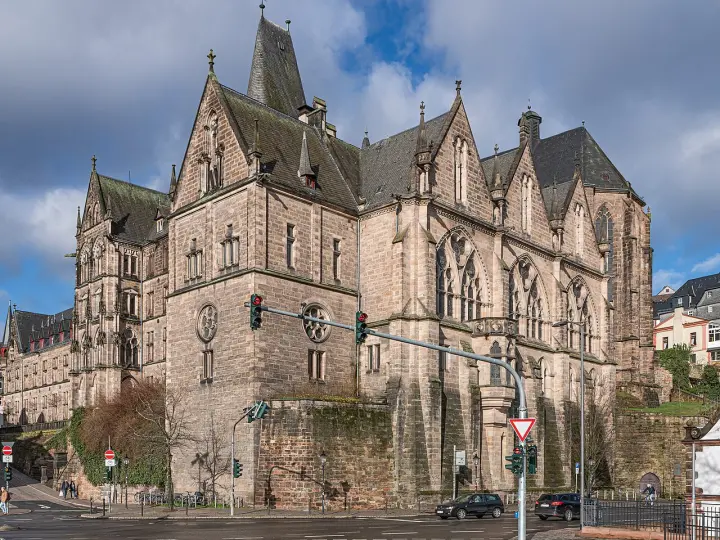
No tuition fee Tuition · sourced 2 years Duration View detailsCampus photos on this page: A.Savin (FAL) — via Wikimedia Commons.
International Political Economy (MSc Double Degree) — FAQs
5 questions
Tuition is No tuition fee. Taken from the university's published fees page, not re-checked since — confirm it before you budget. We confirm the current fee and the scholarships you qualify for — free.
The main intake is Winter semester. Most universities admit on a rolling basis — we confirm the exact deadline for your profile, free.
Bachelor's degree or its equivalent in economics or a related field or in political science or a related field When applying to Marburg, the following criteria must be fulfilled: At the time of application, students should have been awarded at least 72 ECTS credits in economics, business administration, or economics-related methods (e.g. mathematics, statistics), with at least 54 ECTS credits in economics. Please note that the latter admission requirement reflects roughly one and a half years of full-time study of economics courses in a narrow sense, which means that, for example, business administration, accounting, management, marketing, etc. do not count towards the necessary credits for admission. For further details, please take a look at: https://www.uni-marburg.de/en/fb02/studying/study-programmes/international-political-economy/ipe-factsheet-application.pdf
The programme runs about 24 months full-time.
Yes — shortlisting, SOP, LOR, Resume, application, scholarships and visa guidance are all free. We're paid by partner universities, not by you.
Apply to International Political Economy (MSc Double Degree) — free help
A counsellor calls you back during office hours — 9am to 8pm IST, Mon to Sat. We are open now.