
Data Science (MSc)
Philipps-Universität Marburg · Marburg, Europe
Duration
24 mo
Tuition
No tuition fee
sourcedIntake
Winter semester
English
—
Winter semester intake. Most universities admit on a rolling basis — we confirm the exact application deadline for your profile, free.
Course details verified 10 Sep 2026 — intakes, entry requirements and course facts · official source
Fee sourced Taken from the university's published fees page, not re-checked since — confirm it before you budget. See the university fees page.
About this programme
The Master's programme in Data Science of the University of Marburg serves to deepen knowledge and provide specialisation for the acquisition of competencies in dealing with (big) data. Taking into account the new requirements in a digitalised society and the resulting changes in the professional world and the associated transdisciplinarity, you will acquire an expanded skill set and knowledge in the field of computer science and applied mathematics. Building on these, you will be able to independently develop solutions to technical and scientific problems as well as to apply and critically assess scientific findings and deal with them responsibly in an application context. In order to achieve these goals, the Master's programme consists of specialisations in information technology, such as machine learning, software development of scalable systems and big data technology as well as applied mathematics. In addition, it is optionally possible to choose an area of application. In any case, you will become acquainted with concrete applications through the project-oriented parts of the studies and strengthen your social and team working skills. Besides a software project with a duration of one year, in which you practice data science skills such as data modelling and analysis, you will participate in at least one seminar, in which you practice working with relevant scientific literature. In the individual Master’s thesis, you will work on research-related problems from data science. Following the Bologna guidelines on European university education, the course is structured so that 30 credit points (ECTS) should be achieved every semester. The different modules in the Master's programme add up to 120 ECTS: Compulsory Elective Modules in Mathematics (18 ECTS points) According to your own interests, you can deepen and broaden your knowledge and competences in applied mathematics by choosing from our long list of electives. This broadens your spectrum of mathematics skills and provides you with the foundation to critically investigate modern research questions and to apply modern methods. Free Compulsory Elective Modules (24 to 48 ECTS points) In this study area, you choose at least 24 ECTS points from our long list of electives in computer science according to your own interests, to deepen and broaden your knowledge and competences in this discipline. If the optional application area is not selected, the scope of free elective modules grows allowing you to further specialise in topics of the disciplines computer science as well as mathematics. Application Area Modules (optional; 18 to 24 ECTS points if selected) Optionally, you can select an application area (such as medical informatics, social sciences, geoinformatics or languages), which consists of fundamental modules from another subject area and relevant data-science modules. These modules are coordinated such that the most relevant data-science competences for the application in the domain of the subject area can be combined. Practical and Seminar Modules (24 to 27 ECTS points) This study area serves to deepen your practice-oriented scientific skills. These include competencies essential for data-science specialists to carry out a research project in group work, usually involving modelling and implementation in an extensive, data-centric software project. In one or two seminar modules, you can sharpen your profile as well as practice to compare and evaluate research results. In a dedicated module, you will learn and practice techniques of scientific work in data science in an individual project. Master's Thesis (30 ECTS points) The final phase of the course is the Master's thesis. Students apply the skills acquired during the taught part of the programme. You will work on your own research project under the guidance of an experienced professor.
Intakes & deadlines
Winter semester
Dates confirmed for your profile · Open
Summer semester
Dates confirmed for your profile · Open
Entry requirements
-
English
E.G. IELTS Academic: 7
-
Prerequisites
For this consecutive programme, a BSc in Data Science, in Computer Science, in Mathematics, or a comparable university degree with a minimum GPA is required. In any case, in-depth knowledge in the disciplines of computer science and mathematics must be documented, including in particular in the area of machine learning. Admission is based on an eligibility assessment procedure. At the time of application, students should have been awarded at least 144 ECTS points. Detailed information on admission requirements: https://www.uni-marburg.de/en/studying/degree-programs/sciences/datasciencems Language requirements: The teaching language is English but the exams can be taken in English as well as in German. Therefore, it is possible to apply with either English proficiency of at least level C1 of the CEFRL or English proficiency of at least level B1 of the CEFRL and German proficiency of at least level DSH-2.
-
Documents
SOP, LOR & Resume — generate them free in 2 minutes.
This is an indicative early-career range for the whole Computer Science / IT field in Europe, from official graduate-outcome data — not a figure for this programme or university, and not a guarantee of what you will earn. What you actually earn depends on the role, employer, city and your visa.
Source: get in IT (Gehaltsstatistik Informatik 2026), 2026. Market job-board data — less official than a government survey; treat as indicative.
Rupee figure converted at the 18 Aug 2026 mid-market rate; your bank's rate will be worse and currencies move, so use it for planning, not as the amount you will receive.
Fees & scholarships
No tuition fee tuition (sourced). We confirm the exact costs and the scholarships you qualify for at Philipps-Universität Marburg — free, for your profile.
Other programmes at Philipps-Universität Marburg
Applied Methods of Social Science Research (MA)
No tuition fee Tuition · sourced 1 year Duration View details PM Philipps-Universität MarburgBusiness Informatics (MSc)
No tuition fee Tuition · sourced 2 years Duration View details PM Philipps-Universität MarburgBusiness Mathematics (MSc)
No tuition fee Tuition · sourced 2 years Duration View details PM Philipps-Universität MarburgComputer Science (MSc)
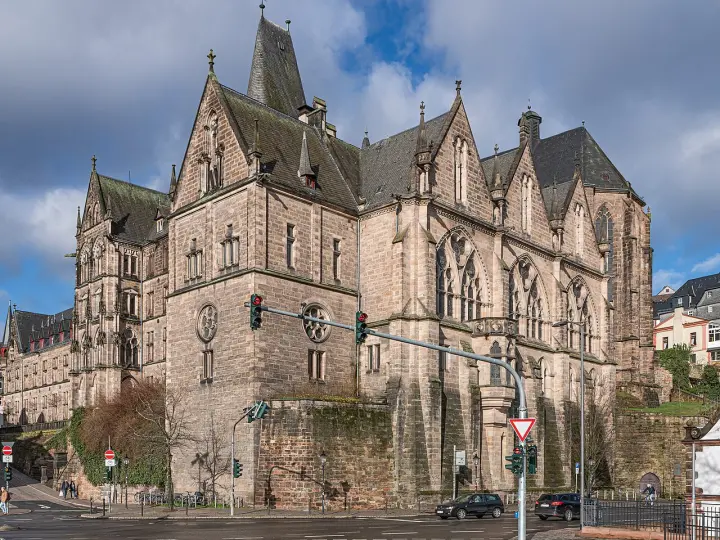
No tuition fee Tuition · sourced 2 years Duration View detailsCampus photos on this page: A.Savin (FAL) — via Wikimedia Commons.
Data Science (MSc) — FAQs
5 questions
Tuition is No tuition fee. Taken from the university's published fees page, not re-checked since — confirm it before you budget. We confirm the current fee and the scholarships you qualify for — free.
The main intake is Winter semester. Most universities admit on a rolling basis — we confirm the exact deadline for your profile, free.
For this consecutive programme, a BSc in Data Science, in Computer Science, in Mathematics, or a comparable university degree with a minimum GPA is required. In any case, in-depth knowledge in the disciplines of computer science and mathematics must be documented, including in particular in the area of machine learning. Admission is based on an eligibility assessment procedure. At the time of application, students should have been awarded at least 144 ECTS points. Detailed information on admission requirements: https://www.uni-marburg.de/en/studying/degree-programs/sciences/datasciencems Language requirements: The teaching language is English but the exams can be taken in English as well as in German. Therefore, it is possible to apply with either English proficiency of at least level C1 of the CEFRL or English proficiency of at least level B1 of the CEFRL and German proficiency of at least level DSH-2. English: E.G. IELTS Academic: 7.
The programme runs about 24 months full-time.
Yes — shortlisting, SOP, LOR, Resume, application, scholarships and visa guidance are all free. We're paid by partner universities, not by you.
Apply to Data Science (MSc) — free help
A counsellor calls you back during office hours — 9am to 8pm IST, Mon to Sat. We are open now.