
Master of Science in International Economics and Business
University of Passau · Passau, Europe
Duration
24 mo
Tuition
No tuition fee
sourcedIntake
Winter semester
English
—
Winter semester intake. Most universities admit on a rolling basis — we confirm the exact application deadline for your profile, free.
Course details verified 09 Sep 2026 — intakes, entry requirements and course facts · official source
Fee sourced Taken from the university's published fees page, not re-checked since — confirm it before you budget. See the university fees page.
About this programme
The MSc International Economics and Business programme imparts in-depth expertise, skills and research methodology in micro- and macroeconomic theory as well as empirical economics with a focus on Global Economy, International Trade and Finance, and Governance, Institutions and Development. The methodological competences, while geared primarily to economic analysis, are enriched with business administration-specific elements. This degree programme is taught entirely in English. Features Focus on economics modules Strong involvement of empirical research (laboratory and field experiments as well as secondary data analysis) Includes selected modules on business administration and econometrics Interdisciplinary modules count towards the degree Excellent staff-student ratio due to small learning groups (about 20 to 30 students each year) Combines theory and practice Excellent results in the CHE Ranking (the university ranking scheme for the German-speaking world) Numerous global university partnerships Test yourself Use our self-assessment tool to find out whether this programme is right for you. Completing the test, which should take about 10 to 15 minutes, will give you a first impression of the programme content and tell you whether you have the prerequisites needed for this degree programme. The programme is divided into seven module groups and the Master's thesis module: A: Core Courses (25–30 ECTS credits) The core econometrics, macroeconomics and microeconomics courses impart the central techniques required for the subsequent stages of your degree programme. B: Advanced Methods (a minimum of 10 ECTS credits) In this module group, you will be acquainted with advanced quantitative methods in in-depth econometrics and behaviour-oriented courses. C: Global Economy, International Trade and Finance (a minimum of 10 ECTS credits) This module group comprises courses on globalisation, trade and finance. You will learn about theories and apply empirical methods to understand human decision-making processes concerning investments, location, trade, and finance as well as their respective systemic interactions and ways of influencing economic policy. D: Governance, Institutions and Development (a minimum of 10 ECTS credits) In this module group, you will learn about theories and apply empirical methods to understand development theory and policy, institutional design, the fight against corruption, ethics, fiscal policy, and health economics. E: Business Administration (a maximum of 20 ECTS credits) Suitable business administration modules complement the knowledge acquired in module groups A to D. F: Foreign language with a business and economics focus (a maximum of 10 ECTS credits) You will gain 10 ECTS credits in one of the following foreign languages offered by the language centre: Chinese, Czech, English, French, Italian, Polish, Portuguese, Russian, or Spanish. G: Interdisciplinary modules (a maximum of 10 ECTS credits) In this module group, you have the opportunity to study Master's-level modules that are taught at other faculties of the University of Passau, and you can have them credited towards your degree. This allows you to give your degree profile a unique interdisciplinary orientation whilst exploring the methodology and subject matters of other disciplines at an advanced level. Master's thesis You will write your Master's thesis on a topic from module group A, B, C, or D. When you pass the thesis module, 20 ECTS credits will be awarded.
Intakes & deadlines
Winter semester
Dates confirmed for your profile · Open
Entry requirements
-
English
E.G. UNIcert® English: UNIcert® II TOEIC: 785 Reading: 385 Listening: 400 Speaking: 160 Writing: 150 TOEFL iBT (before 2026): 72 Reading: 18 Listening: 17 Speaking: 20 Writing: 17 PTE Academic: 59 ISE (paper edition): ISE II Cambridge English Qualifications Business (BEC) : B2 Business Vantage IELTS Academic: 5.5 Cambridge English Qualifications: B2 First
-
Prerequisites
To apply, you need a good undergraduate degree with at least 35 ECTS credits in economics (gained in subjects such as microeconomics, macroeconomics and/or economic policy) and at least 15 ECTS credits in mathematics and statistics. Beyond this, there are no specific requirements on the content of your first degree programme.
-
Documents
SOP, LOR & Resume — generate them free in 2 minutes.
This is an indicative early-career range for the whole Business & Management field in Europe, from official graduate-outcome data — not a figure for this programme or university, and not a guarantee of what you will earn. What you actually earn depends on the role, employer, city and your visa.
Source: Profiling Institut - Gehaltsranking nach Studienfach 2026 (StepStone Gehaltsreport 2026), 2026. Market job-board data — less official than a government survey; treat as indicative.
Rupee figure converted at the 18 Aug 2026 mid-market rate; your bank's rate will be worse and currencies move, so use it for planning, not as the amount you will receive.
Fees & scholarships
No tuition fee tuition (sourced). We confirm the exact costs and the scholarships you qualify for at University of Passau — free, for your profile.
Other programmes at University of Passau
Master of Arts in Communication in Digital Societies
No tuition fee Tuition · sourced 2 years Duration View details PA University of PassauMaster of Arts in Development Studies
No tuition fee Tuition · sourced 2 years Duration View details PA University of PassauMaster of Arts in European Studies
No tuition fee Tuition · sourced 2 years Duration View details PA University of PassauMaster of Arts in Governance and Public Policy
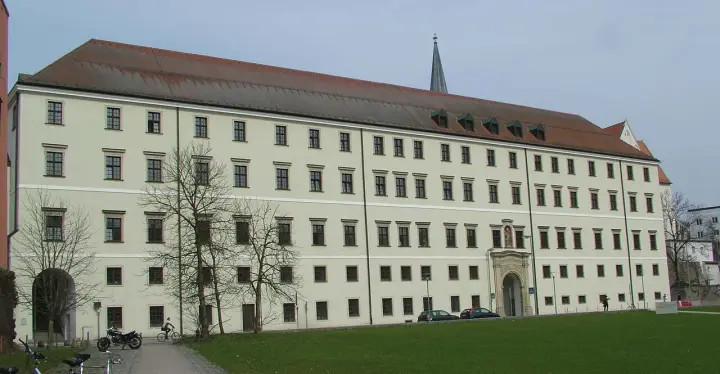
No tuition fee Tuition · sourced 2 years Duration View detailsCampus photos on this page: Kurt Seebauer at de.wikipedia (CC BY-SA 3.0) — via Wikimedia Commons.
Master of Science in International Economics and Business — FAQs
5 questions
Tuition is No tuition fee. Taken from the university's published fees page, not re-checked since — confirm it before you budget. We confirm the current fee and the scholarships you qualify for — free.
The main intake is Winter semester. Most universities admit on a rolling basis — we confirm the exact deadline for your profile, free.
To apply, you need a good undergraduate degree with at least 35 ECTS credits in economics (gained in subjects such as microeconomics, macroeconomics and/or economic policy) and at least 15 ECTS credits in mathematics and statistics. Beyond this, there are no specific requirements on the content of your first degree programme. English: E.G. UNIcert® English: UNIcert® II TOEIC: 785 Reading: 385 Listening: 400 Speaking: 160 Writing: 150 TOEFL iBT (before 2026): 72 Reading: 18 Listening: 17 Speaking: 20 Writing: 17 PTE Academic: 59 ISE (paper edition): ISE II Cambridge English Qualifications Business (BEC) : B2 Business Vantage IELTS Academic: 5.5 Cambridge English Qualifications: B2 First.
The programme runs about 24 months full-time.
Yes — shortlisting, SOP, LOR, Resume, application, scholarships and visa guidance are all free. We're paid by partner universities, not by you.
Apply to Master of Science in International Economics and Business — free help
A counsellor calls you back during office hours — 9am to 8pm IST, Mon to Sat. We are open now.