
Embedded Computing Systems (ESY)
University of Kaiserslautern-Landau · Landau, Europe
Duration
24 mo
Tuition
No tuition fee
sourcedIntake
Winter semester
English
—
Winter semester intake. Most universities admit on a rolling basis — we confirm the exact application deadline for your profile, free.
Course details verified 10 Sep 2026 — intakes, entry requirements and course facts · official source
Fee sourced Taken from the university's published fees page, not re-checked since — confirm it before you budget. See the university fees page.
About this programme
Embedded Computing Systems (ESY) is a four-semester Master's programme. A total of 120 ECTS must be acquired. In general, developing embedded systems requires competences in several areas: System architectures: hardware and software Design methodologies: system-level modelling, design techniques, testing, and verification Embedded systems application areas: knowledge on application areas is needed for optimised embedded systems solutions The curriculum consists of a core programme, an elective programme, and a Master's thesis. The core programme covers the fundamentals of embedded computing systems and offers education in all three teaching areas. The elective programme allows you to sharpen your personal profile by selecting specific courses from RPTU and its associated research institutes. Core Programme (35 to 55 CPs) The core programme contains the mandatory courses that will teach you the fundamentals of embedded systems design. In order to understand how an embedded system works, you will study processor architectures and practise their design in Architecture of Digital Systems I and the Embedded Processor Lab. These courses give you an introduction to modern RISC processors and other important processor architectures as they are widely used in today's embedded systems. The courses Architecture of Digital Systems II and the Embedded Systems Laboratory broaden the focus from processors to systems that contain further components and communication structures. Embedded system engineering is more than just hardware design. As we move from the components of the system to understanding the system as a whole, we are also confronted with various aspects of software design. In the courses Real-Time Systems I and Operating Systems, you will learn how the software distributes tasks and organises correct communication between all components in a system. It is daily practice for SoC designers to work with Electronic Design Automation (EDA) tools. Therefore, it is important to understand how these tools work internally and how they map to microelectronic circuits and components. You will study those aspects in the courses Synthesis and Optimisation of Microelectronic Systems I and Microelectronic Circuit and System Design I. The course Verification of Digital Systems (with lab) introduces the fundamentals of Electronic Design Automation and their application to formal design verification. Elective Programme (35 to 55 CPs) The elective programme allows you to build your own personal profile and to gain additional competences in fields that are most interesting to you. You can select from a wide range of modules available at RPTU. An individual study plan is created and agreed on between the student and the ESY programme adviser. Master's Thesis (30 CPs) The last part of the curriculum is the Master's thesis. In general, the Master's thesis is embedded into larger research projects conducted at RPTU, at local research institutes, or in industry. The topic of your Master's thesis is determined during your second or third semester of studies. About 50% of our students carry out their thesis in one of our industrial partner companies.
Intakes & deadlines
Winter semester
Dates confirmed for your profile · Open
Summer semester
Dates confirmed for your profile · Open
Entry requirements
-
English
E.G. TOEFL iBT (since 2026): 4.5 Reading: 4.5 Listening: 4.5 Speaking: 4.5 Writing: 4.5 TOEFL iBT (before 2026): 80 Reading: 20 Listening: 20 Speaking: 20 Writing: 20 IELTS Academic: 6
-
Prerequisites
Bachelor's degree in Electrical Engineering or an equivalent foreign degree in a related field CGPA (cumulative grade point average): Your Bachelor's degree should be completed with a minimum CGPA of 3.5 out of 4 or equivalent. GRE recommended English certificate (details below)
-
Documents
SOP, LOR & Resume — generate them free in 2 minutes.
This is an indicative early-career range for the whole Computer Science / IT field in Europe, from official graduate-outcome data — not a figure for this programme or university, and not a guarantee of what you will earn. What you actually earn depends on the role, employer, city and your visa.
Source: get in IT (Gehaltsstatistik Informatik 2026), 2026. Market job-board data — less official than a government survey; treat as indicative.
Rupee figure converted at the 18 Aug 2026 mid-market rate; your bank's rate will be worse and currencies move, so use it for planning, not as the amount you will receive.
Fees & scholarships
No tuition fee tuition (sourced). We confirm the exact costs and the scholarships you qualify for at University of Kaiserslautern-Landau — free, for your profile.
Other programmes at University of Kaiserslautern-Landau
Actuarial and Financial Mathematics
No tuition fee Tuition · sourced 2 years Duration View details KL University of Kaiserslautern-LandauAutomation & Control (A&C)
No tuition fee Tuition · sourced 2 years Duration View details KL University of Kaiserslautern-LandauComputer Science (Master of Science)
No tuition fee Tuition · sourced 2 years Duration View details KL University of Kaiserslautern-LandauDigital Process Engineering
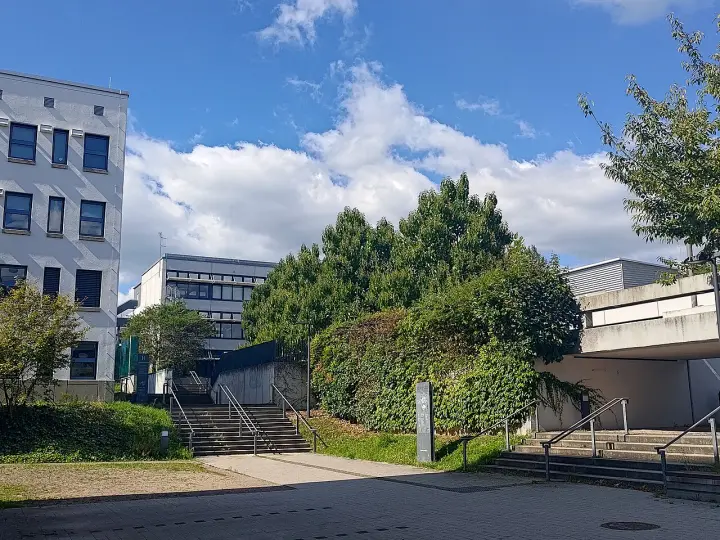
No tuition fee Tuition · sourced 2 years Duration View detailsCampus photos on this page: Leorichter (CC0) — via Wikimedia Commons.
Embedded Computing Systems (ESY) — FAQs
5 questions
Tuition is No tuition fee. Taken from the university's published fees page, not re-checked since — confirm it before you budget. We confirm the current fee and the scholarships you qualify for — free.
The main intake is Winter semester. Most universities admit on a rolling basis — we confirm the exact deadline for your profile, free.
Bachelor's degree in Electrical Engineering or an equivalent foreign degree in a related field CGPA (cumulative grade point average): Your Bachelor's degree should be completed with a minimum CGPA of 3.5 out of 4 or equivalent. GRE recommended English certificate (details below) English: E.G. TOEFL iBT (since 2026): 4.5 Reading: 4.5 Listening: 4.5 Speaking: 4.5 Writing: 4.5 TOEFL iBT (before 2026): 80 Reading: 20 Listening: 20 Speaking: 20 Writing: 20 IELTS Academic: 6.
The programme runs about 24 months full-time.
Yes — shortlisting, SOP, LOR, Resume, application, scholarships and visa guidance are all free. We're paid by partner universities, not by you.
Apply to Embedded Computing Systems (ESY) — free help
A counsellor calls you back during office hours — 9am to 8pm IST, Mon to Sat. We are closed right now, so your request is first in line when we reopen.