Interdisciplinary Engineering
Universität Trier · Trier, Europe
Duration
18 mo
Tuition
No tuition fee
sourcedIntake
Winter semester
English
—
Winter semester intake. Most universities admit on a rolling basis — we confirm the exact application deadline for your profile, free.
Course details verified 10 Sep 2026 — intakes, entry requirements and course facts · official source
Fee sourced Taken from the university's published fees page, not re-checked since — confirm it before you budget. See the university fees page.
About this programme
The networking of disciplines is a fundamental building block for creating new knowledge in science and research. Many applications would be inconceivable without close cooperation between different disciplines. The same is increasingly true in business and industry. Only by bringing together many different types of knowledge and ways of thinking and by exploiting synergy effects we can achieve a high level of innovative strength and ultimately a competitive advantage. Thinking outside the box is in demand! The "Master of Science – Interdisciplinary Engineering" degree programme picks up on this development and trains experts who are exceptionally capable of integrating existing and new specialist knowledge in complex contexts, even across disciplines. Content from the fields of electrical engineering, mechanical and automotive engineering, and building, supply, and energy technology is combined and supplemented by interdisciplinary (team) projects and seminars that promote methodical and social competence as well as analytical skills. Graduates thus acquire the necessary tools to become involved in innovative interface areas. The programme offers excellent career opportunities in business and research and entitles graduates to embark on doctoral studies. The Master's degree programme in "Interdisciplinary Engineering" combines competencies from the fields of electrical engineering, mechanical engineering as well as building, supply, and energy engineering. The standard period of study is three semesters (90 ECTS). Students who have completed a six-semester Bachelor's degree programme can acquire an additional 30 ECTS within the framework of an enrolment catalogue up to the registration of the Master's thesis in order to achieve the 300 ECTS required for a Master's degree. This may extend the duration of study. As part of the admission process, the core discipline applicable to the degree programme is determined for each student. As a rule, it is identical to the subject area of the first university degree. In addition, students can choose a focus deviating from the core discipline during the course of study if they complete at least 20 ECTS of the teaching modules as well as the final thesis in a specific subject area. The programme is divided into teaching modules (45 ECTS) and independent work (45 ECTS). Students must earn at least 15 ECTS in Master's modules from a discipline that differs from their Bachelor's programme (supplementary discipline). Students have the opportunity to combine courses from different disciplines in order to gain a broad base in an application field: For the application field "electromobility", for example, this could mean choosing modules from electrical engineering (theory of drive technology, control engineering, learning systems), mechanical engineering (energy-efficient vehicles, vehicle technology, vehicle safety), and building, supply, and energy engineering (regenerative energy systems, smart grids, grid integration of renewable energies) in order to cover all aspects of electromobility. Not only the division of the teaching modules but also the organisational and content-related design of the modules in independent work emphasises the interdisciplinary character of the study programme. Thus, an interdisciplinary (team) project and an interdisciplinary seminar are scheduled in the second semester. In this way, students can sharpen their individual interdisciplinary profiles. The degree is completed with the Master's thesis (30 ECTS), in which students demonstrate that they are able to deal scientifically with problems and present results. The academic degree of "Master of Science" (MSc) provides access to doctoral studies and qualifies for activities in research and development.
Intakes & deadlines
Winter semester
Dates confirmed for your profile · Open
Summer semester
Dates confirmed for your profile · Open
Entry requirements
-
English
E.G. telc English: telc English C1
-
Prerequisites
The Master's programme "Interdisciplinary Engineering" is open to applicants who prove a first professional university degree with an overall mark of usually at least 2.5. The subject orientation of the first university degree must contain essential contents of a degree programme in electrical engineering, mechanical engineering, automotive engineering, technical building services, industrial engineering or medical engineering. Usually the core discipline is identical to the subject orientation of the first professional university degree. Applicants with a first professional university degree with less than 210 ECTS (e.g. six-semester Bachelor's programme) who wish to enrol in a Master's degree programme with 90 ECTS have the option of taking additional credits at the latest by the time of registration of the Master's thesis in order to achieve the 300 ECTS required for a Master's degree. For this purpose, suitable Bachelor's and Master's modules ("bridge modules") are defined in a catalogue of additional credits. You can get an overview of these modules and your personal selection with the "Module Choice Tool". Applicants for the degree programme in "Interdisciplinary Engineering", in which the language of instruction is partly English, must also provide evidence of language skills in English and German.
-
Documents
SOP, LOR & Resume — generate them free in 2 minutes.
This is an indicative early-career range for the whole Engineering (general) field in Europe, from official graduate-outcome data — not a figure for this programme or university, and not a guarantee of what you will earn. What you actually earn depends on the role, employer, city and your visa.
Source: Profiling Institut - Gehaltsranking nach Studienfach 2026 (StepStone Gehaltsreport 2026), 2026. Market job-board data — less official than a government survey; treat as indicative.
Rupee figure converted at the 18 Aug 2026 mid-market rate; your bank's rate will be worse and currencies move, so use it for planning, not as the amount you will receive.
Fees & scholarships
No tuition fee tuition (sourced). We confirm the exact costs and the scholarships you qualify for at Universität Trier — free, for your profile.
Other programmes at Universität Trier
MA German as a Second and Foreign Language / Deutsch als Zweit- und Fremdsprache
No tuition fee Tuition · sourced 2 years Duration View details TR Universität TrierMaster of Arts in Anglophone Literatures and Media
No tuition fee Tuition · sourced 2 years Duration View details TR Universität TrierMaster of Arts in Contemporary Human Geography
No tuition fee Tuition · sourced 2 years Duration View details TR Universität TrierMaster of Arts in English Linguistics
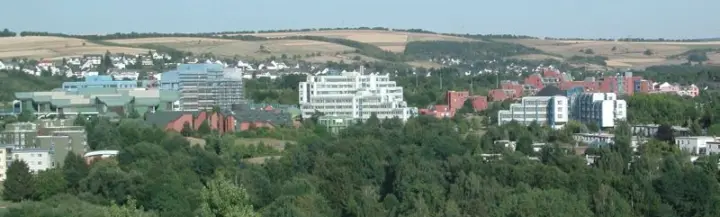
No tuition fee Tuition · sourced 2 years Duration View detailsCampus photos on this page: Stefan Kühn (CC BY 3.0) — via Wikimedia Commons.
Interdisciplinary Engineering — FAQs
5 questions
Tuition is No tuition fee. Taken from the university's published fees page, not re-checked since — confirm it before you budget. We confirm the current fee and the scholarships you qualify for — free.
The main intake is Winter semester. Most universities admit on a rolling basis — we confirm the exact deadline for your profile, free.
The Master's programme "Interdisciplinary Engineering" is open to applicants who prove a first professional university degree with an overall mark of usually at least 2.5. The subject orientation of the first university degree must contain essential contents of a degree programme in electrical engineering, mechanical engineering, automotive engineering, technical building services, industrial engineering or medical engineering. Usually the core discipline is identical to the subject orientation of the first professional university degree. Applicants with a first professional university degree with less than 210 ECTS (e.g. six-semester Bachelor's programme) who wish to enrol in a Master's degree programme with 90 ECTS have the option of taking additional credits at the latest by the time of registration of the Master's thesis in order to achieve the 300 ECTS required for a Master's degree. For this purpose, suitable Bachelor's and Master's modules ("bridge modules") are defined in a catalogue of additional credits. You can get an overview of these modules and your personal selection with the "Module Choice Tool". Applicants for the degree programme in "Interdisciplinary Engineering", in which the language of instruction is partly English, must also provide evidence of language skills in English and German. English: E.G. telc English: telc English C1.
The programme runs about 18 months full-time.
Yes — shortlisting, SOP, LOR, Resume, application, scholarships and visa guidance are all free. We're paid by partner universities, not by you.
Apply to Interdisciplinary Engineering — free help
A counsellor calls you back during office hours — 9am to 8pm IST, Mon to Sat. We are open now.