Master of Science in Optoelectronics & Photonics
Universität Paderborn · Paderborn, Europe
Duration
24 mo
Tuition
No tuition fee
sourcedIntake
Winter semester
English
—
Winter semester intake. Most universities admit on a rolling basis — we confirm the exact application deadline for your profile, free.
Course details verified 10 Sep 2026 — intakes, entry requirements and course facts · official source
Fee sourced Taken from the university's published fees page, not re-checked since — confirm it before you budget. See the university fees page.
About this programme
The interplay between optics and electronics is of both fundamental scientific interest and the foundation of a broad range of modern technology. Remarkable progress has been made in recent years combining techniques from areas as diverse as nanophotonics, semiconductor physics and even quantum optics. Learning how to bring fundamental principles of optoelectronic interaction out of the laboratory and engineer them into workable devices is a key skill set that will drive this field forward. Our two-year Master's course in Optoelectronics and Photonics places students squarely at the intersection of modern physics, precision engineering and state-of-the-art technology. Students will develop a broad, technical skill set as well as rigorous understanding of the underlying concepts. On completion, successful students will be ideally suited to a future academic or industrial career in this exciting and fast-moving field. We offer: A broad range of targeted interdisciplinary courses, taught exclusively in English Master's projects in internationally active research groups Smooth progression towards PhD study in Germany and beyond Career perspectives in existing and emerging industries A gateway to European academic and industrial networks In the first two semesters, you will attend lectures in physics and electrical engineering as well as practicals in the lab. Most of the courses in this phase of your studies are compulsory to provide you with a broad background. In the second and third semesters, these courses are complemented by elective courses that can be chosen according to your interests and desired specialisation in the field of optical technologies. All lectures are accompanied by practical classes where problems are solved, discussed, and presented by the students. In addition, you will learn to develop a scientific topic based on existing literature and present it to your fellow students in a seminar. Finally, a few courses of general studies can be chosen freely from the university's lecture catalogue. In particular, this includes the possibility to attend German language classes. In your second year, you will start joining one of the research groups within the departments and work on a supervised individual lab project that may form the basis for your Master's thesis. After completion of the Master's thesis research project, the written thesis will be submitted towards the end of the fourth semester. Subsequently, the thesis work is defended in a colloquium which consists of a presentation followed by questions. Degree holders have a deep understanding of the fundamentals of optical technologies and have the qualifications for independent scientific work in research and technology. The special expertise in optical technologies and the acquisition of skills in both physics and engineering represent a key advantage for employment in the optics and electronics industry or in academic institutions. The degree also qualifies graduates to enter PhD programmes in Paderborn or elsewhere. PDF Download
Intakes & deadlines
Winter semester
Dates confirmed for your profile · Open
Entry requirements
-
English
E.G. TOEFL iBT (before 2026): 80 Reading: 20 Listening: 20 Speaking: 20 Writing: 20 IELTS Academic: 6 Cambridge English Qualifications: B2 First
-
Prerequisites
Bachelor's degree in Physics (or equivalent Natural Science or Engineering degree that includes physical and mathematical fundamentals and a quantum theory course)
-
Documents
SOP, LOR & Resume — generate them free in 2 minutes.
This is an indicative early-career range for the whole Engineering (general) field in Europe, from official graduate-outcome data — not a figure for this programme or university, and not a guarantee of what you will earn. What you actually earn depends on the role, employer, city and your visa.
Source: Profiling Institut - Gehaltsranking nach Studienfach 2026 (StepStone Gehaltsreport 2026), 2026. Market job-board data — less official than a government survey; treat as indicative.
Rupee figure converted at the 18 Aug 2026 mid-market rate; your bank's rate will be worse and currencies move, so use it for planning, not as the amount you will receive.
Fees & scholarships
No tuition fee tuition (sourced). We confirm the exact costs and the scholarships you qualify for at Universität Paderborn — free, for your profile.
Other programmes at Universität Paderborn
Additive Manufacturing
No tuition fee Tuition · sourced 2 years Duration View details PA Universität PaderbornBeNeLux Studies
No tuition fee Tuition · sourced 2 years Duration View details PA Universität PaderbornGerman as a Second and Foreign Language for Work and Specialised Studies
No tuition fee Tuition · sourced 2 years Duration View details PA Universität PaderbornMaster of Science in Applied Neurosciences in Sports & Exercise (ANSE)
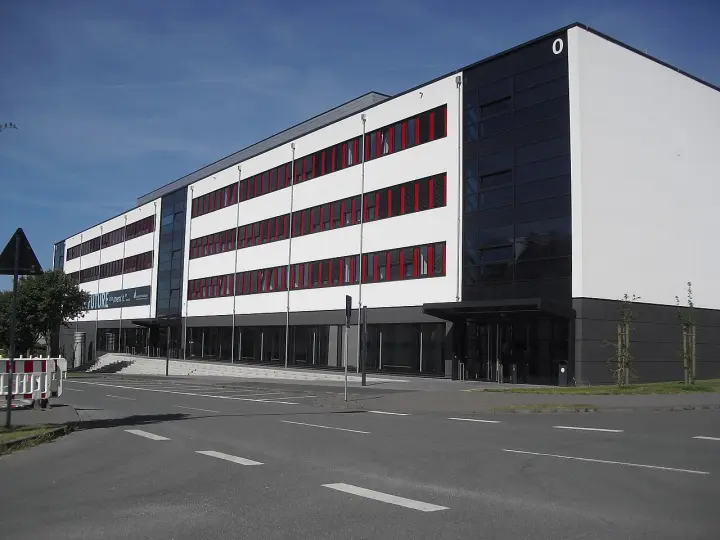
No tuition fee Tuition · sourced 2 years Duration View detailsCampus photos on this page: Athde (CC0) — via Wikimedia Commons.
Master of Science in Optoelectronics & Photonics — FAQs
5 questions
Tuition is No tuition fee. Taken from the university's published fees page, not re-checked since — confirm it before you budget. We confirm the current fee and the scholarships you qualify for — free.
The main intake is Winter semester. Most universities admit on a rolling basis — we confirm the exact deadline for your profile, free.
Bachelor's degree in Physics (or equivalent Natural Science or Engineering degree that includes physical and mathematical fundamentals and a quantum theory course) English: E.G. TOEFL iBT (before 2026): 80 Reading: 20 Listening: 20 Speaking: 20 Writing: 20 IELTS Academic: 6 Cambridge English Qualifications: B2 First.
The programme runs about 24 months full-time.
Yes — shortlisting, SOP, LOR, Resume, application, scholarships and visa guidance are all free. We're paid by partner universities, not by you.
Apply to Master of Science in Optoelectronics & Photonics — free help
A counsellor calls you back during office hours — 9am to 8pm IST, Mon to Sat. We are closed right now, so your request is first in line when we reopen.