
Scenographic Design and Communication
TU Dortmund University · Dortmund, Europe
Duration
18 mo
Tuition
No tuition fee
sourcedIntake
Winter semester
English
—
Winter semester intake. Most universities admit on a rolling basis — we confirm the exact application deadline for your profile, free.
Course details verified 10 Sep 2026 — intakes, entry requirements and course facts · official source
Fee sourced Taken from the university's published fees page, not re-checked since — confirm it before you budget. See the university fees page.
About this programme
Scenography and communication deals with questions such as: How can I design museum and exhibition spaces across different media? How can I create narrative qualities in film, theatre and stage spaces? What potential does the scenography of public spaces offer in terms of shaping social developments? Which scenographic communication strategies are relevant for the future? The project studies focus on theatre and stage spaces, museum and exhibition spaces, media and hyper-media spaces, public spaces and temporary spaces for brand staging and corporate communication. You can experiment with individual projects and work in interdisciplinary teams on third-party funded projects. The three-semester Master's degree programme is offered as a bilingual study programme with a predominantly German-language focus or with a predominantly English-language focus. Choosing a language track does not result in a division into German- and English-speaking cohorts; it is relevant only for examination purposes. Courses can be selected regardless of the chosen language focus and are taught bilingually. This means that no one is excluded due to a lack of proficiency in English or German. Because of this mix, most courses are taught in English. All instructors are available in both languages. The project-oriented course allows you to specialise in the areas of exhibitions, museums, art in public spaces and the stage. At the same time, you can deepen your knowledge creatively, technically and scientifically at the faculty and in collaborations outside the university. The course offers you the greatest possible freedom. You can implement scenographic projects of your choice in all conceivable fields of creative and artistic spatial and event design. In the first year of study, you will acquire the necessary knowledge through the modules Experimental Exploration & Design of Scenographic Fields of Work and Scenographic Conceptualisation of Spatial Design and Staging, among others. The second year of study includes the module Project Realisation of a Scenographic Design Project. Learning management skills is also part of the course. The project-oriented structure leads to numerous collaborations with external funding partners and, as a result, to projects carried out under real-world conditions. Students acquire the necessary competencies through the implementation of projects, not through isolated training in individual aspects of scenography. The study programme is internationally oriented. Project practice during the course promotes international exchange and contributes to the formation of a worldwide scenographic network. This is a thematic overview of the course content. First semester: 01 Scenography + Communication (15 CP) 02 Conception + Design (8 CP) 03 Science (7 CP) Second semester: 04 Scenography + Communication (15 CP) 05 Conception + Design (8 CP) 06 Science (7 CP) Third semester: 07 Best practice / foundation (2 CP) 08 Project support for Master's thesis (8 CP) 08 Thesis + Colloquium (20 CP) The first two semesters of the programme have the same structure and are designed so students can start in either semester. This also doubles the number of project choice options. In two major design projects (01, 04), which always include a realisation component and very often involve a partnership with an external partner and third-party funder, students go through all phases—including research, analysis, conceptualisation, design, implementation, and documentation—and acquire the necessary skills for each. The projects are often carried out in teams. All students are exposed to all aspects of the process but may also choose to focus on specific areas. Each of these two modules accounts for half of a semester’s workload. In two smaller design projects (02, 05), students can adopt a more experimental approach; in module 05, students can also work on independent, self-initiated projects, either individually or in groups. Two academic courses (03, 06)
Intakes & deadlines
Winter semester
Dates confirmed for your profile · Open
Summer semester
Dates confirmed for your profile · Open
Entry requirements
-
English
E.G. TOEIC: 945 Reading: 455 Listening: 490 Speaking: 180 Writing: 180 TOEFL iBT (before 2026): 95 Reading: 24 Listening: 22 Speaking: 25 Writing: 24 IELTS Academic: 6.5 Cambridge English Qualifications: C1 Advanced
-
Prerequisites
The following aspects need to be considered as admission requirements required degree knowledge of German or English suitability assessment registration Please find more details on each topic here, in the section "What do I need": https://www.fh-dortmund.de/studiengaenge/szenografie-und-kommunikation-scenographic-design-and-communication-master.php?loc=en-US.
-
Documents
SOP, LOR & Resume — generate them free in 2 minutes.
Fees & scholarships
No tuition fee tuition (sourced). We confirm the exact costs and the scholarships you qualify for at TU Dortmund University — free, for your profile.
Other programmes at TU Dortmund University
Automation and Robotics
No tuition fee Tuition · sourced 2 years Duration View details TD TU Dortmund UniversityBiochemical Engineering – Specialisation: Biopharmaceutical Engineering
No tuition fee Tuition · sourced 2 years Duration View details TD TU Dortmund UniversityChemical Engineering – Specialisation: Process Systems Engineering
No tuition fee Tuition · sourced 2 years Duration View details TD TU Dortmund UniversityEconometrics
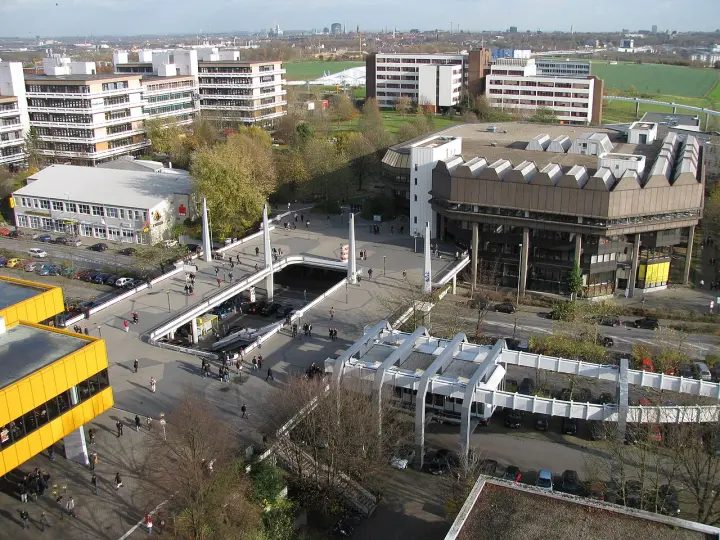
No tuition fee Tuition · sourced 2 years Duration View detailsCampus photos on this page: Chin tin tin (CC BY 3.0) — via Wikimedia Commons.
Scenographic Design and Communication — FAQs
5 questions
Tuition is No tuition fee. Taken from the university's published fees page, not re-checked since — confirm it before you budget. We confirm the current fee and the scholarships you qualify for — free.
The main intake is Winter semester. Most universities admit on a rolling basis — we confirm the exact deadline for your profile, free.
The following aspects need to be considered as admission requirements required degree knowledge of German or English suitability assessment registration Please find more details on each topic here, in the section "What do I need": https://www.fh-dortmund.de/studiengaenge/szenografie-und-kommunikation-scenographic-design-and-communication-master.php?loc=en-US. English: E.G. TOEIC: 945 Reading: 455 Listening: 490 Speaking: 180 Writing: 180 TOEFL iBT (before 2026): 95 Reading: 24 Listening: 22 Speaking: 25 Writing: 24 IELTS Academic: 6.5 Cambridge English Qualifications: C1 Advanced.
The programme runs about 18 months full-time.
Yes — shortlisting, SOP, LOR, Resume, application, scholarships and visa guidance are all free. We're paid by partner universities, not by you.
Apply to Scenographic Design and Communication — free help
A counsellor calls you back during office hours — 9am to 8pm IST, Mon to Sat. We are open now.