
Religion, Ethics, and Politics
TU Dortmund University · Dortmund, Europe
Duration
24 mo
Tuition
No tuition fee
sourcedIntake
Winter semester
English
—
Winter semester intake. Most universities admit on a rolling basis — we confirm the exact application deadline for your profile, free.
Course details verified 09 Sep 2026 — intakes, entry requirements and course facts · official source
Fee sourced Taken from the university's published fees page, not re-checked since — confirm it before you budget. See the university fees page.
About this programme
The tense relationship between religion and politics is one of the most important social issues of our time. Societal and scientific debates on the issue have been triggered by increasing religious pluralisation and changing moral concepts as well as globalisation and migration. How tolerant should societies be of religious groups and their rituals and practices? What values, such as equal rights for women and men, should not be open to discussion? What possibilities exist for cooperation between the state and religious communities and where is potential for conflict? How does religiousness or non-religiousness affect our identity? These are concrete sample questions that the Master's programme in "Religion, Ethics, and Politics" (MaREPol) deals with. MaREPol examines the relationship between religion, politics, and society from theological, philosophical, and political science perspectives. Students learn to address and understand the interaction between these spheres as well as the challenges that result from this complex field of tension and to develop interdisciplinary solutions. In doing so, they deal with the ethics and aesthetics of religions, analyse the relationship between religion and state in political systems, or discuss theological justifications for the political engagement of religious communities. The Master's programme in "Religion, Ethics, and Politics" brings philosophical, political science and theological perspectives systematically together. The programme covers all disciplines in ten modules, which take place interactively along current and important discussions. Altogether, the course of studies is covered by all three institutes of the Faculty of Humanities and Theology: the Protestant Theology, the Institute of Catholic Theology and the Institute of Philosophy and Political Science. Foundation Courses At the beginning of your studies, you will attend foundation courses that systematically introduce you into the self-understanding of the four disciplines, controversies and central questions, scientific ways of thinking as well as methodology. In addition, you will have the opportunity to acquire basic knowledge of history, religion, and literature of Jewish and Islamic Studies. Interdisciplinary Clusters: Tolerance, Conflict, Identity Three topic-oriented interfaces (clusters) build upon the foundation courses: Tolerance, Conflict, Identity. Each cluster combines two of the three disciplines. You can choose two of the three clusters to study in the Master's programme. The seminars of the clusters cover different methods and perspectives on selected issues. Research orientation with a practical focus MaREPol gives you the chance to focus on perspectives within or outside academia. That means that besides the chance to prepare for a scientific career, you will attend a course in project management where you will acquire application-oriented knowledge and skills. A compulsory internship is an integral part of the programme. Additionally, students can go abroad on an Erasmus stay for one semester to enjoy academic exchange, gain international experience, and improve their language skills. Sharpen your Focus: In-Depth and Supplementary Modules and Master’s Thesis In the second half of your study you will be able to sharpen your focus by selecting one of the four disciplines as in-depth and a second one as supplementary subject. The Master’s thesis is designed to support and deepen your academic and professional qualifications. PDF Download
Intakes & deadlines
Winter semester
Dates confirmed for your profile · Open
Summer semester
Dates confirmed for your profile · Open
Entry requirements
-
Prerequisites
Prerequisites The prerequisites for admission to the Master's programme in "Religion, Ethics and Politics" are as follows: 1) A Bachelor's degree (or equivalent) in humanities, cultural sciences, social sciences, economics, natural sciences, and/or engineering, which has provided significant knowledge in a philosophical, political science or a theological subject; 2) The overall grade achieved in the Bachelor’s degree should be at least "good" (grade: 2.5) or better. (If you have a foreign degree, your grade must be converted into the German grading system.) 3) You will need to submit an examination task.
-
Documents
SOP, LOR & Resume — generate them free in 2 minutes.
Fees & scholarships
No tuition fee tuition (sourced). We confirm the exact costs and the scholarships you qualify for at TU Dortmund University — free, for your profile.
Other programmes at TU Dortmund University
Automation and Robotics
No tuition fee Tuition · sourced 2 years Duration View details TD TU Dortmund UniversityBiochemical Engineering – Specialisation: Biopharmaceutical Engineering
No tuition fee Tuition · sourced 2 years Duration View details TD TU Dortmund UniversityChemical Engineering – Specialisation: Process Systems Engineering
No tuition fee Tuition · sourced 2 years Duration View details TD TU Dortmund UniversityEconometrics
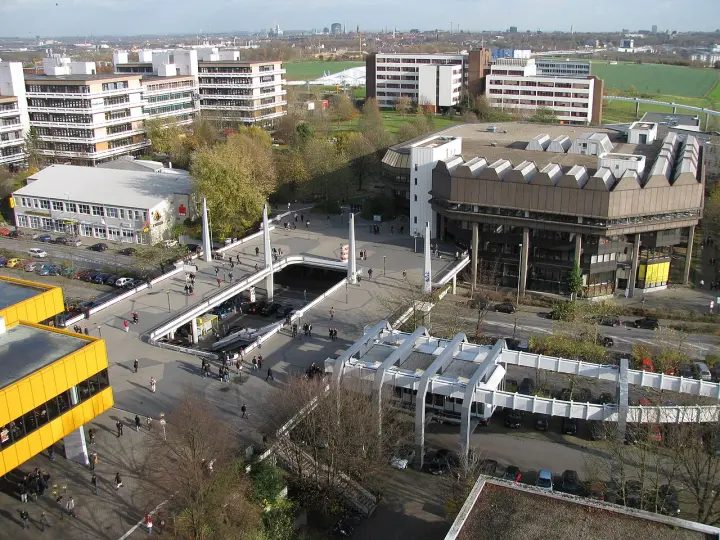
No tuition fee Tuition · sourced 2 years Duration View detailsCampus photos on this page: Chin tin tin (CC BY 3.0) — via Wikimedia Commons.
Religion, Ethics, and Politics — FAQs
5 questions
Tuition is No tuition fee. Taken from the university's published fees page, not re-checked since — confirm it before you budget. We confirm the current fee and the scholarships you qualify for — free.
The main intake is Winter semester. Most universities admit on a rolling basis — we confirm the exact deadline for your profile, free.
Prerequisites The prerequisites for admission to the Master's programme in "Religion, Ethics and Politics" are as follows: 1) A Bachelor's degree (or equivalent) in humanities, cultural sciences, social sciences, economics, natural sciences, and/or engineering, which has provided significant knowledge in a philosophical, political science or a theological subject; 2) The overall grade achieved in the Bachelor’s degree should be at least "good" (grade: 2.5) or better. (If you have a foreign degree, your grade must be converted into the German grading system.) 3) You will need to submit an examination task.
The programme runs about 24 months full-time.
Yes — shortlisting, SOP, LOR, Resume, application, scholarships and visa guidance are all free. We're paid by partner universities, not by you.
Apply to Religion, Ethics, and Politics — free help
A counsellor calls you back during office hours — 9am to 8pm IST, Mon to Sat. We are closed right now, so your request is first in line when we reopen.