
MSc Particle Accelerator Science
Technical University of Darmstadt · Darmstadt, Germany
Duration
24 mo
Tuition
No tuition fee
sourcedIntake
Winter semester
English
—
Winter semester intake. Most universities admit on a rolling basis — we confirm the exact application deadline for your profile, free.
Course details verified 09 Sep 2026 — intakes, entry requirements and course facts · official source
Fee sourced Taken from the university's published fees page, not re-checked since — confirm it before you budget. See the university fees page.
About this programme
Are you searching for the Higgs Boson or Dark Matter? Do you want to tailor materials to your needs? Would you like to cure cancer, study nuclei and their role in the Universe, or look into the heart of matter? Particle accelerators will help you do that. The “Particle Accelerator Science” MSc study programme is an English-language cooperative programme between Technical University of Darmstadt, Johannes Gutenberg University Mainz and Goethe University Frankfurt am Main as part of the strategic alliance between the Rhein-Main Universities. In this programme, the next specialist in Particle Accelerator Science is always no more than a one-hour train ride away. All three partners of the RMU are recognised for their outstanding expertise in the physics and technology of particle accelerators in Germany and beyond. The different areas of research and development at our universities cover a wide technological spectrum and range of applications, from nuclear and particle physics, by way of biology, biophysics, and medical technology, to, e.g. materials research and atomic and quantum, laser and plasma physics. The international Master's programme in Particle Accelerator Science is a four-semester programme. The first two semesters consist of lectures, seminars and laboratory practicals. You will complete the "Practical Introduction to Scientific Research" in the third semester, followed by a Master's thesis in the fourth semester. This gives you the opportunity to work on a research project in the last year of your studies. PDF Download
Intakes & deadlines
Winter semester
Dates confirmed for your profile · Open
Summer semester
Dates confirmed for your profile · Open
Entry requirements
-
English
E.G. IELTS Academic: 5.5
-
Prerequisites
Admission to the Master's programme requires the following knowledge for successful study, which can usually be acquired in degree programmes in the natural sciences or engineering with a Bachelor of Science degree. The following mandatory entry requirements must be demonstrated for admission; they cannot be demonstrated by means of conditions (§ 17a (8) APB), i.e. it is not possible to start the programme without demonstrating these mandatory entry requirements: Selecting suitable physical methods for working on tasks from current research and development in particle accelerators, developing conceptual solutions and implementing them in practice, as well as familiarising oneself with new physical methods; Confident use of the definitions of electric and magnetic fields in electrostatics, magnetostatics and quasi-static electrodynamics; recognising the connection between electricity and magnetism; Identifying, classifying and critically analysing questions from the constituent subjects of accelerator physics and technology, i.e. physics, electrical engineering, information technology and materials science; Confident use of mathematical methods of linear algebra and analysis (including vector analysis) to solve problems and tasks in accelerator science; Fundamental practical knowledge of experimental measurement technology. Accordingly, compulsory entry-level competencies in the following areas and with the following CP must be proven: at least 20 CP in mathematics and at least 5 CP in the fundamentals of physics and at least 5 CP in theoretical electrodynamics, and at least 4 CP in measurement technology or natural science laboratory practicals. The CP values are based on the standard credit points system.
-
Documents
SOP, LOR & Resume — generate them free in 2 minutes.
Fees & scholarships
No tuition fee tuition (sourced). We confirm the exact costs and the scholarships you qualify for at Technical University of Darmstadt — free, for your profile.
Other programmes at Technical University of Darmstadt
Cognitive Science
No tuition fee Tuition · sourced 2 years Duration View details TD Technical University of DarmstadtData and Discourse Studies
No tuition fee Tuition · sourced 2 years Duration View details TD Technical University of DarmstadtElectrical Engineering and Information Technology — International Master of Science
No tuition fee Tuition · sourced 2 years Duration View details TD Technical University of DarmstadtInformation and Communication Engineering
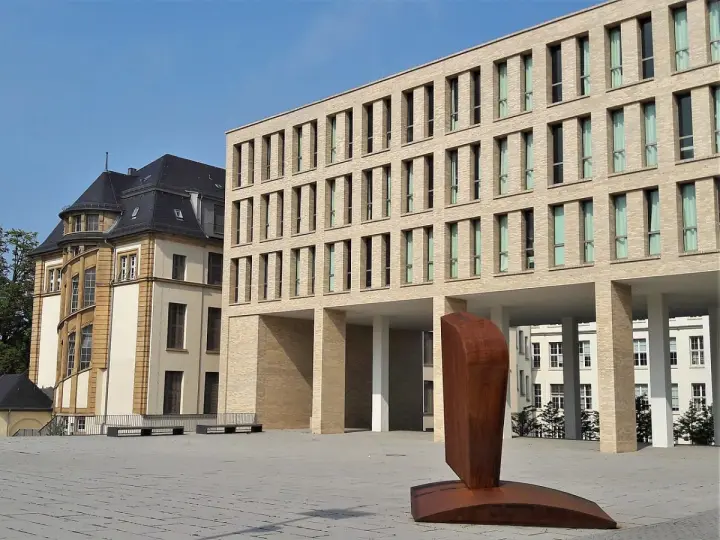
No tuition fee Tuition · sourced 2 years Duration View detailsCampus photos on this page: Grffine (CC BY-SA 4.0) — via Wikimedia Commons.
MSc Particle Accelerator Science — FAQs
5 questions
Tuition is No tuition fee. Taken from the university's published fees page, not re-checked since — confirm it before you budget. We confirm the current fee and the scholarships you qualify for — free.
The main intake is Winter semester. Most universities admit on a rolling basis — we confirm the exact deadline for your profile, free.
Admission to the Master's programme requires the following knowledge for successful study, which can usually be acquired in degree programmes in the natural sciences or engineering with a Bachelor of Science degree. The following mandatory entry requirements must be demonstrated for admission; they cannot be demonstrated by means of conditions (§ 17a (8) APB), i.e. it is not possible to start the programme without demonstrating these mandatory entry requirements: Selecting suitable physical methods for working on tasks from current research and development in particle accelerators, developing conceptual solutions and implementing them in practice, as well as familiarising oneself with new physical methods; Confident use of the definitions of electric and magnetic fields in electrostatics, magnetostatics and quasi-static electrodynamics; recognising the connection between electricity and magnetism; Identifying, classifying and critically analysing questions from the constituent subjects of accelerator physics and technology, i.e. physics, electrical engineering, information technology and materials science; Confident use of mathematical methods of linear algebra and analysis (including vector analysis) to solve problems and tasks in accelerator science; Fundamental practical knowledge of experimental measurement technology. Accordingly, compulsory entry-level competencies in the following areas and with the following CP must be proven: at least 20 CP in mathematics and at least 5 CP in the fundamentals of physics and at least 5 CP in theoretical electrodynamics, and at least 4 CP in measurement technology or natural science laboratory practicals. The CP values are based on the standard credit points system. English: E.G. IELTS Academic: 5.5.
The programme runs about 24 months full-time.
Yes — shortlisting, SOP, LOR, Resume, application, scholarships and visa guidance are all free. We're paid by partner universities, not by you.
Apply to MSc Particle Accelerator Science — free help
A counsellor calls you back during office hours — 9am to 8pm IST, Mon to Sat. We are open now.