
Railway Systems Engineering
RWTH Aachen University · Aachen, Germany, Europe
Duration
24 mo
Tuition
No tuition fee
sourcedIntake
Winter semester
English
—
Winter semester intake. Most universities admit on a rolling basis — we confirm the exact application deadline for your profile, free.
Course details verified 09 Sep 2026 — intakes, entry requirements and course facts · official source
Fee sourced Taken from the university's published fees page, not re-checked since — confirm it before you budget. See the university fees page.
About this programme
How can innovative ideas in rail vehicle construction enable new transport concepts? How can transport networks be logically developed, expanded, relieved, and ecologically planned? How do random disturbances in transportation have to be considered in order to avoid jamming or to optimise safety strategies? How can we shift more passenger and freight transport to the rails? Is driverless operation possible for all kinds of rail transport means? When the interaction of technical possibilities, infrastructure, and human behaviour is supposed to be optimised, transport engineers are called upon for their interdisciplinary perspective. Students of the Railway Systems Engineering programme acquire this interdisciplinary expertise by studying the perspectives of three engineering disciplines: civil engineering, mechanical engineering, and electrical engineering. The specialisation Railway Systems Engineering (RSE) concentrates on the further development of railway engineering. Students work with rail vehicles, rail transportation systems, and infrastructure developments in rail transportation. This Master's programme covers each aspect of the complete system of "railway": the infrastructure, operation, and vehicles, including the electrical drive as well as electric power supply. Furthermore, this is the only specialisation of the Master's degree programme in Transport Engineering and Mobility that can be studied completely in English. Course objectives and future opportunities The objective of this specialisation is to train and educate engineers with multidisciplinary expertise that can take the challenges of the modern railway sector head on. Railways remain ecologically superior, even as modern high-speed trains compete successfully with short and medium distance aeroplanes. The growing number of megacities all around the world would be in chaos without metros, LRVs, and trams. Furthermore, without freight transport on rails, our highways would be even more congested than they are today. But there is still need for innovation. Digitalisation is the key word, implying driverless operation for all types of railways, energy optimised driving with zero emission, automated condition based monitoring and predictive maintenance, better use of the track capacities, etc. Railway systems engineers can work for rolling stock manufacturers as well as for their consultants and suppliers. Their expertise is required by the operators as well as by the infrastructure managers. Consequently, along with the engineering companies in the private sector, the opportunities in the public sector are open to them as well. Finally, no matter where a railway systems engineer works, the diverse tasks at hand are guaranteed to be interesting, challenging, and rewarding. The faculties of Civil Engineering, Mechanical Engineering, Electrical Engineering and the School of Business and Economics have established an interdisciplinary study programme on the field of transportation called Transport Engineering and Mobility. The Master's programme is offered in five specialisations, covering all kinds of transportation. The Railway Systems Engineering (RSE) Master's programme is offered in German ("Bahnsystemingenieurwesen") as well as in English. The RSE Master's programme is organised by the Research Center Railways, a cooperation between three institutes from the three different engineering faculties mentioned above. These are: Institute of Transportation Science and Chair of Railway Engineering and Transport Economics (VIA) See: http://www.via.rwth-aachen.de Chair and Institute of Rail Vehicles and Transport Systems (IFS) See: https://www.ifs.rwth-aachen.de/en/ Chair and Institute for Power Electronics and Electrical Drives (ISEA) See: https://www.isea.rwth-aachen.de/ Exemplary study plan First semester: Railway Systems Principles of Rail Vehicle Technology Power Electronics - Fundamentals, Topologies and Analysis Environmental Sustainability in Transport Engi
Intakes & deadlines
Winter semester
Dates confirmed for your profile · Open
Summer semester
Dates confirmed for your profile · Open
Entry requirements
-
English
E.G. IELTS Academic: 6 UNIcert® English: UNIcert® II PTE Academic: 60 TOEFL iBT (before 2026): 90 Cambridge English Qualifications: B2 First
-
Prerequisites
Academic admission requirements include a first university degree that proves the necessary engineering background education as outlined in the exam regulations. Applicants should have completed 18 ECTS in mathematics/statistics (at least 14 ECTS in mathematics and 2 ECTS in statistics), 11 ECTS in mechanics, and 5 ECTS in the field of basic electrical engineering. Furthermore, they have to prove knowledge equivalent to at least 10 ECTS in at least two of the following topics: building material science/material science, automatic control, hydromechanics/fluid mechanics/thermodynamics, physics. Subject-specific knowledge equating to 40 ECTS is required. From this subject-specific knowledge, at least 10 ECTS must have been acquired in two of the following fields: transportation science, mechanical engineering, or electrical engineering. This knowledge must be comparable with what is taught in the RWTH Bachelor's programme in Transport Engineering and Mobility. The examination board may admit students to a Master's degree programme on the condition they obtain additional qualifications. Evidence of the completion of such additional requirements must be provided before registering for the Master's thesis. Admission to the Master's programme is not possible if your additional requirements exceed the CP (credit points) listed below: mathematical-statistic basics: 8 CP basics in mechanics: 9 CP further engineering basics: 8 CP subject-related basics: 15 CP or total scope of additional requirements: 30 CP. In addition, proof of the Graduate Record Examination (GRE) General Test is required. Applicants who are nationals of a member state of the European Union or of the European Economic Area (EEA) are exempt from this requirement.
-
Documents
SOP, LOR & Resume — generate them free in 2 minutes.
This is an indicative early-career range for the whole Engineering (general) field in Europe, from official graduate-outcome data — not a figure for this programme or university, and not a guarantee of what you will earn. What you actually earn depends on the role, employer, city and your visa.
Source: Profiling Institut - Gehaltsranking nach Studienfach 2026 (StepStone Gehaltsreport 2026), 2026. Market job-board data — less official than a government survey; treat as indicative.
Rupee figure converted at the 18 Aug 2026 mid-market rate; your bank's rate will be worse and currencies move, so use it for planning, not as the amount you will receive.
Fees & scholarships
No tuition fee tuition (sourced). We confirm the exact costs and the scholarships you qualify for at RWTH Aachen University — free, for your profile.
Other programmes at RWTH Aachen University
 RWTH Aachen University
Advanced Computational Methods in Civil Engineering
No tuition fee Tuition · sourced 2 years Duration View details
RWTH Aachen University
Applied Geosciences – Applied Mineralogy and Crystallography (AMC) (MSc)
No tuition fee Tuition · sourced 2 years Duration View details
RWTH Aachen University
Applied Geosciences – Computational Geology and Geophysics (CGG) (MSc)
No tuition fee Tuition · sourced 2 years Duration View details
RWTH Aachen University
Applied Geosciences – Energy & Mineral Resources (EMR) (MSc)
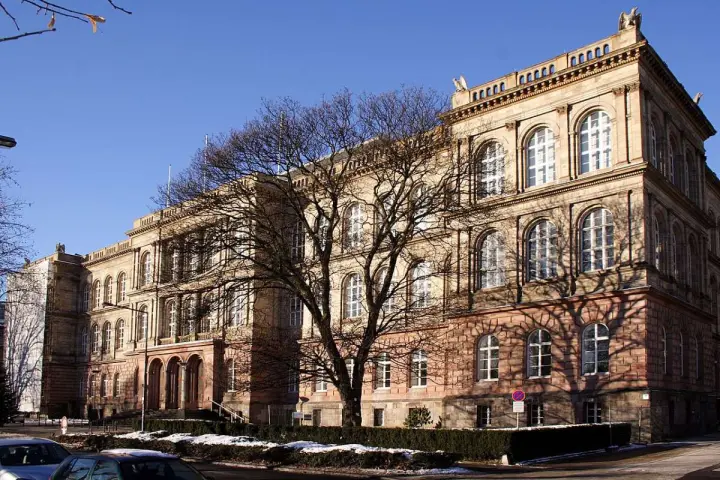
No tuition fee Tuition · sourced 2 years Duration View detailsCampus photos on this page: א (Aleph) (CC BY-SA 2.5) — via Wikimedia Commons.
Railway Systems Engineering — FAQs
5 questions
Tuition is No tuition fee. Taken from the university's published fees page, not re-checked since — confirm it before you budget. We confirm the current fee and the scholarships you qualify for — free.
The main intake is Winter semester. Most universities admit on a rolling basis — we confirm the exact deadline for your profile, free.
Academic admission requirements include a first university degree that proves the necessary engineering background education as outlined in the exam regulations. Applicants should have completed 18 ECTS in mathematics/statistics (at least 14 ECTS in mathematics and 2 ECTS in statistics), 11 ECTS in mechanics, and 5 ECTS in the field of basic electrical engineering. Furthermore, they have to prove knowledge equivalent to at least 10 ECTS in at least two of the following topics: building material science/material science, automatic control, hydromechanics/fluid mechanics/thermodynamics, physics. Subject-specific knowledge equating to 40 ECTS is required. From this subject-specific knowledge, at least 10 ECTS must have been acquired in two of the following fields: transportation science, mechanical engineering, or electrical engineering. This knowledge must be comparable with what is taught in the RWTH Bachelor's programme in Transport Engineering and Mobility. The examination board may admit students to a Master's degree programme on the condition they obtain additional qualifications. Evidence of the completion of such additional requirements must be provided before registering for the Master's thesis. Admission to the Master's programme is not possible if your additional requirements exceed the CP (credit points) listed below: mathematical-statistic basics: 8 CP basics in mechanics: 9 CP further engineering basics: 8 CP subject-related basics: 15 CP or total scope of additional requirements: 30 CP. In addition, proof of the Graduate Record Examination (GRE) General Test is required. Applicants who are nationals of a member state of the European Union or of the European Economic Area (EEA) are exempt from this requirement. English: E.G. IELTS Academic: 6 UNIcert® English: UNIcert® II PTE Academic: 60 TOEFL iBT (before 2026): 90 Cambridge English Qualifications: B2 First.
The programme runs about 24 months full-time.
Yes — shortlisting, SOP, LOR, Resume, application, scholarships and visa guidance are all free. We're paid by partner universities, not by you.
Apply to Railway Systems Engineering — free help
A counsellor calls you back during office hours — 9am to 8pm IST, Mon to Sat. We are closed right now, so your request is first in line when we reopen.