
Molecular and Cellular Biophysics
Julius-Maximilians-Universität Würzburg · Würzburg, Europe
Duration
24 mo
Tuition
No tuition fee
sourcedIntake
Winter semester
English
—
Winter semester intake. Most universities admit on a rolling basis — we confirm the exact application deadline for your profile, free.
Course details verified 09 Sep 2026 — intakes, entry requirements and course facts · official source
Fee sourced Taken from the university's published fees page, not re-checked since — confirm it before you budget. See the university fees page.
About this programme
The Faculty of Biology at Würzburg University warmly welcomes motivated graduates with a background in Biology (BSc or equivalent) to its two-year international Master’s programme in Molecular and Cellular Biophysics. Designed for globally minded young scientists, the programme enables you to explore how cellular structures and individual molecules function independently or within complex networks, using state-of-the-art biophysical and bioinformatic technologies. Drawing from cutting-edge research, you will investigate the key components of living systems – from individual cells to single molecules. Depending on your interests, you can specialise in your major topic in the theoretical and methodological aspects of membrane transport, structural biology, biochemistry, biomedicine, molecular signal perception and transduction, complemented by bioinformatics as a minor topic for the integrative analysis of large-scale biological data. You will learn from internationally renowned researchers in an environment that fosters curiosity, innovation, and collaboration. The Faculty’s broad expertise and cooperative network ensure an intellectually stimulating curriculum. Through an inspiring combination of lectures, seminars, and extensive laboratory training – all taught in English – you’ll acquire advanced, research-oriented training in quantitative sciences, preparing you for PhD programmes or careers in life sciences research, biophysics, biotechnology, pharmaceuticals, and beyond. The website of the Master of Science programme in Molecular and Cellular Biophysics is the best way to find out more about this programme: https://www.biologie.uni-wuerzburg.de/masterbiosciences/msc-programmes/biophysics/ Contact: Prof Dietmar Geiger (Plant Physiology and Biophysics) dietmar.geiger@uni-wuerzburg.de PD Dr Sören Doose (Biotechnology and Biophysics) soeren.doose@uni-wuerzburg.de During the two-year Master’s programme in Molecular and Cellular Biophysics, students are required to complete a total of 120 ECTS credits. The programme combines two fields of study, with Molecular and Cellular Biophysics as the major topic and Computational Biology as the minor topic. In both topics, students complete graded modules with 30 ECTS credits each. These comprise two theoretical modules (10 ECTS credits each) and one advanced practical course (F1) worth 10 ECTS credits. As Molecular and Cellular Biophysics serves as the major topic, students must additionally complete a twelve-week ungraded Advanced Practical Course 2 (F2, 15 ECTS) in this topic. This course precedes the Master’s thesis (25 ECTS) and the final thesis colloquium (5 ECTS). Throughout the programme, students are actively engaged in ongoing research projects, thereby developing the ability to plan and conduct independent theoretical and experimental work. They learn to analyse, interpret, and critically discuss their findings in a written thesis and to present and defend their results in a final colloquium. The credit line “Additional Qualifications” enables students to broaden their scope beyond the focal topic areas by selecting additional modules amounting to 15 ECTS credits. These extra modules, assessed on a pass/fail basis, allow students to pursue individual academic interests. PDF Download
Intakes & deadlines
Winter semester
Dates confirmed for your profile · Open
Summer semester
Dates confirmed for your profile · Open
Entry requirements
-
English
E.G. Cambridge English Qualifications: C1 Advanced IELTS Academic: 6.5
-
Prerequisites
Bachelor of Science in biology or equivalent study degree that fulfils the criteria of the "Fachkanon Biologie" / subject specific criteria, in particular: Bachelor of Science in Biology or a similar programme Biosciences: 75 ECTS credit equivalents Chemistry (including biochemistry and physical chemistry): 15 ECTS Physics, mathematics, biostatistics: 15 ECTS OR Biosciences: 60 ECTS Chemistry (including biochemistry and physical chemistry): 20 ECTS Physics, mathematics, biostatistics: 12 ECTS OR Biosciences: 70 ECTS Chemistry (including biochemistry and physical chemistry): 10 ECTS Physics, mathematics, biostatistics: 12 ECTS Proof of experimental laboratory experience, preferably by an experimental thesis comprising a minimum of 10 ECTS Please submit either your final degree or your transcript of records to certify the minimum requirement of 150 ECTS. You have to submit your completed transcript of records not later than 15 September or 15 March, respectively.
-
Documents
SOP, LOR & Resume — generate them free in 2 minutes.
This is an indicative early-career range for the whole Engineering (general) field in Europe, from official graduate-outcome data — not a figure for this programme or university, and not a guarantee of what you will earn. What you actually earn depends on the role, employer, city and your visa.
Source: Profiling Institut - Gehaltsranking nach Studienfach 2026 (StepStone Gehaltsreport 2026), 2026. Market job-board data — less official than a government survey; treat as indicative.
Rupee figure converted at the 18 Aug 2026 mid-market rate; your bank's rate will be worse and currencies move, so use it for planning, not as the amount you will receive.
Fees & scholarships
No tuition fee tuition (sourced). We confirm the exact costs and the scholarships you qualify for at Julius-Maximilians-Universität Würzburg — free, for your profile.
Other programmes at Julius-Maximilians-Universität Würzburg
Adult Education and Management in Lifelong Education
No tuition fee Tuition · sourced 2 years Duration View details JMW Julius-Maximilians-Universität WürzburgBehavioural Neurobiology / Neuroethology, Master of Science in Biology
No tuition fee Tuition · sourced 2 years Duration View details JMW Julius-Maximilians-Universität WürzburgCell and Infection Biology, Master of Science
No tuition fee Tuition · sourced 2 years Duration View details JMW Julius-Maximilians-Universität WürzburgChina Business and Economics, Master of Science
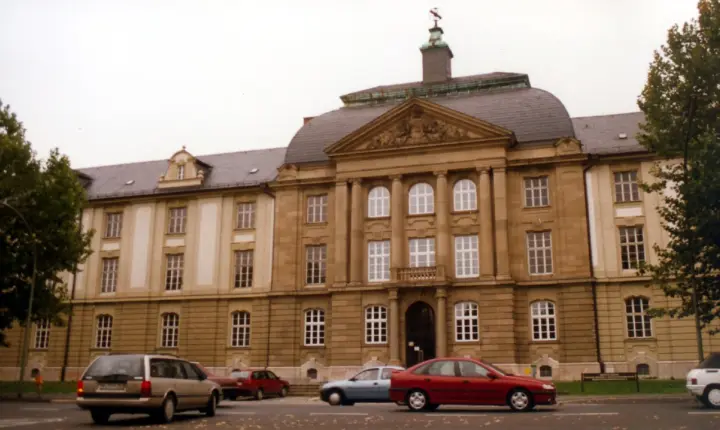
No tuition fee Tuition · sourced 2 years Duration View detailsCampus photos on this page: Robert Emmerich (CC BY-SA 3.0) — via Wikimedia Commons.
Molecular and Cellular Biophysics — FAQs
5 questions
Tuition is No tuition fee. Taken from the university's published fees page, not re-checked since — confirm it before you budget. We confirm the current fee and the scholarships you qualify for — free.
The main intake is Winter semester. Most universities admit on a rolling basis — we confirm the exact deadline for your profile, free.
Bachelor of Science in biology or equivalent study degree that fulfils the criteria of the "Fachkanon Biologie" / subject specific criteria, in particular: Bachelor of Science in Biology or a similar programme Biosciences: 75 ECTS credit equivalents Chemistry (including biochemistry and physical chemistry): 15 ECTS Physics, mathematics, biostatistics: 15 ECTS OR Biosciences: 60 ECTS Chemistry (including biochemistry and physical chemistry): 20 ECTS Physics, mathematics, biostatistics: 12 ECTS OR Biosciences: 70 ECTS Chemistry (including biochemistry and physical chemistry): 10 ECTS Physics, mathematics, biostatistics: 12 ECTS Proof of experimental laboratory experience, preferably by an experimental thesis comprising a minimum of 10 ECTS Please submit either your final degree or your transcript of records to certify the minimum requirement of 150 ECTS. You have to submit your completed transcript of records not later than 15 September or 15 March, respectively. English: E.G. Cambridge English Qualifications: C1 Advanced IELTS Academic: 6.5.
The programme runs about 24 months full-time.
Yes — shortlisting, SOP, LOR, Resume, application, scholarships and visa guidance are all free. We're paid by partner universities, not by you.
Apply to Molecular and Cellular Biophysics — free help
A counsellor calls you back during office hours — 9am to 8pm IST, Mon to Sat. We are open now.