
International Master of Science in Physics
Julius-Maximilians-Universität Würzburg · Würzburg, Europe
Duration
24 mo
Tuition
No tuition fee
sourcedIntake
Winter semester
English
—
Winter semester intake. Most universities admit on a rolling basis — we confirm the exact application deadline for your profile, free.
Course details verified 09 Sep 2026 — intakes, entry requirements and course facts · official source
Fee sourced Taken from the university's published fees page, not re-checked since — confirm it before you budget. See the university fees page.
About this programme
The International Master of Science in Physics programme is a two-year programme with the first year focused on lectures, seminars and lab courses in order to deepen and broaden the knowledge of students beyond the experiences from BSc-level studies. In the second year, students work on a topical project in physics integrated in a faculty research team under the supervision of a professor or senior scientist, leading to a Master's thesis. Our faculty consists of 15 chairs, which cover a broad range of topics within condensed matter physics, particle and astrophysics, energy research, quantum optics, optoelectronics and imaging technologies, combining experimental, theoretical and applied approaches. We collaborate with leading groups of the top universities and research institutes worldwide, such as at Cambridge, Harvard, Princeton, Stanford, Riken, the Max Planck Society and NASA. One major focus is on research in topological and correlated solid state physics, which receives annual multimillion funding through individual grants and awards and a collaborative research centre. Our expertise in material synthesis, characterisation and spectroscopy as well as in theoretical prediction and modelling and in the exploration of applications, allows us a cradle-to-paper approach, all within our faculty. Materials synthesised by our molecular beam epitaxy and pulsed laser deposition groups undergo structural, optical, magnetic and quantum transport measurements and are shared with groups performing a number of spectroscopy techniques. These include angle-resolved photoemission spectroscopy, spin-polarised scanning tunnelling spectroscopy, electron and nuclear spin resonance spectroscopy and resonant X-ray spectroscopy as well as electron microscopy. Research in theoretical physics develops and employs ab-initio, field-theoretical, many-body theory, Monte-Carlo and holographic methods. Our research also covers theoretical and experimental particle physics, theoretical and observational astrophysics and astronomy as well as quantum field theory and string theory. In particular, we carry out both theoretical and experimental precision analyses of the Standard Model in view of finding deviations and signals for new physics. Major topics in astronomy are high-energy astronomy and the study of cosmic particle accelerators as well as dark matter. Moreover, we investigate the AdS/CFT correspondence, its applications and its relations to quantum information and quantum gravity. A further important focus is on the development of technologies for renewable energy harvesting, nano- and biophotonics, molecular electronics, quantum communication, spintronics and NMR imaging techniques. A wide range of epitaxial growth equipment for inorganic and organic semiconductor heterostructures, clean room facilities, spectroscopy labs and lithography are routinely used by our researchers and students. The International Master of Science in Physics programme is a combination of two major topics: A) Experimental Physics and B) Theoretical Physics with strong emphasis on scientific research during a one-year Master's Project. During the first year of the programme, the students enrol in the Advanced Laboratory Courses and the Advanced Seminar Physics as well as at least three to four elective courses in Theoretical or Experimental Physics. All modules except for the laboratory courses are accompanied by a graded examination. In semesters three and four, further specialised research training is provided in a selected field of interest. These two Master's project modules lead to the Master's thesis itself. The students are actively involved in ongoing research projects. They learn to plan and perform independent theoretical and experimental work. They also learn to summarise and discuss the results obtained in the Master's thesis. The thesis has to be presented and discussed within the working group seminar. Further modules (up to 5 ECTS) are selected within th
Intakes & deadlines
Winter semester
Dates confirmed for your profile · Open
Summer semester
Dates confirmed for your profile · Open
Entry requirements
-
English
E.G. TOEFL iBT (before 2026): 72 Reading: 24 Listening: 22 Speaking: 25 Writing: 24 Cambridge English Qualifications: C1 Advanced IELTS Academic: 6
-
Prerequisites
Check our website for information on Academic Requirements and Skills and Required Documents for Application Important: Please note that a GRE Subject Test in Physics with a minimum score of 600 points has to be submitted.
-
Documents
SOP, LOR & Resume — generate them free in 2 minutes.
Fees & scholarships
No tuition fee tuition (sourced). We confirm the exact costs and the scholarships you qualify for at Julius-Maximilians-Universität Würzburg — free, for your profile.
Other programmes at Julius-Maximilians-Universität Würzburg
Adult Education and Management in Lifelong Education
No tuition fee Tuition · sourced 2 years Duration View details JMW Julius-Maximilians-Universität WürzburgBehavioural Neurobiology / Neuroethology, Master of Science in Biology
No tuition fee Tuition · sourced 2 years Duration View details JMW Julius-Maximilians-Universität WürzburgCell and Infection Biology, Master of Science
No tuition fee Tuition · sourced 2 years Duration View details JMW Julius-Maximilians-Universität WürzburgChina Business and Economics, Master of Science
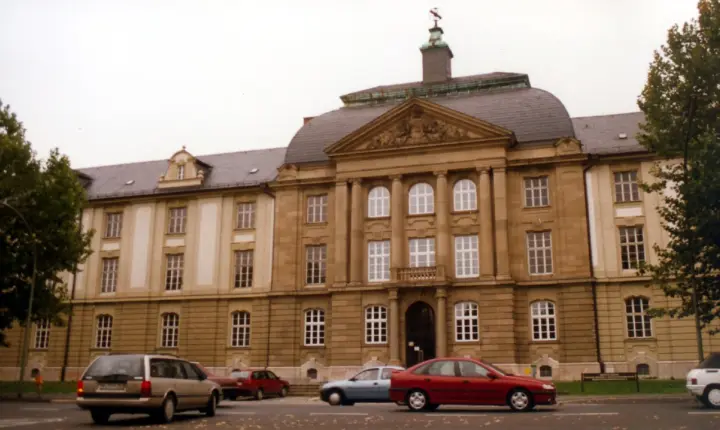
No tuition fee Tuition · sourced 2 years Duration View detailsCampus photos on this page: Robert Emmerich (CC BY-SA 3.0) — via Wikimedia Commons.
International Master of Science in Physics — FAQs
5 questions
Tuition is No tuition fee. Taken from the university's published fees page, not re-checked since — confirm it before you budget. We confirm the current fee and the scholarships you qualify for — free.
The main intake is Winter semester. Most universities admit on a rolling basis — we confirm the exact deadline for your profile, free.
Check our website for information on Academic Requirements and Skills and Required Documents for Application Important: Please note that a GRE Subject Test in Physics with a minimum score of 600 points has to be submitted. English: E.G. TOEFL iBT (before 2026): 72 Reading: 24 Listening: 22 Speaking: 25 Writing: 24 Cambridge English Qualifications: C1 Advanced IELTS Academic: 6.
The programme runs about 24 months full-time.
Yes — shortlisting, SOP, LOR, Resume, application, scholarships and visa guidance are all free. We're paid by partner universities, not by you.
Apply to International Master of Science in Physics — free help
A counsellor calls you back during office hours — 9am to 8pm IST, Mon to Sat. We are open now.