
Master of Science in Soft Matter and Materials
Johannes Gutenberg Universität Mainz · Mainz, Europe
Duration
24 mo
Tuition
No tuition fee
sourcedIntake
Winter semester
English
—
Winter semester intake. Most universities admit on a rolling basis — we confirm the exact application deadline for your profile, free.
Course details verified 10 Sep 2026 — intakes, entry requirements and course facts · official source
Fee sourced Taken from the university's published fees page, not re-checked since — confirm it before you budget. See the university fees page.
About this programme
Please have a look at our degree programme video! The Master of Science in Soft Matter and Material is a jointly offered, research-focused degree programme with an increasing emphasis on practical components. It is offered by Johannes Gutenberg University Mainz (JGU) and the Technical University of Darmstadt, both members of the Rhine-Main Universities Alliance. The study of soft matter and soft materials requires a comprehensive understanding of physics and chemistry in this field. The goal of the Soft Matter and Materials Master's programme is to provide technical knowledge and conceptual competence in the production of building blocks (e.g. polymers, supramolecular tectons, colloids) and in the structure-dynamics-property relationships of soft matter and materials. Functional concepts will be taught using both general synthetic components and biologically-relevant components. Knowledge of the technical processing and industrial utilisation of soft materials will round off the training. All teaching and learning content will be in English. The first two semesters of the programme lay the physical and chemical foundations and take place exclusively on the Mainz and Darmstadt campuses, respectively. Following the initial two semesters, the programme offers research-focused content that can be flexibly selected. Throughout all semesters, there is a gradual increase in practical components. As early as the second semester (assuming you start your studies in the winter semester), students will be offered a module in which they can choose two of four main subjects, e.g. polymers at interfaces, sustainable polymer chemistry, and technical polymer science. In the third semester, students will choose two research modules from a wide range of courses offered by the chemistry and physics faculties of TU Darmstadt and Mainz University (JGU) as well as the Max Planck Institute for Polymer Research Mainz. In addition, a flexible module is available where students can choose from several current offerings each semester.
Intakes & deadlines
Winter semester
Dates confirmed for your profile · Open
Summer semester
Dates confirmed for your profile · Open
Entry requirements
-
English
E.G. IELTS Academic: 5.5 PTE Academic: 59 telc English: telc English B2-C1 University TOEFL iBT (before 2026): 72 Reading: 18 Listening: 17 Speaking: 20 Writing: 17 Cambridge English Qualifications: B2 First
-
Prerequisites
Academic admission requirements include a Bachelor’s degree in Chemistry, Chemical Engineering, Physics, or Materials Science from a university in Germany or abroad that is not significantly different from the JGU. Evidence of practical laboratory exercises amounting to at least 18 credit points (CP), with a portion of it completed using chemical working techniques Evidence of achievements in molecular sciences amounting to at least 3 CP Evidence of achievements in thermodynamics amounting to at least 3 CP Achievements that were not completed during the Bachelor’s degree may also be taken into account. The examination board will decide on this.
-
Documents
SOP, LOR & Resume — generate them free in 2 minutes.
Fees & scholarships
No tuition fee tuition (sourced). We confirm the exact costs and the scholarships you qualify for at Johannes Gutenberg Universität Mainz — free, for your profile.
Other programmes at Johannes Gutenberg Universität Mainz
Franco-German Master of Arts in German Studies / Master Recherche Études Germaniques, Mainz-Dijon
No tuition fee Tuition · sourced 2 years Duration View details JGM Johannes Gutenberg Universität MainzHuman Geography: Globalisation, Media, and Culture
No tuition fee Tuition · sourced 2 years Duration View details JGM Johannes Gutenberg Universität MainzInnovative Coaching in High Performance Sports
€1,100/yr Tuition · sourced 2 years Duration View details JGM Johannes Gutenberg Universität MainzInternational Master's in Cinema Studies (IMACS)
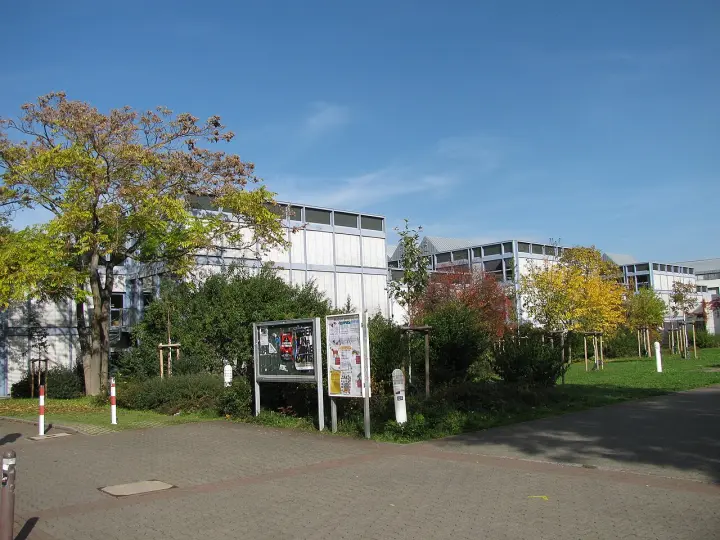
No tuition fee Tuition · sourced 2 years Duration View detailsCampus photos on this page: GeorgDerReisende (CC BY-SA 4.0) — via Wikimedia Commons.
Master of Science in Soft Matter and Materials — FAQs
5 questions
Tuition is No tuition fee. Taken from the university's published fees page, not re-checked since — confirm it before you budget. We confirm the current fee and the scholarships you qualify for — free.
The main intake is Winter semester. Most universities admit on a rolling basis — we confirm the exact deadline for your profile, free.
Academic admission requirements include a Bachelor’s degree in Chemistry, Chemical Engineering, Physics, or Materials Science from a university in Germany or abroad that is not significantly different from the JGU. Evidence of practical laboratory exercises amounting to at least 18 credit points (CP), with a portion of it completed using chemical working techniques Evidence of achievements in molecular sciences amounting to at least 3 CP Evidence of achievements in thermodynamics amounting to at least 3 CP Achievements that were not completed during the Bachelor’s degree may also be taken into account. The examination board will decide on this. English: E.G. IELTS Academic: 5.5 PTE Academic: 59 telc English: telc English B2-C1 University TOEFL iBT (before 2026): 72 Reading: 18 Listening: 17 Speaking: 20 Writing: 17 Cambridge English Qualifications: B2 First.
The programme runs about 24 months full-time.
Yes — shortlisting, SOP, LOR, Resume, application, scholarships and visa guidance are all free. We're paid by partner universities, not by you.
Apply to Master of Science in Soft Matter and Materials — free help
A counsellor calls you back during office hours — 9am to 8pm IST, Mon to Sat. We are open now.