
Digitalised Energy Systems
Carl von Ossietzky Universität Oldenburg · Oldenburg, Europe
Duration
24 mo
Tuition
No tuition fee
sourcedIntake
Winter semester
English
—
Winter semester intake. Most universities admit on a rolling basis — we confirm the exact application deadline for your profile, free.
Course details verified 10 Sep 2026 — intakes, entry requirements and course facts · official source
Fee sourced Taken from the university's published fees page, not re-checked since — confirm it before you budget. See the university fees page.
About this programme
To mitigate climate change is a matter of urgency, and thus, the energy transition represents one of the greatest technological and societal challenges of our time. The main challenge for a reliable, economically and ecologically feasible energy supply lies in the efficient, secure and reliable digitalisation of a technical system that integrates a huge, fluctuating, and difficult-to-forecast number of energy generators, consumers, storage facilities and grid components into a technically stable and financially viable overall system. In addition, the energy system is a critical infrastructure – the lifeline of modern societies. The failure or impairment of such a system would result in long lasting supply bottlenecks, significant disruptions to public safety or other dramatic effects. This degree programme enables graduates to conduct research at research institutions or universities on the still missing elements of a successful digitalisation in the energy domain and thus on the implementation of the energy transition; or to occupy diverse positions in the energy industry due to the high practical relevance of the study content. The Master's programme consists of a compulsory part, which teaches core competences in the field of designing and engineering of cyber-physical energy systems. These competences reflect the diversity of energy informatics systems and their fields of application and, together with various thematic specialisation options, allow for a meaningful deepening and specialisation with respect to individual interests. Different domain-specific application perspectives are taught independently so that students acquire broad application knowledge that goes beyond the specific energy system class. Societal and socio-technical issues are also represented as a cross-sectional topic. The courses cover the following topics and more: Smart grids Renewable energy (Distributed) Artificial intelligence Co-simulation Design and assessment of experiments Control theory Critical engineering Energy markets Requirements engineering Modelling and control Cyber-resilience In a cross-group research project, which addresses control at the component level, communication, and also the use of agents in the context of optimisation in energy systems, the learned contents are consolidated and tested in practice. The degree programme consists of the following content areas: "Fundamental Competencies" with a scope of 54 CP teaches basic competencies from the areas of computer science, automation, and electrical engineering. This area is subdivided into "Automation and Electrical Engineering" and "Computer Science and Energy Informatics" to reflect the interdisciplinary nature of the degree programme, which maps the aspects that are required to develop and analyse necessary system intelligence in the energy system. The courses from both areas are therefore also strongly interlinked in terms of content in order to bring together practical skills from computer science, electrical engineering and an engineering approach in designing cyber-physical energy systems right from the start. "Foundations of Digitalised Energy Systems" with a scope of 36 CP aims to impart competencies and knowledge in the future field of digitalised energy systems. This area is subdivided into "Digitalised Energy System Automation, Control and Optimisation" and "Digitalised Energy System Design and Assessment" in order to take into account the different technical system classes with their respective specific design and analysis methods. The third subsection, "Innovation Topics and Smart Grids", reflects the different domain-specific application perspectives and offers insights into current developments and research topics. The Master's thesis module (30 CP) PDF Download
Intakes & deadlines
Winter semester
Dates confirmed for your profile · Open
Entry requirements
-
English
E.G. TOEIC: 785 Reading: 385 Listening: 400 Speaking: 160 Writing: 150 TOEFL iBT (before 2026): 72 Reading: 18 Listening: 17 Speaking: 20 Writing: 17 Cambridge English Qualifications: B2 First IELTS Academic: 5.5
-
Prerequisites
A Bachelor's degree or an equivalent degree in computer science, business information systems, engineering, electrical engineering or a suitable previous information technology degree programme with a predominantly technical and information technology component, or a comparable degree programme with a minimum of 180 credit points at a German university or at a university belonging to one of the Bologna signatory states Technical aptitude is demonstrated by: Knowledge in object-oriented modelling and programming (minimum of 5 CP) Information processing (minimum of 5 CP) Mathematics, esp. linear algebra and analysis (minimum of 10 credits) All applicants have to register on uni-assist and upload all their documents. The latest information can be found on the following website: https://uol.de/en/course-of-study/digitalised-energy-systems-master-630.
-
Documents
SOP, LOR & Resume — generate them free in 2 minutes.
This is an indicative early-career range for the whole Engineering (general) field in Europe, from official graduate-outcome data — not a figure for this programme or university, and not a guarantee of what you will earn. What you actually earn depends on the role, employer, city and your visa.
Source: Profiling Institut - Gehaltsranking nach Studienfach 2026 (StepStone Gehaltsreport 2026), 2026. Market job-board data — less official than a government survey; treat as indicative.
Rupee figure converted at the 18 Aug 2026 mid-market rate; your bank's rate will be worse and currencies move, so use it for planning, not as the amount you will receive.
Fees & scholarships
No tuition fee tuition (sourced). We confirm the exact costs and the scholarships you qualify for at Carl von Ossietzky Universität Oldenburg — free, for your profile.
Other programmes at Carl von Ossietzky Universität Oldenburg
Biology
No tuition fee Tuition · sourced 2 years Duration View details CVO Carl von Ossietzky Universität OldenburgData Science and Machine Learning, MSc
No tuition fee Tuition · sourced 2 years Duration View details CVO Carl von Ossietzky Universität OldenburgMaster of Science in Engineering Physics
No tuition fee Tuition · sourced 2 years Duration View details CVO Carl von Ossietzky Universität OldenburgMaster of Science in Neuroscience
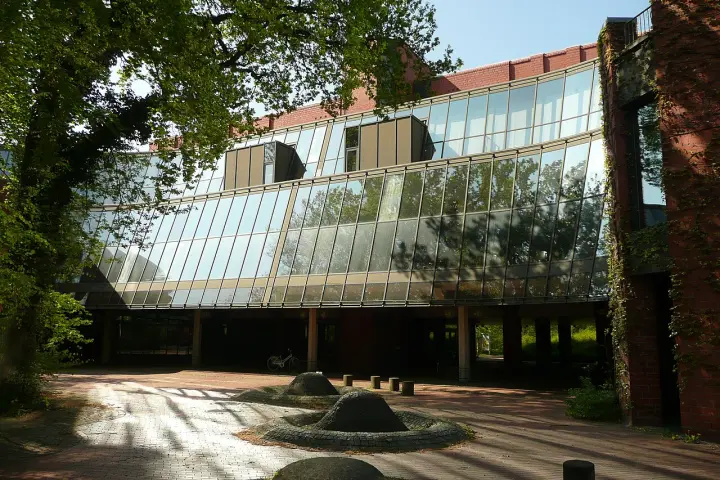
No tuition fee Tuition · sourced 2 years Duration View detailsCampus photos on this page: WilfriedC (Wilfried Cordes) (CC BY-SA 3.0) — via Wikimedia Commons.
Digitalised Energy Systems — FAQs
5 questions
Tuition is No tuition fee. Taken from the university's published fees page, not re-checked since — confirm it before you budget. We confirm the current fee and the scholarships you qualify for — free.
The main intake is Winter semester. Most universities admit on a rolling basis — we confirm the exact deadline for your profile, free.
A Bachelor's degree or an equivalent degree in computer science, business information systems, engineering, electrical engineering or a suitable previous information technology degree programme with a predominantly technical and information technology component, or a comparable degree programme with a minimum of 180 credit points at a German university or at a university belonging to one of the Bologna signatory states Technical aptitude is demonstrated by: Knowledge in object-oriented modelling and programming (minimum of 5 CP) Information processing (minimum of 5 CP) Mathematics, esp. linear algebra and analysis (minimum of 10 credits) All applicants have to register on uni-assist and upload all their documents. The latest information can be found on the following website: https://uol.de/en/course-of-study/digitalised-energy-systems-master-630. English: E.G. TOEIC: 785 Reading: 385 Listening: 400 Speaking: 160 Writing: 150 TOEFL iBT (before 2026): 72 Reading: 18 Listening: 17 Speaking: 20 Writing: 17 Cambridge English Qualifications: B2 First IELTS Academic: 5.5.
The programme runs about 24 months full-time.
Yes — shortlisting, SOP, LOR, Resume, application, scholarships and visa guidance are all free. We're paid by partner universities, not by you.
Apply to Digitalised Energy Systems — free help
A counsellor calls you back during office hours — 9am to 8pm IST, Mon to Sat. We are open now.