Bonn-Cologne Graduate School of Physics and Astronomy: MSc in Physics (Cologne)
University of Cologne · Cologne, Europe
Duration
24 mo
Tuition
No tuition fee
sourcedIntake
Winter semester
English
—
Winter semester intake. Most universities admit on a rolling basis — we confirm the exact application deadline for your profile, free.
Course details verified 09 Sep 2026 — intakes, entry requirements and course facts · official source
Fee sourced Taken from the university's published fees page, not re-checked since — confirm it before you budget. See the university fees page.
About this programme
The Bonn-Cologne Graduate School of Physics and Astronomy is a joint programme of graduate studies between the Universities of Bonn and Cologne that was funded through the Excellence Initiative from 2007 to 2019. The MSc programme in Cologne comprises a mandatory part made up of required courses (advanced quantum mechanics or statistical physics and an advanced lab course) as well as an optional part with a broad range of choices. This includes a Master's thesis at the frontier of current research. The two-year Master's programme builds upon the Bachelor's programme. Students acquire advanced skills to solve more complex problems. In this programme, students select their main and minor subjects according to their interests from a considerable number of research areas covered by the Cologne physics institutes. Initially, courses in two main areas of specialisation will be taken. These subjects are oriented in accordance with the main research activities of the participating physics institutes. One of the subjects will develop into the primary, the other into the secondary area of specialisation. As a rule, the primary area of specialisation is also the basis for the MSc thesis. The primary areas of specialisation are: Astrophysics Condensed Matter Physics Foundations of Quantum Technology: Matter, Light, and Information Molecular Physics Nuclear and Particle Physics Quantum Field Theory / General Theory of Relativity Solid State Theory / Computational Physics Statistical and Biological Physics All graduate studies (MSc and PhD) in the department of physics at the University of Cologne are coordinated by the Bonn-Cologne Graduate School of Physics and Astronomy. The following list gives an overview of the curriculum for the MSc in Physics. Hours per week and credit points are given in brackets (HPW Lecture / HPW Problem Classes or Seminars / HPW Practical Courses / CPs). Semester One Practical Training I (0/0/3/6) Secondary Area of Specialisation (depending on choice of subject) Advanced Quantum Mechanics or Advanced Statistical Physics (4/2/0/9) Elective Area (depending on choice of subject) Primary Area of Specialisation (depending on choice of subject) Semester Two Practical Training II – Lab Course (0/0/3/6) Secondary Area of Specialisation (depending on choice of subject) Elective Area (depending on choice of subject) Primary Area of Specialisation (depending on choice of subject) Semester Three Practical Training II – Advanced Seminar (0/2/0/3) Introductory Project I (9/0/0/12) Introductory Project II (9/0/0/12) Semester Four Research Module Master's Thesis (six months/30) Total number of credits points in: Primary Area of Specialisation: 18 CP Secondary Area of Specialisation: 12 CP Elective Area: 12 CP PDF Download
Intakes & deadlines
Winter semester
Dates confirmed for your profile · Open
Summer semester
Dates confirmed for your profile · Open
Entry requirements
-
English
E.G. Cambridge English Qualifications: B2 First TOEFL iBT (before 2026): 72 Reading: 18 Listening: 17 Speaking: 20 Writing: 17 IELTS Academic: 5.5
-
Prerequisites
A BSc degree (or equivalent) in Physics (or a related field) is required. In particular, we require applicants to have successfully completed the following coursework by the time the semester starts: at least 15 credit points in theoretical physics – Note that either a course in quantum mechanics or a course in statistical physics is required. at least 15 credit points in mathematics at least 15 credit points in advanced experimental physics at least 12 credit points in experimental/practical training (e.g. laboratory practicals)
-
Documents
SOP, LOR & Resume — generate them free in 2 minutes.
Fees & scholarships
No tuition fee tuition (sourced). We confirm the exact costs and the scholarships you qualify for at University of Cologne — free, for your profile.
Other programmes at University of Cologne
Business Administration (Master of Science) – Major: Accounting & Taxation, Corporate Development, Finance, Marketing, Supply Chain Management
No tuition fee Tuition · sourced 2 years Duration View details CO University of CologneBusiness Analytics & Econometrics – Master of Science
No tuition fee Tuition · sourced 2 years Duration View details CO University of CologneDouble Master's Programme in Business Administration – Master of Science
No tuition fee Tuition · sourced 2 years Duration View details CO University of CologneDouble Master's Programme in Demography and Social Inequality - Master of Science
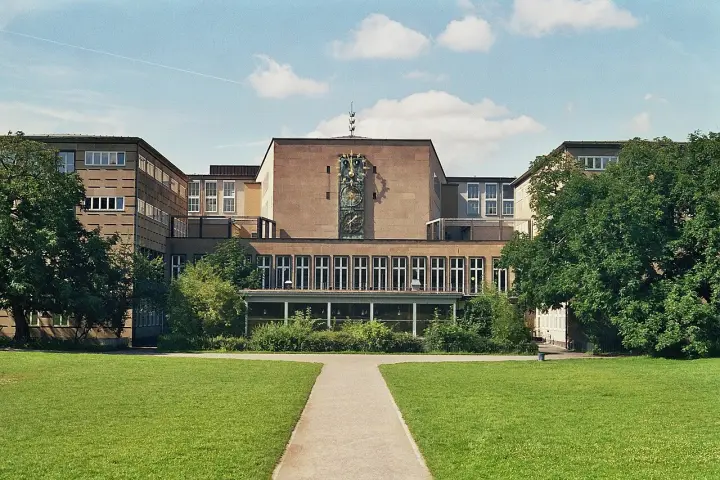
No tuition fee Tuition · sourced 2 years Duration View detailsCampus photos on this page: UzK (Public domain) — via Wikimedia Commons.
Bonn-Cologne Graduate School of Physics and Astronomy: MSc in Physics (Cologne) — FAQs
5 questions
Tuition is No tuition fee. Taken from the university's published fees page, not re-checked since — confirm it before you budget. We confirm the current fee and the scholarships you qualify for — free.
The main intake is Winter semester. Most universities admit on a rolling basis — we confirm the exact deadline for your profile, free.
A BSc degree (or equivalent) in Physics (or a related field) is required. In particular, we require applicants to have successfully completed the following coursework by the time the semester starts: at least 15 credit points in theoretical physics – Note that either a course in quantum mechanics or a course in statistical physics is required. at least 15 credit points in mathematics at least 15 credit points in advanced experimental physics at least 12 credit points in experimental/practical training (e.g. laboratory practicals) English: E.G. Cambridge English Qualifications: B2 First TOEFL iBT (before 2026): 72 Reading: 18 Listening: 17 Speaking: 20 Writing: 17 IELTS Academic: 5.5.
The programme runs about 24 months full-time.
Yes — shortlisting, SOP, LOR, Resume, application, scholarships and visa guidance are all free. We're paid by partner universities, not by you.
Apply to Bonn-Cologne Graduate School of Physics and Astronomy: MSc in Physics (Cologne) — free help
A counsellor calls you back during office hours — 9am to 8pm IST, Mon to Sat. We are open now.