
Scientific Computing
University of Bayreuth · Bayreuth, Europe
Duration
24 mo
Tuition
No tuition fee
sourcedIntake
Winter semester
English
—
Winter semester intake. Most universities admit on a rolling basis — we confirm the exact application deadline for your profile, free.
Course details verified 09 Sep 2026 — intakes, entry requirements and course facts · official source
Fee sourced Taken from the university's published fees page, not re-checked since — confirm it before you budget. See the university fees page.
About this programme
The past several years have shown that numerical simulations of phenomena in technology and the natural sciences are an essential tool for accelerating development cycles in industry and businesses. While researchers once had to meticulously study the properties of a product on the basis of prototypes, they are now simulated and optimised on computers. Demands for the capabilities of numerical simulation continue to grow with the need for models that are more and more precise, the incorporation of new problem areas such as data analysis (e.g. big data) or stochastic models (i.e. those containing uncertain data). All these fields are encompassed in the young and forward-looking research area of scientific computing. The field addresses the entire workflow, including modelling; mathematical, numerical, and statistical analysis; optimisation; the implementation of algorithms on high-performance computers; and the visualisation of results. However, little attention has been paid to training students in this development. The international Master’s programme is geared towards students working at the intersection of mathematics, computer science, and application fields. The objective of the programme is to offer a specialised educational background that enables highly qualified, hard-working students to apply state-of-the-art methods and tools of Scientific Computing to solve challenging problems in modern technology and sciences. This interdisciplinary approach starts with an in-depth understanding of the mathematical core of the problem, provides a wide overview of modern numerical methods for solving differential and integral equations and analysing large amounts of data, and, finally, supplies practical skills and experience in the area of high-performance computing necessary to implement these solutions in the form of numerical software. In doing so, the programme offers a focused education at the level of a mathematics student that is also attainable by interested students from other disciplines. To this end, special financial support and intensive supervision is provided, which can only be guaranteed within the framework of an elite degree programme, for which the state of Bavaria offers special funding. The contents taught are applied to interdisciplinary problems in modelling seminars. In these seminars problems are presented by well-known industrial partners, who also accompany the solution process. Very talented students can combine the Master's programme with a fast-track doctorate. The Master's programme is organised in elective and mandatory modules. The elective modules consist of several courses, from which the participants can choose according to their interests. They have to fulfil a certain amount of credit points in these elective modules. The following four main areas are includes in the elite Master's programme in Scientific Computing: Numerical mathematics (numerical methods for different types of differential equations, approximation methods, optimisation). Modelling and simulation of many problems from (bio)physics, (bio)computer science, chemistry, engineering sciences and climate/environmental sciences High performance computing (data structures, parallel systems and algorithms) Scientific computing (complexity reduction, fast and efficient methods, mesh-free methods, data analysis, quantification of uncertainties, multiscale problems, optimisation methods in machine learning) Each year, a modelling seminar (summer semester) and a status seminar (winter semester) will be held. Students must attend two of each of these events. An industrial internship and a practical course on parallel numerical methods deepen the learned methods and algorithms. One of the modules of the programme is dedicated to key skills, such as lecture and presentation techniques, literature research, teamwork or dealing with foreign-language specialist literature. Students have to attend seminars in this module for a certain amount of
Intakes & deadlines
Winter semester
Dates confirmed for your profile · Open
Summer semester
Dates confirmed for your profile · Open
Entry requirements
-
English
E.G. Cambridge English Qualifications: B2 First TOEFL iBT (before 2026): 72 Reading: 18 Listening: 17 Speaking: 20 Writing: 17 UNIcert® English: UNIcert® II IELTS Academic: 5.5
-
Prerequisites
A Bachelor’s degree in mathematics, computer science, engineering science or physics (or a degree with equivalent content) with a final grade of 1.9 or better Sufficient specialised knowledge in numerical mathematics of at least 16 credits
-
Documents
SOP, LOR & Resume — generate them free in 2 minutes.
Fees & scholarships
No tuition fee tuition (sourced). We confirm the exact costs and the scholarships you qualify for at University of Bayreuth — free, for your profile.
Other programmes at University of Bayreuth
African Studies: Language, Arts, Philosophy
No tuition fee Tuition · sourced 2 years Duration View details BA University of BayreuthBattery Materials and Technology (Master of Science)
No tuition fee Tuition · sourced 2 years Duration View details BA University of BayreuthBiofabrication
No tuition fee Tuition · sourced 2 years Duration View details BA University of BayreuthComputer Science, Master of Science (MSc)
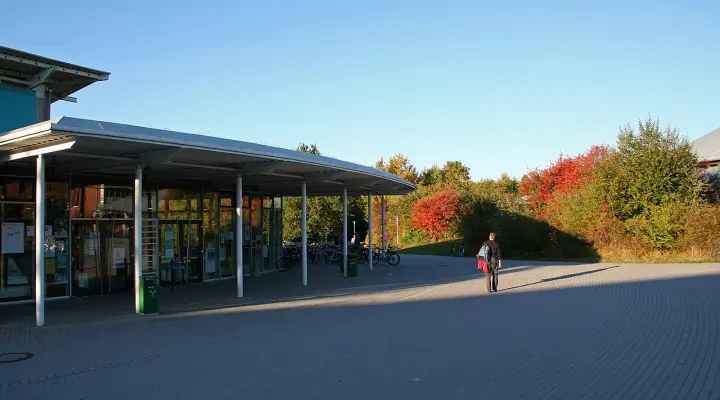
No tuition fee Tuition · sourced 2 years Duration View detailsCampus photos on this page: H. Wurst (CC BY-SA 2.0 de) — via Wikimedia Commons.
Scientific Computing — FAQs
5 questions
Tuition is No tuition fee. Taken from the university's published fees page, not re-checked since — confirm it before you budget. We confirm the current fee and the scholarships you qualify for — free.
The main intake is Winter semester. Most universities admit on a rolling basis — we confirm the exact deadline for your profile, free.
A Bachelor’s degree in mathematics, computer science, engineering science or physics (or a degree with equivalent content) with a final grade of 1.9 or better Sufficient specialised knowledge in numerical mathematics of at least 16 credits English: E.G. Cambridge English Qualifications: B2 First TOEFL iBT (before 2026): 72 Reading: 18 Listening: 17 Speaking: 20 Writing: 17 UNIcert® English: UNIcert® II IELTS Academic: 5.5.
The programme runs about 24 months full-time.
Yes — shortlisting, SOP, LOR, Resume, application, scholarships and visa guidance are all free. We're paid by partner universities, not by you.
Apply to Scientific Computing — free help
A counsellor calls you back during office hours — 9am to 8pm IST, Mon to Sat. We are open now.