Nanoscience (MSc)
Universität Kassel · Kassel, Europe
Duration
24 mo
Tuition
No tuition fee
sourcedIntake
Winter semester
English
—
Winter semester intake. Most universities admit on a rolling basis — we confirm the exact application deadline for your profile, free.
Course details verified 10 Sep 2026 — intakes, entry requirements and course facts · official source
Fee sourced Taken from the university's published fees page, not re-checked since — confirm it before you budget. See the university fees page.
About this programme
The Nanoscience consecutive study programme expands the knowledge and skills obtained in a corresponding Bachelor's degree programme towards deeper theoretical understanding and practical applications of nanoscale phenomena. Embedded in state-of-the-art research, students apply interdisciplinary approaches based on physics, chemistry, and biology to special research areas of nanoscience such as materials chemistry, nanoelectronics, and photonics or advanced molecular biology. By planning and conducting experiments and presenting the results in written and oral form, students develop their skills in scientific practice. They obtain competencies highly beneficial for employment in an interdisciplinary environment in industry or public service. These competencies include not only subject-specific knowledge but also soft skills such as scientific communication and time management. In addition to lectures in all natural sciences with special emphasis on the nanoscale and laboratory work involving at least one natural science, individual specialisation is possible in a large number of elective courses. Some of the courses may also be taken abroad in a partner university or institution. The two-year programme concludes with a Master's thesis on a special research topic in nanoscience. Upon successful completion of the programme, the academic title Master of Science will be awarded. Watch our image video to gain further insights into studying at the University of Kassel. Students may enter into the two-year programme in the winter or summer semester (i.e. October or April). In order to complete the programme, a total number of 120 credits have to be obtained, including the Master's thesis. Depending on the previous subject of study, additional requirements of up to 30 credits may be necessary. The actual duration of the study programme may differ based on these requirements and individual pacing. The modules are divided into compulsory modules, focus modules, and elective modules. Compulsory modules are "Methods of Nanostructure Analysis", "Nanophysics", "Nanochemistry", "Nanobiology", a preparatory project before starting with the Master's thesis, and the Master's degree module with the thesis itself. Students are required to select at least one advanced module from the three disciplines as a focus module. Further elective modules can be chosen from a variety of modules. Examples of course-like modules are "Aromatic Building Blocks for Organic Nanostructures", "Nanoscale Quantum Optics", "Basics in Chronobiology and Olfaction", and many others. A detailed description of the modules can be found in the "Modulhandbuch" (module handbook) on our website. PDF Download
Intakes & deadlines
Winter semester
Dates confirmed for your profile · Open
Summer semester
Dates confirmed for your profile · Open
Entry requirements
-
English
E.G. UNIcert® English: UNIcert® II TOEIC: 785 Reading: 385 Listening: 400 Speaking: 160 Writing: 150 TOEFL iBT Home Edition (before 2026): 72 Reading: 18 Listening: 17 Speaking: 20 Writing: 17 TOEFL iBT (before 2026): 72 Reading: 18 Listening: 17 Speaking: 20 Writing: 17 telc English: telc English B2 PTE Academic: 59 IELTS Academic: 5.5 Cambridge English Qualifications: B2 First
-
Prerequisites
In order to obtain admission to the Master's programme in Nanoscience, applicants must have a Bachelor's degree of at least 180 credits (ECTS) in nanoscience or a related equivalent degree. Sufficient knowledge in chemistry, physics, and biology including practical skills in at least one of the disciplines must be documented. The examination committee may demand a hearing for assessing the fulfilment of the admission requirements and/or may stipulate additional obligations of up to 30 credits.
-
Documents
SOP, LOR & Resume — generate them free in 2 minutes.
Fees & scholarships
No tuition fee tuition (sourced). We confirm the exact costs and the scholarships you qualify for at Universität Kassel — free, for your profile.
Other programmes at Universität Kassel
Agriculture, Ecology & Societies (AGES)
No tuition fee Tuition · sourced 2 years Duration View details KA Universität KasselEconomic Behavior & Governance (EB&Go)
No tuition fee Tuition · sourced 2 years Duration View details KA Universität KasselElectrical Communication Engineering (MSc)
No tuition fee Tuition · sourced 2 years Duration View details KA Universität KasselEuropean Master's in Business Studies (EMBS)
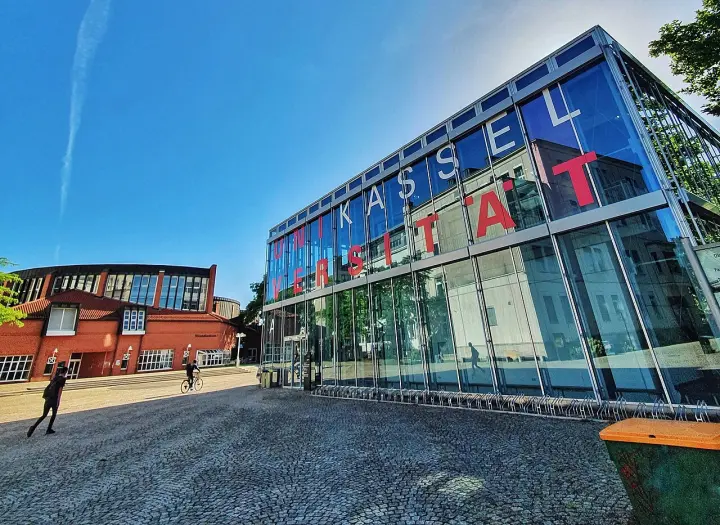
€3,350/yr Tuition · sourced 2 years Duration View detailsCampus photos on this page: Mönch K36 (CC BY-SA 4.0) — via Wikimedia Commons.
Nanoscience (MSc) — FAQs
5 questions
Tuition is No tuition fee. Taken from the university's published fees page, not re-checked since — confirm it before you budget. We confirm the current fee and the scholarships you qualify for — free.
The main intake is Winter semester. Most universities admit on a rolling basis — we confirm the exact deadline for your profile, free.
In order to obtain admission to the Master's programme in Nanoscience, applicants must have a Bachelor's degree of at least 180 credits (ECTS) in nanoscience or a related equivalent degree. Sufficient knowledge in chemistry, physics, and biology including practical skills in at least one of the disciplines must be documented. The examination committee may demand a hearing for assessing the fulfilment of the admission requirements and/or may stipulate additional obligations of up to 30 credits. English: E.G. UNIcert® English: UNIcert® II TOEIC: 785 Reading: 385 Listening: 400 Speaking: 160 Writing: 150 TOEFL iBT Home Edition (before 2026): 72 Reading: 18 Listening: 17 Speaking: 20 Writing: 17 TOEFL iBT (before 2026): 72 Reading: 18 Listening: 17 Speaking: 20 Writing: 17 telc English: telc English B2 PTE Academic: 59 IELTS Academic: 5.5 Cambridge English Qualifications: B2 First.
The programme runs about 24 months full-time.
Yes — shortlisting, SOP, LOR, Resume, application, scholarships and visa guidance are all free. We're paid by partner universities, not by you.
Apply to Nanoscience (MSc) — free help
A counsellor calls you back during office hours — 9am to 8pm IST, Mon to Sat. We are open now.