Water Security and Global Change
Technische Universität Dresden · Dresden, Europe
Duration
24 mo
Tuition
No tuition fee
sourcedIntake
Winter semester
English
—
Winter semester intake. Most universities admit on a rolling basis — we confirm the exact application deadline for your profile, free.
Course details verified 10 Sep 2026 — intakes, entry requirements and course facts · official source
Fee sourced Taken from the university's published fees page, not re-checked since — confirm it before you budget. See the university fees page.
About this programme
The Joint Master's programme in Water Security and Global Change immerses students in a dynamic educational environment that addresses the urgent and vital issue of water security, bridging perspectives from both the global South and global North. Drawing on the collective expertise of all partner institutions, the programme adopts an integrated and comprehensive approach to meet the needs of regional, national, and international stakeholders. Building upon existing modules, the programme features a modular structure with opportunities for specialisation. Student mobility is coordinated as part of this collaborative effort, while courses are taught by the participating institutions, ensuring a high standard of education. Through a joint curriculum, the programme is established across three degree-awarding universities (RWTH Aachen, IIT Madras, TU Dresden), with two associated partners (UNU Flores and AIT Bangkok). Upon completion, students receive a joint degree. What does this programme offer? Gain comprehensive insight into the hydrological cycle, water system components, and their interactions with the environment, society, and ecosystems. Explore the repercussions of global change on water resources and ecosystems. Gain an understanding of the effects of temperature shifts, precipitation patterns, and sea level rise on water availability and quality. Learn about water resource governance structures, policies, and regulations at various levels and their implications for water security. Study water pollution sources, their impacts on human health and the environment, and strategies for monitoring and enhancing water quality. Develop skills in managing and optimising water resources, including sustainable water use, conservation, and integrated management strategies. Learn to assess and mitigate water-related risks such as floods, droughts, and water scarcity, and build resilience in water systems. Collaborate across disciplines, integrating knowledge from environmental science, engineering, policy, economics, and social sciences to address water security challenges. Enhance research skills and analytical abilities to investigate complex water-related problems and propose evidence-based solutions. Explore ethical, social, and equity aspects of water security, acknowledging access to clean water as a fundamental human right. The Joint Master's programme has a scope of earning 120 ECTS points / 213 IITM credits in total. It consists of three semesters of course work with 90 ECTS points / 159 IITM credits in total and a fourth semester of thesis of 30 ECTS / 54 IITM credits. Each semester consists of 30 ECTS points / 54 IITM credits of course work with courses of 5 or 7.5 ECTS points. 30 ECTS (approx. 51 to 54 IITM credits) per semester may change according to the agreed schedule (see programme timeline table). Coursework consists of mandatory and elective courses, which are offered equally by all three partner universities and sum up to 30 ECTS points / 53 IITM credits provided by each partner university. The programme enables to define up to 30 ECTS points / 53 IITM credits elective courses. Study contents of RWTH Aachen University, Germany Climate Adaptation in Coastal & Hydraulic Engineering International Project Management Technological Modernisation and Globalisation Flood Protection Environment, Local Economies & Resource Conflict Geographic Information System in Water Management I Hydrodynamic Simulation Hydraulic Engineering Numerical Modelling in Water Resources Management Global Changes and Sustainable Development Geographical Information Systems in Water Management II Flood Risk Management Sediment Transport and Morphodynamics Industrial Waste Water Treatment Sanitary Engineering in Developing Countries Study contents of Indian Institute of Technology Madras IITM, India Physics-Chemical Processes for Water & Wastewater Treatment Sustainability in River Basin Management Water, Health and Hygiene Water Resources Plann
Intakes & deadlines
Winter semester
Dates confirmed for your profile · Open
Entry requirements
-
English
E.G. IELTS Academic: 6 TOEFL iBT (before 2026): 79 Reading: 18 Listening: 17 Speaking: 20 Writing: 17
-
Prerequisites
Admission to the programme may be granted to applicants who have received a Bachelor's or comparable degree that fulfils the following conditions: The qualifying degree needs to have a major focus in one of the academic subjects listed below: Civil Engineering Mechanical Engineering Environmental Engineering Hydro Science Engineering Water Resources Engineering Computational engineering Agricultural or Landscape Engineering The qualifying degree needs to encompass a minimum workload of 180 ECTS points or must have been awarded by a higher education institution officially recognised by at least one of the following institutions: AICTE, AIU, ACU, IAU, Central Office for Foreign Education The accumulated grade point average of the qualifying degree shall not be below 60% aggregate marks or “first class”.
-
Documents
SOP, LOR & Resume — generate them free in 2 minutes.
This is an indicative early-career range for the whole Engineering (general) field in Europe, from official graduate-outcome data — not a figure for this programme or university, and not a guarantee of what you will earn. What you actually earn depends on the role, employer, city and your visa.
Source: Profiling Institut - Gehaltsranking nach Studienfach 2026 (StepStone Gehaltsreport 2026), 2026. Market job-board data — less official than a government survey; treat as indicative.
Rupee figure converted at the 18 Aug 2026 mid-market rate; your bank's rate will be worse and currencies move, so use it for planning, not as the amount you will receive.
Fees & scholarships
No tuition fee tuition (sourced). We confirm the exact costs and the scholarships you qualify for at Technische Universität Dresden — free, for your profile.
Other programmes at Technische Universität Dresden
AI, Regulatory Affairs & Transformation in Medical Technology (MBA)
€4,170/yr Tuition · sourced 2 years Duration View details TD Technische Universität DresdenAir Transport and Logistics
No tuition fee Tuition · sourced 2 years Duration View details TD Technische Universität DresdenBiochemistry
No tuition fee Tuition · sourced 2 years Duration View details TD Technische Universität DresdenChemistry
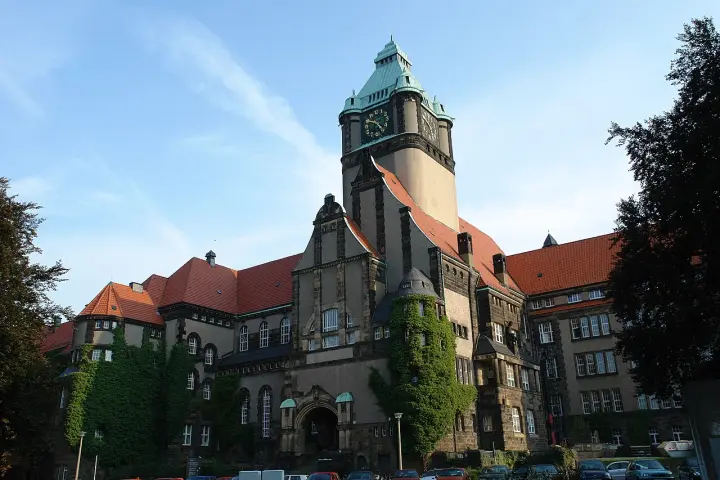
No tuition fee Tuition · sourced 2 years Duration View detailsCampus photos on this page: Hullbr3ach (CC BY-SA 2.5) — via Wikimedia Commons.
Water Security and Global Change — FAQs
5 questions
Tuition is No tuition fee. Taken from the university's published fees page, not re-checked since — confirm it before you budget. We confirm the current fee and the scholarships you qualify for — free.
The main intake is Winter semester. Most universities admit on a rolling basis — we confirm the exact deadline for your profile, free.
Admission to the programme may be granted to applicants who have received a Bachelor's or comparable degree that fulfils the following conditions: The qualifying degree needs to have a major focus in one of the academic subjects listed below: Civil Engineering Mechanical Engineering Environmental Engineering Hydro Science Engineering Water Resources Engineering Computational engineering Agricultural or Landscape Engineering The qualifying degree needs to encompass a minimum workload of 180 ECTS points or must have been awarded by a higher education institution officially recognised by at least one of the following institutions: AICTE, AIU, ACU, IAU, Central Office for Foreign Education The accumulated grade point average of the qualifying degree shall not be below 60% aggregate marks or “first class”. English: E.G. IELTS Academic: 6 TOEFL iBT (before 2026): 79 Reading: 18 Listening: 17 Speaking: 20 Writing: 17.
The programme runs about 24 months full-time.
Yes — shortlisting, SOP, LOR, Resume, application, scholarships and visa guidance are all free. We're paid by partner universities, not by you.
Apply to Water Security and Global Change — free help
A counsellor calls you back during office hours — 9am to 8pm IST, Mon to Sat. We are closed right now, so your request is first in line when we reopen.