
Physics
Saarland University · Saarbrücken, Europe
Duration
24 mo
Tuition
No tuition fee
sourcedIntake
Winter semester
English
—
Winter semester intake. Most universities admit on a rolling basis — we confirm the exact application deadline for your profile, free.
Course details verified 09 Sep 2026 — intakes, entry requirements and course facts · official source
Fee sourced Taken from the university's published fees page, not re-checked since — confirm it before you budget. See the university fees page.
About this programme
The research-oriented Master’s programme in Physics leading to the Master of Science (MSc) degree provides students with in-depth technical knowledge, skills and methods that enable them to work independently in science, to develop innovative ideas, to critically classify scientific findings and to act responsibly. Students receive a comprehensive education in physics as well as an insight into the content and methods of related sciences. The education in the Master's programme includes modules in theoretical and experimental physics. Connections to neighbouring disciplines or applications of physics in engineering, life sciences or in medicine are established through the non-physics elective. Interdisciplinary key qualifications and content are also taught as part of the programme, e.g. an introduction to the planning and coordination of scientific projects or training in skills for the comprehensible communication of scientific findings. In the first year of study, students acquire advanced knowledge in the subfields of quantum mechanics and statistical physics as part of the theoretical physics curriculum (module “Theoretical Physics V”). In the experimental component of the programme, more advanced concepts in solid-state physics and atomic physics are covered (module “Experimental Physics V”). This includes the application of modern experimental methods in research lab courses and current projects conducted by experimentally oriented research groups. The second year of the Master’s programme can be characterised as a research phase. In the third semester, students are prepared for the Master’s thesis, which constitutes the completion of the degree programme. PDF Download
Intakes & deadlines
Winter semester
Dates confirmed for your profile · Open
Summer semester
Dates confirmed for your profile · Open
Entry requirements
-
English
E.G. IELTS Academic: 6 TOEFL iBT (before 2026): 85 Reading: 18 Listening: 17 Speaking: 20 Writing: 17
-
Prerequisites
Admission to the consecutive Master’s degree programme in Physics requires both of the following: a Bachelor’s degree or an equivalent university degree with a focus on physics or a subject closely related to physics specific aptitude for a Master’s programme, which is generally demonstrated by a Bachelor’s degree with an overall grade of 2.5 or better, or by passing an aptitude assessment test For the Physics degree programme, subject-specific competencies are required in the areas of mechanics, electrodynamics and optics, thermodynamics and statistics, atomic and molecular physics, condensed matter physics, nuclear and particle physics, as well as quantum mechanics. The number of credit points earned in lectures and tutorials in experimental physics, theoretical physics, and mathematical foundations should be at least 30 CP in each area. At least 20 CP should have been obtained through physics laboratory courses.
-
Documents
SOP, LOR & Resume — generate them free in 2 minutes.
Fees & scholarships
No tuition fee tuition (sourced). We confirm the exact costs and the scholarships you qualify for at Saarland University — free, for your profile.
Other programmes at Saarland University
Bioinformatics
No tuition fee Tuition · sourced 2 years Duration View details SA Saarland UniversityBiophysics
No tuition fee Tuition · sourced 2 years Duration View details SA Saarland UniversityComputer Science (MSc)
No tuition fee Tuition · sourced 2 years Duration View details SA Saarland UniversityCybersecurity (MSc)
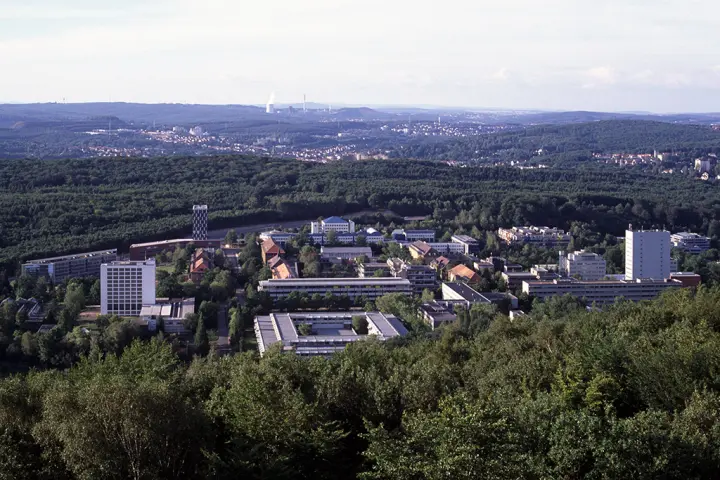
No tuition fee Tuition · sourced 2 years Duration View detailsCampus photos on this page: The original uploader was CAPTN HIRNI at German Wikipedia. (CC BY-SA 3.0) — via Wikimedia Commons.
Physics — FAQs
5 questions
Tuition is No tuition fee. Taken from the university's published fees page, not re-checked since — confirm it before you budget. We confirm the current fee and the scholarships you qualify for — free.
The main intake is Winter semester. Most universities admit on a rolling basis — we confirm the exact deadline for your profile, free.
Admission to the consecutive Master’s degree programme in Physics requires both of the following: a Bachelor’s degree or an equivalent university degree with a focus on physics or a subject closely related to physics specific aptitude for a Master’s programme, which is generally demonstrated by a Bachelor’s degree with an overall grade of 2.5 or better, or by passing an aptitude assessment test For the Physics degree programme, subject-specific competencies are required in the areas of mechanics, electrodynamics and optics, thermodynamics and statistics, atomic and molecular physics, condensed matter physics, nuclear and particle physics, as well as quantum mechanics. The number of credit points earned in lectures and tutorials in experimental physics, theoretical physics, and mathematical foundations should be at least 30 CP in each area. At least 20 CP should have been obtained through physics laboratory courses. English: E.G. IELTS Academic: 6 TOEFL iBT (before 2026): 85 Reading: 18 Listening: 17 Speaking: 20 Writing: 17.
The programme runs about 24 months full-time.
Yes — shortlisting, SOP, LOR, Resume, application, scholarships and visa guidance are all free. We're paid by partner universities, not by you.
Apply to Physics — free help
A counsellor calls you back during office hours — 9am to 8pm IST, Mon to Sat. We are open now.