
Master Border Studies
Saarland University · Saarbrücken, Europe
Duration
24 mo
Tuition
No tuition fee
sourcedIntake
Winter semester
English
—
Winter semester intake. Most universities admit on a rolling basis — we confirm the exact application deadline for your profile, free.
Course details verified 09 Sep 2026 — intakes, entry requirements and course facts · official source
Fee sourced Taken from the university's published fees page, not re-checked since — confirm it before you budget. See the university fees page.
About this programme
Our Master's in Border Studies is a two-year joint international study programme that addresses the complex economic, political, social and cultural issues of borders and of border regions in Europe and beyond. The study programme is designed for students with different disciplinary backgrounds who wish to develop the necessary skills and competencies to work in intercultural and cross-border settings. The multilingual study programme is located in three countries at four different universities: University of Luxembourg (LUX) University of Lorraine (FR) Saarland University (DE) University of Kaiserslautern (DE) Courses in this Master's in Border Studies are taught in German, French and English. Border Studies: Addressing the challenges of the 21st century In the wake of the abolition of regular border controls in Europe and the fall of the iron curtain, the field of Border Studies has opened up new objects of research and has experienced significant growth. At the same time, European societies experience the challenges of new border closures. The Master's programme in Border Studies provides students with the major concepts and analytical tools to understand the social, cultural, political and economic challenges of border regions and cross-border cooperation. Students gain theoretical knowledge of border problems, border cultures, border literatures and constructions of “otherness”. Students acquire the needed skills to play a crucial part in the increasing discussions on national and European identities, worldwide mobilities, migration, cultural diversity, citizenship and cross-border cooperation – especially in the Greater Region. Students may specialise in one of the two tracks: spatial track, including geography and spatial planning language and cultural track, including cultural studies, literature, linguistics, intercultural communication The Master's programme in Border Studies prepares for a career in cross-border and intercultural working settings, especially in border regions in Europe (such as the Greater Region) and beyond. The careers of our graduates show that they find attractive positions very quickly. Some examples from the Greater Region, the home countries of students and throughout Europe include: cross-border cooperation projects cross-border administration higher education institutions national and regional ministries diplomatic service migration services political education international companies journalism academia and research The curriculum covers a full-time two-year programme (120 ECTS) Semester 1 Students spend the first semester at the University of Luxembourg and at the University of Lorraine. They gain knowledge of central concepts and research methods in the study of border regions and are introduced to current debates on border issues from a spatial/geographical and a linguistic, cultural, and sociological perspective. Semester 2 Students spend the second semester mainly at the University of Lorraine as well as at the University of Luxembourg. They further specialise their studies by choosing between one of the two tracks of the programme: spatial studies language and cultural studies Each track consists of one module (12 ECTS) and an elective module selected from the other track (6 ECTS). Students have to accomplish a mandatory internship during the second semester. Semester 3 Students spend the third semester at Saarland University and the University of Kaiserslautern. Students participate in a seven-day excursion, and they work on a case study in cross-border relationships and cooperation. Students deepen their knowledge according to the chosen specialisation in the second semester. Semester 4 The last semester is dedicated to the final Master’s thesis. At the beginning and the end of the fourth semester, a workshop takes place in which students present and discuss their Master’s theses. PDF Download
Intakes & deadlines
Winter semester
Dates confirmed for your profile · Open
Entry requirements
-
English
E.G. Cambridge English Qualifications: B2 First
-
Prerequisites
Applicants must have a Bachelor’s degree or equivalent in the field of anthropology, cultural studies, geography, history, intercultural communication, law, linguistics, political science, sociology or spatial planning. The programme is limited to 20 students. Selection is based on the application documents, which should include a motivation letter, a curriculum vitae, certificates and diplomas of previous studies and proof of written and oral language skills in German, French and English (level B2). You can find more information here: http://www.uni-gr.eu/de/Master_Border_Studies.
-
Documents
SOP, LOR & Resume — generate them free in 2 minutes.
Fees & scholarships
No tuition fee tuition (sourced). We confirm the exact costs and the scholarships you qualify for at Saarland University — free, for your profile.
Other programmes at Saarland University
Bioinformatics
No tuition fee Tuition · sourced 2 years Duration View details SA Saarland UniversityBiophysics
No tuition fee Tuition · sourced 2 years Duration View details SA Saarland UniversityComputer Science (MSc)
No tuition fee Tuition · sourced 2 years Duration View details SA Saarland UniversityCybersecurity (MSc)
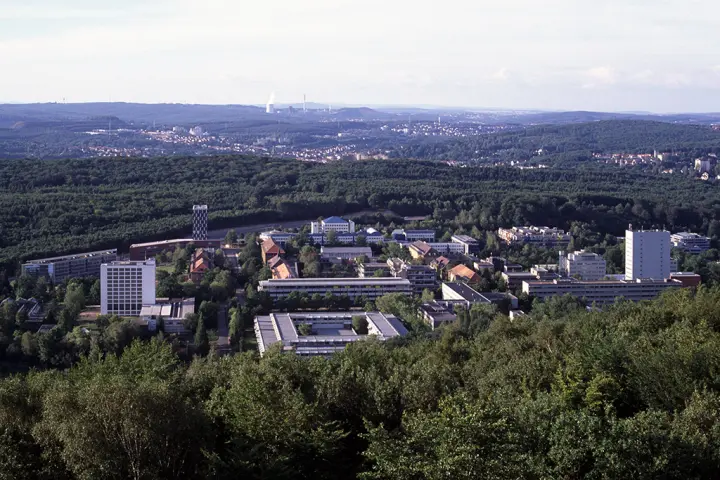
No tuition fee Tuition · sourced 2 years Duration View detailsCampus photos on this page: The original uploader was CAPTN HIRNI at German Wikipedia. (CC BY-SA 3.0) — via Wikimedia Commons.
Master Border Studies — FAQs
5 questions
Tuition is No tuition fee. Taken from the university's published fees page, not re-checked since — confirm it before you budget. We confirm the current fee and the scholarships you qualify for — free.
The main intake is Winter semester. Most universities admit on a rolling basis — we confirm the exact deadline for your profile, free.
Applicants must have a Bachelor’s degree or equivalent in the field of anthropology, cultural studies, geography, history, intercultural communication, law, linguistics, political science, sociology or spatial planning. The programme is limited to 20 students. Selection is based on the application documents, which should include a motivation letter, a curriculum vitae, certificates and diplomas of previous studies and proof of written and oral language skills in German, French and English (level B2). You can find more information here: http://www.uni-gr.eu/de/Master_Border_Studies. English: E.G. Cambridge English Qualifications: B2 First.
The programme runs about 24 months full-time.
Yes — shortlisting, SOP, LOR, Resume, application, scholarships and visa guidance are all free. We're paid by partner universities, not by you.
Apply to Master Border Studies — free help
A counsellor calls you back during office hours — 9am to 8pm IST, Mon to Sat. We are open now.