
Planetary Health
Rheinische Friedrich-Wilhelms-Universität Bonn · Bonn, Europe
Duration
24 mo
Tuition
No tuition fee
sourcedIntake
Winter semester
English
—
Winter semester intake. Most universities admit on a rolling basis — we confirm the exact application deadline for your profile, free.
Course details verified 10 Sep 2026 — intakes, entry requirements and course facts · official source
Fee sourced Taken from the university's published fees page, not re-checked since — confirm it before you budget. See the university fees page.
About this programme
The MSc Planetary Health is a genuinely interdisciplinary degree, by design. The programme structurally prevents siloed learning: regardless of your chosen specialisation (Environmental Health, Human Health, or Societal Health), you are required to take modules in the other two specialisations and in a shared cross-disciplinary area. From day one, you work in interdisciplinary project groups alongside peers from very different academic backgrounds. Students learn about cutting-edge methods to solve pressing global problems. The curriculum includes machine learning and causal inference, spatial data analysis and GIS with R, analytical epidemiology, satellite remote sensing, probabilistic programming, and integrated assessment modelling — all taught in the context of climate change, biodiversity loss, food security, and public health. You graduate fluent in the tools that research and policy organisations actually use. The students are embedded in ongoing research from the start. The programme is directly connected to the University of Bonn's Excellence Cluster PhenoRob and two Collaborative Research Centres focusing on climate and land use change as well as on development and future making in rural areas. Several methodology courses were developed specifically by these research groups to give students early access to frontier methods. The thesis semester (30 ECTS) can be conducted within these networks, providing you with experience in applied problem-focused research. The MSc Planetary Health opens doors across academia, policy, and the private sector. The degree signals both disciplinary depth (your major specialisation appears on the certificate) and cross-disciplinary competence — making you competitive for PhD programmes in multiple fields as well as roles in international organisations, public health agencies, environmental NGOs, and sustainable business. The MSc Planetary Health is entirely taught in English and is explicitly designed for an international career. This is a two-year (120 ECTS) MSc programme with a thesis, organised for students with a Bachelor's degree in Agricultural Sciences, Agribusiness, Agricultural Management, Agricultural Economics, Nutritional Economics, Nutrition and Food Sciences, Economics, Geography, Biology, Ecology, Environmental Sciences, Human Medicine, or a related discipline. The study programme is instructed in English and organised in modules, which usually consist of units within a semester that have a thematic, methodical or systematic link. The first semester is dedicated to "learning interdisciplinarity", in the field of Planetary Health (30 ECTS), through compulsory courses. In the second and third semesters, the students choose a field of specialisation and deepen their disciplinary knowledge in their chosen field (30 ECTS), whilst further nurturing their knowledge of methods or concepts across specialisations (30 ECTS). All courses in the second and third semesters are selected by the students from a large pool of elective courses. The final semester is devoted to the Master's thesis (30 ECTS), which is written within the field of specialisation. The fields of specialisations are: Environmental Health: Students learn how to systematically analyse and assess the impacts of human activities on environmental factors such as air and water quality, climate change, biodiversity loss, and pollution levels. Human Health: Students acquire the ability to recognise interactions between environmental changes and both individual and population health, and to evaluate their influence on diseases. Societal Health: Students develop a systemic understanding of the interactions between societal, political, and economic frameworks and their influence on human use of the environment and resources.
Intakes & deadlines
Winter semester
Dates confirmed for your profile · Open
Entry requirements
-
English
E.G. IELTS Academic: 6.5 TOEFL iBT Home Edition (before 2026): 90 Reading: 20 Listening: 20 Speaking: 20 Writing: 20 Cambridge English Qualifications: B2 First
-
Prerequisites
The consecutive Master’s degree programme in "Planetary Health" is aimed at applicants who, as an admission requirement, can demonstrate a first professionally qualifying university degree in Agricultural Sciences, Agribusiness, Agricultural Management, Agricultural Economics, Nutritional Economics, Nutrition and Food Sciences, Economics, Geography, Biology, Ecology, Environmental Sciences, Human Medicine, or a related field. The Examination Board determines which degrees are considered to be in a related field. The qualifying (Bachelor's or equivalent) university degree for the MSc Planetary Health must demonstrate a minimum average grade of 2.5 or a comparable classification under another grading system. Enrolment in the programme may be granted prior to fulfilment of the admission requirements if applicants: At the time of application for the Master’s programme, can demonstrate that they have already earned 150 ECTS credits in the course of study leading to the first professionally qualifying university degree; and Have completed all examinations required for the successful completion of the degree programme leading to the first professionally qualifying university degree in the semester prior to commencing the Master’s programme.
-
Documents
SOP, LOR & Resume — generate them free in 2 minutes.
Fees & scholarships
No tuition fee tuition (sourced). We confirm the exact costs and the scholarships you qualify for at Rheinische Friedrich-Wilhelms-Universität Bonn — free, for your profile.
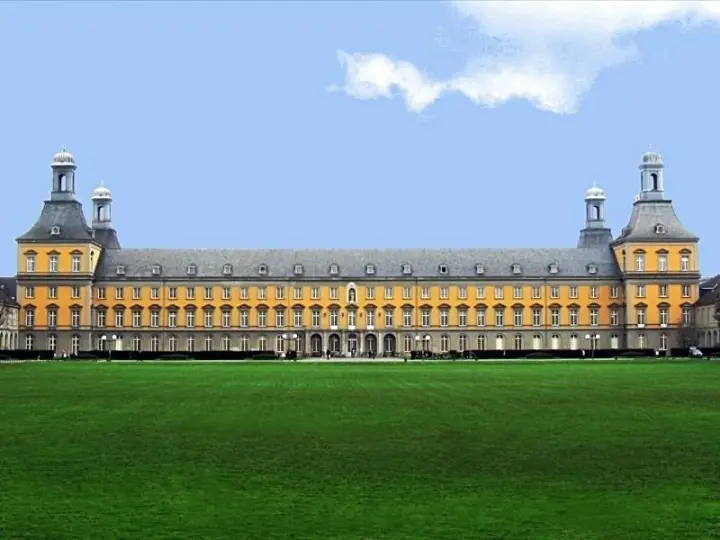
Other programmes at Rheinische Friedrich-Wilhelms-Universität Bonn
Agricultural and Food Economics (AFECO)
No tuition fee Tuition · sourced 2 years Duration View details RFW Rheinische Friedrich-Wilhelms-Universität BonnAgricultural Sciences and Resource Management in the Tropics and Subtropics (ARTS)
No tuition fee Tuition · sourced 2 years Duration View details RFW Rheinische Friedrich-Wilhelms-Universität BonnAnthropology of the Americas
No tuition fee Tuition · sourced 2 years Duration View details RFW Rheinische Friedrich-Wilhelms-Universität BonnApplied Linguistics
No tuition fee Tuition · sourced 2 years Duration View detailsCampus photos on this page: Daniel Tibi (Dti) | daniel-tibi.de (Public domain) — via Wikimedia Commons.
Planetary Health — FAQs
5 questions
Tuition is No tuition fee. Taken from the university's published fees page, not re-checked since — confirm it before you budget. We confirm the current fee and the scholarships you qualify for — free.
The main intake is Winter semester. Most universities admit on a rolling basis — we confirm the exact deadline for your profile, free.
The consecutive Master’s degree programme in "Planetary Health" is aimed at applicants who, as an admission requirement, can demonstrate a first professionally qualifying university degree in Agricultural Sciences, Agribusiness, Agricultural Management, Agricultural Economics, Nutritional Economics, Nutrition and Food Sciences, Economics, Geography, Biology, Ecology, Environmental Sciences, Human Medicine, or a related field. The Examination Board determines which degrees are considered to be in a related field. The qualifying (Bachelor's or equivalent) university degree for the MSc Planetary Health must demonstrate a minimum average grade of 2.5 or a comparable classification under another grading system. Enrolment in the programme may be granted prior to fulfilment of the admission requirements if applicants: At the time of application for the Master’s programme, can demonstrate that they have already earned 150 ECTS credits in the course of study leading to the first professionally qualifying university degree; and Have completed all examinations required for the successful completion of the degree programme leading to the first professionally qualifying university degree in the semester prior to commencing the Master’s programme. English: E.G. IELTS Academic: 6.5 TOEFL iBT Home Edition (before 2026): 90 Reading: 20 Listening: 20 Speaking: 20 Writing: 20 Cambridge English Qualifications: B2 First.
The programme runs about 24 months full-time.
Yes — shortlisting, SOP, LOR, Resume, application, scholarships and visa guidance are all free. We're paid by partner universities, not by you.
Apply to Planetary Health — free help
A counsellor calls you back during office hours — 9am to 8pm IST, Mon to Sat. We are open now.