
Neurosciences
Rheinische Friedrich-Wilhelms-Universität Bonn · Bonn, Europe
Duration
24 mo
Tuition
No tuition fee
sourcedIntake
Winter semester
English
—
Winter semester intake. Most universities admit on a rolling basis — we confirm the exact application deadline for your profile, free.
Course details verified 10 Sep 2026 — intakes, entry requirements and course facts · official source
Fee sourced Taken from the university's published fees page, not re-checked since — confirm it before you budget. See the university fees page.
About this programme
The MSc Neurosciences programme aims towards an integrated understanding of modern neurosciences over the full spectrum of current research, ranging from molecules and physiology to morphology. A strong emphasis is placed on practical research experience in the laboratories of the participating departments and research groups. Mandatory courses on neuromorphology, neurophysiology, and molecular neurobiology will lay the foundation in the first semester. At the same time, students will have the opportunity to focus their interests on any of these fields or select from a wide spectrum of courses addressing topics such as neuroethology, neurogenetics, clinical neurosciences, cognitive neurosciences, reconstructive neurobiology, neurodegenerative diseases, computational neurosciences, etc. For up-to-date information, see: https://www.neurosciences.uni-bonn.de/. The MSc Neurosciences course programme is consistently modularised according to the European Credit Transfer System (ECTS). A total of 120 credit points (30 per semester) will be accumulated during two years of study. For maximum choice and compatibility, the curriculum is divided into modules, combining courses, lectures, seminars, and laboratory work. During the first semester, three compulsory modules (7.5 credit points [CP] each) provide the basics of neuroscience. Additionally, students have to choose one elective module (7.5 CP each) during their first semester. In the second semester, a fourth compulsory module propagates knowledge in statistics, scientific writing, and research ethics. Three elective modules (7.5 CP each) from different research fields complete the second semester. In the third semester, students have to select two elective practical courses (lab rotations, 15 CP each). Finally, in the fourth semester, the programme is completed by writing the Master's thesis (30 CP). For details and current information, see: https://www.neurosciences.uni-bonn.de/curriculum. PDF Download
Intakes & deadlines
Winter semester
Dates confirmed for your profile · Open
Entry requirements
-
English
E.G. TOEFL iBT Home Edition (before 2026): 79 Reading: 19 Listening: 19 Speaking: 19 Writing: 19 TOEFL iBT (before 2026): 79 Reading: 19 Listening: 19 Speaking: 19 Writing: 19 UNIcert® English: UNIcert® II IELTS Academic: 6 Cambridge English Qualifications: B2 First
-
Prerequisites
The programme is open to both domestic and international students. Applicants must hold a Bachelor's degree or higher in biology, psychology, medicine, physics, or related fields with outstanding grades and/or other study results. Solid knowledge in subjects such as molecular biology, cell biology, or physiology, as well as laboratory experience in at least one of these subjects, is required as an entrance requirement. To have a realistic chance of acceptance, you will need to have an average Bachelor's result of at least 78% (in a grading system with a passing level of 50%). The minimum grade for the application is 2.3 in the German grading system.
-
Documents
SOP, LOR & Resume — generate them free in 2 minutes.
Fees & scholarships
No tuition fee tuition (sourced). We confirm the exact costs and the scholarships you qualify for at Rheinische Friedrich-Wilhelms-Universität Bonn — free, for your profile.
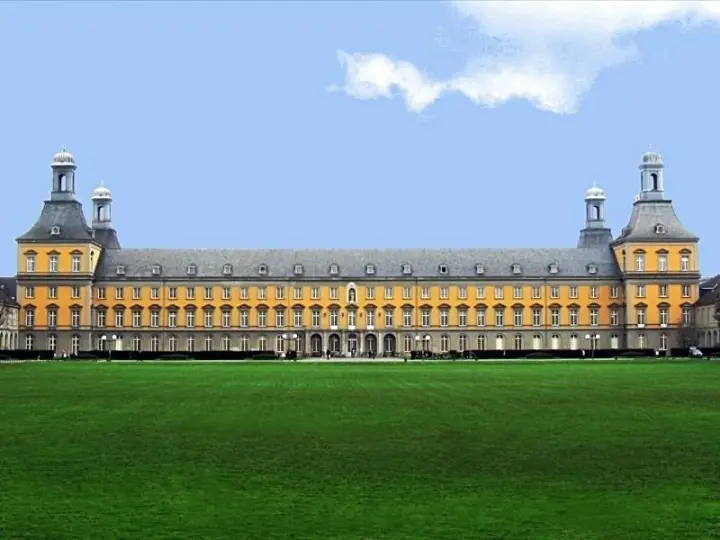
Other programmes at Rheinische Friedrich-Wilhelms-Universität Bonn
Agricultural and Food Economics (AFECO)
No tuition fee Tuition · sourced 2 years Duration View details RFW Rheinische Friedrich-Wilhelms-Universität BonnAgricultural Sciences and Resource Management in the Tropics and Subtropics (ARTS)
No tuition fee Tuition · sourced 2 years Duration View details RFW Rheinische Friedrich-Wilhelms-Universität BonnAnthropology of the Americas
No tuition fee Tuition · sourced 2 years Duration View details RFW Rheinische Friedrich-Wilhelms-Universität BonnApplied Linguistics
No tuition fee Tuition · sourced 2 years Duration View detailsCampus photos on this page: Daniel Tibi (Dti) | daniel-tibi.de (Public domain) — via Wikimedia Commons.
Neurosciences — FAQs
5 questions
Tuition is No tuition fee. Taken from the university's published fees page, not re-checked since — confirm it before you budget. We confirm the current fee and the scholarships you qualify for — free.
The main intake is Winter semester. Most universities admit on a rolling basis — we confirm the exact deadline for your profile, free.
The programme is open to both domestic and international students. Applicants must hold a Bachelor's degree or higher in biology, psychology, medicine, physics, or related fields with outstanding grades and/or other study results. Solid knowledge in subjects such as molecular biology, cell biology, or physiology, as well as laboratory experience in at least one of these subjects, is required as an entrance requirement. To have a realistic chance of acceptance, you will need to have an average Bachelor's result of at least 78% (in a grading system with a passing level of 50%). The minimum grade for the application is 2.3 in the German grading system. English: E.G. TOEFL iBT Home Edition (before 2026): 79 Reading: 19 Listening: 19 Speaking: 19 Writing: 19 TOEFL iBT (before 2026): 79 Reading: 19 Listening: 19 Speaking: 19 Writing: 19 UNIcert® English: UNIcert® II IELTS Academic: 6 Cambridge English Qualifications: B2 First.
The programme runs about 24 months full-time.
Yes — shortlisting, SOP, LOR, Resume, application, scholarships and visa guidance are all free. We're paid by partner universities, not by you.
Apply to Neurosciences — free help
A counsellor calls you back during office hours — 9am to 8pm IST, Mon to Sat. We are open now.