
Molecular Cell Biology
Rheinische Friedrich-Wilhelms-Universität Bonn · Bonn, Europe
Duration
24 mo
Tuition
No tuition fee
sourcedIntake
Winter semester
English
—
Winter semester intake. Most universities admit on a rolling basis — we confirm the exact application deadline for your profile, free.
Course details verified 10 Sep 2026 — intakes, entry requirements and course facts · official source
Fee sourced Taken from the university's published fees page, not re-checked since — confirm it before you budget. See the university fees page.
About this programme
All biological processes have molecular foundations that we need to understand in order to understand life itself and to understand the causes of many diseases. Organisms represent the highest form of organisation and are highly complex living systems. They are capable of growing, metabolising nutrients, and usually reproducing. They can be investigated from the molecular level over the cellular level up to a whole organ. The aim of the Molecular Cell Biology programme is to provide deep insights into these processes. The students get an overview of a wide range of modern cell biological, biochemical, genetic and computer-aided methods and are thus able to answer fundamental questions of biology and medical research. The settlement of the Master's programme in three faculties (the mathematics and natural sciences, the medical and the agricultural faculty) opens up a unique spectrum of thematic orientations and possible elective modules. It is an explicit wish and aim of the Master's programme to enable graduates to start a PhD study programme directly afterwards. Possible professional fields: Basic research in all areas of life sciences as well as in (bio)medical research (institutes of the Max Planck Institute and large research institutions, etc.), executive activity in the pharmaceutical industry, science (teaching/research at universities, research institutions, etc.) In the first semester, basic biochemistry, molecular genetics, developmental biology and physiology, molecular cell biology, biophysics and statistics are studied in depth. The practical component involves mandatory basic courses conducted in laboratories at the University of Bonn to enhance practical laboratory skills. In the second semester, students work on small scientific projects in one of our research laboratories at the Faculty of Biology, Medicine or Agriculture. In addition, soft skills such as scientific writing and presentation skills are taught. Through participation in the Journal Club and the Teachers' Seminar, students gain insights into the latest research projects. The third semester, oriented towards practical experience, consists of two lab rotations and a project exchange, enabling students to pursue internships outside the university. Furthermore, students practice presentation skills by delivering their own project presentations during student presentations. In the final semester, students can dedicate their full attention to the Master's thesis. PDF Download
Intakes & deadlines
Winter semester
Dates confirmed for your profile · Open
Entry requirements
-
English
E.G. PTE Academic: 59 TOEFL iBT (before 2026): 72 Reading: 18 Listening: 17 Speaking: 20 Writing: 17 IELTS Academic: 5.5
-
Prerequisites
University degree (German or non-German) in a relevant discipline Minimum grade of 2.7 or local equivalent Practical knowledge in biochemistry, molecular biology, microbiology and cell biology at the level of the Bachelor of Biology with 5 ECTS each (total 20 ECTS) or an equivalent form of proof
-
Documents
SOP, LOR & Resume — generate them free in 2 minutes.
Fees & scholarships
No tuition fee tuition (sourced). We confirm the exact costs and the scholarships you qualify for at Rheinische Friedrich-Wilhelms-Universität Bonn — free, for your profile.
Other programmes at Rheinische Friedrich-Wilhelms-Universität Bonn
Agricultural and Food Economics (AFECO)
No tuition fee Tuition · sourced 2 years Duration View details RFW Rheinische Friedrich-Wilhelms-Universität BonnAgricultural Sciences and Resource Management in the Tropics and Subtropics (ARTS)
No tuition fee Tuition · sourced 2 years Duration View details RFW Rheinische Friedrich-Wilhelms-Universität BonnAnthropology of the Americas
No tuition fee Tuition · sourced 2 years Duration View details RFW Rheinische Friedrich-Wilhelms-Universität BonnApplied Linguistics
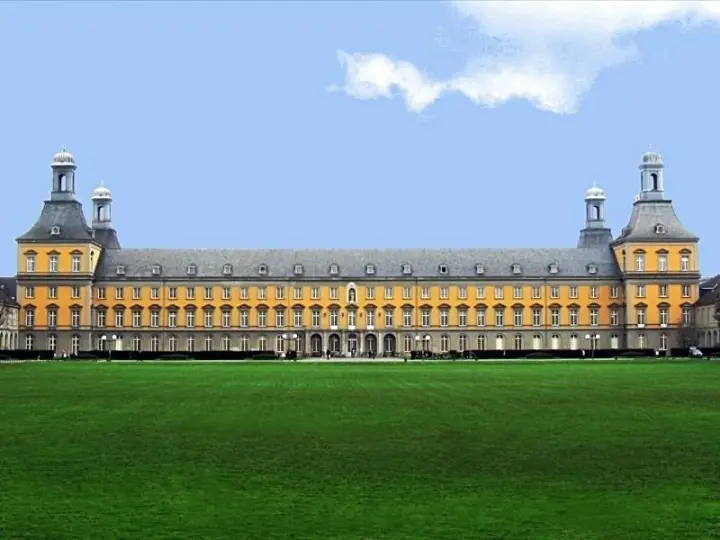
No tuition fee Tuition · sourced 2 years Duration View detailsCampus photos on this page: Daniel Tibi (Dti) | daniel-tibi.de (Public domain) — via Wikimedia Commons.
Molecular Cell Biology — FAQs
5 questions
Tuition is No tuition fee. Taken from the university's published fees page, not re-checked since — confirm it before you budget. We confirm the current fee and the scholarships you qualify for — free.
The main intake is Winter semester. Most universities admit on a rolling basis — we confirm the exact deadline for your profile, free.
University degree (German or non-German) in a relevant discipline Minimum grade of 2.7 or local equivalent Practical knowledge in biochemistry, molecular biology, microbiology and cell biology at the level of the Bachelor of Biology with 5 ECTS each (total 20 ECTS) or an equivalent form of proof English: E.G. PTE Academic: 59 TOEFL iBT (before 2026): 72 Reading: 18 Listening: 17 Speaking: 20 Writing: 17 IELTS Academic: 5.5.
The programme runs about 24 months full-time.
Yes — shortlisting, SOP, LOR, Resume, application, scholarships and visa guidance are all free. We're paid by partner universities, not by you.
Apply to Molecular Cell Biology — free help
A counsellor calls you back during office hours — 9am to 8pm IST, Mon to Sat. We are open now.