
Medical Immunosciences and Infection
Rheinische Friedrich-Wilhelms-Universität Bonn · Bonn, Europe
Duration
24 mo
Tuition
No tuition fee
sourcedIntake
Winter semester
English
—
Winter semester intake. Most universities admit on a rolling basis — we confirm the exact application deadline for your profile, free.
Course details verified 10 Sep 2026 — intakes, entry requirements and course facts · official source
Fee sourced Taken from the university's published fees page, not re-checked since — confirm it before you budget. See the university fees page.
About this programme
The Master's programme in "Medical Immunosciences and Infection" at the Medical Faculty of the University of Bonn is a two-year, research-oriented, international study programme. It aims to immerse students in the fields of translational immunology and infectious diseases and to equip them with all of the essential skills for independent scientific work and a successful research career in academia and industry. The course content focuses on the underlying molecular mechanisms of immune-mediated, inflammatory and infectious diseases and the development of new immunomodulatory approaches for their treatment. Current concepts of immunology and infectious disease research will be discussed in lectures and literature seminars and can be directly applied to individual research projects. These research projects can be performed within the highly competitive and interdisciplinary research groups at the University Hospital Bonn, associated institutes or other national or international research institutions. The Master's course of study is part of the educational and training concept of the Bonn Cluster of Excellence ImmunoSensation3, which is a collaborative endeavour between the major centres of immunological research in Bonn: the Faculty of Medicine, the Faculty of Mathematics / Natural Sciences (Department of Life and Medical Sciences) and the DZNE (German Center for Neurodegenerative Diseases). Through their association with the Cluster of Excellence ImmunoSensation3, students will have access to a wide variety of scientific courses, technical platforms and interdisciplinary local and international research groups. In addition, the scientific interactions within the cluster provide an unparalleled atmosphere of scientific exchange in which students will have contact with renowned experts in the field of innate immunity. Career opportunities: ImmunoSensation3 has developed a PhD student training programme, which has evolved into the Bonn International Graduate School Immunosciences and Infection (BIGS Immunosciences and Infection). This graduate school is closely associated with the Master's programme and offers a unique platform in collaboration with PhD students in the fields of immunology and infectious diseases in Bonn. The Master's programme is structured into thematically related and self-contained modules. Elective compulsory modules allow students to set their individual research priorities. Modules consist of lectures, workshops, practical courses and individual research projects. Lectures (first and second semester): The compulsory lectures in the first two semesters will provide in-depth education on the underlying mechanisms and treatment of diseases. They train in scientific writing and soft skills. Topics Immunology: components of the immune system, immunophysiology, immunogenetics, immune response Infection: virology, microbiology, treatment of infectious diseases, microbiome, basics in clinical diagnostic, pathogen to host interaction, clinical infectiology Clinical Immunology and Immunopharmacology: basic anatomy, immunopharmacology, immune diagnostics, fundamentals of clinical trials, general principles of inflammatory and immune-mediated diseases, transplantation, translational immunology, fundamentals of tumour immunology, rheumatology, anti-infective treatment Methods in Life Sciences and Statistics Ethical and Regulatory Aspects in Live Science and Scientific Presentation Elective lectures: These elective compulsory modules allow students to set their individual research priorities. Students choose at least one. Topics Developmental neurobiology Cellular neurobiology of disease Immunometabolism Immuno-oncology Introduction to molecular biology and biochemistry Nucleic acid recognition in antiviral innate immunity and autoinflammation T cell function Extracellular vesicles in innate immunity Practical course: Extracellular vesicles in innate immunity and virally-induced G4 structures Practical course: Insights
Intakes & deadlines
Winter semester
Dates confirmed for your profile · Open
Entry requirements
-
English
E.G. UNIcert® English: UNIcert® II PTE Academic: 59 telc English: telc English B2 Cambridge English Qualifications: B2 First TOEFL iBT (before 2026): 72 Reading: 18 Listening: 17 Speaking: 20 Writing: 17 IELTS Academic: 5.5
-
Prerequisites
Applicants should have completed a qualifying degree (e.g. Bachelor's degree) from a European or foreign college or university in the fields of (Molecular) Biomedicine, Biochemistry, Medical Biology, Biology, Human Biology or in a related life sciences field. The degree must have been completed with the German grade 2.3 /good (In the German grading system, 1.0 [very good] is the best, 2.0 [good] and 4.0 is considered sufficient to pass.) Applicants who have not yet completed their Bachelor's degrees must prove a current grade of 2.0 (German system). Prerequisite courses include: - 30 ECTS (European Credit Transfer and Accumulation System credit points) in total in Immunology, Pharmacology, Biochemistry, Anatomy or Physiology - 30 ECTS in total in subjects like Chemistry, Genetics, Developmental Biology, Molecular Biology, Cell Biology or Microbiology In addition, the final thesis written as part of the first higher education degree must be a text based on a practical wet lab experiment; students in a degree programme whose curriculum does not include a thesis are required to provide proof of practical experience working in a research laboratory worth at least 15 ECTS. A transcript of records with achieved grades has to be included in the application. More details about our entry requirements and the selection procedure can be found on our website.
-
Documents
SOP, LOR & Resume — generate them free in 2 minutes.
Fees & scholarships
No tuition fee tuition (sourced). We confirm the exact costs and the scholarships you qualify for at Rheinische Friedrich-Wilhelms-Universität Bonn — free, for your profile.
Other programmes at Rheinische Friedrich-Wilhelms-Universität Bonn
Agricultural and Food Economics (AFECO)
No tuition fee Tuition · sourced 2 years Duration View details RFW Rheinische Friedrich-Wilhelms-Universität BonnAgricultural Sciences and Resource Management in the Tropics and Subtropics (ARTS)
No tuition fee Tuition · sourced 2 years Duration View details RFW Rheinische Friedrich-Wilhelms-Universität BonnAnthropology of the Americas
No tuition fee Tuition · sourced 2 years Duration View details RFW Rheinische Friedrich-Wilhelms-Universität BonnApplied Linguistics
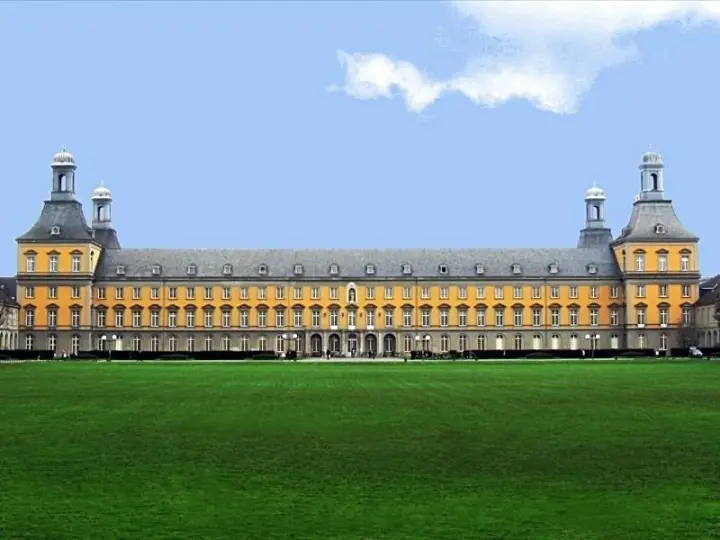
No tuition fee Tuition · sourced 2 years Duration View detailsCampus photos on this page: Daniel Tibi (Dti) | daniel-tibi.de (Public domain) — via Wikimedia Commons.
Medical Immunosciences and Infection — FAQs
5 questions
Tuition is No tuition fee. Taken from the university's published fees page, not re-checked since — confirm it before you budget. We confirm the current fee and the scholarships you qualify for — free.
The main intake is Winter semester. Most universities admit on a rolling basis — we confirm the exact deadline for your profile, free.
Applicants should have completed a qualifying degree (e.g. Bachelor's degree) from a European or foreign college or university in the fields of (Molecular) Biomedicine, Biochemistry, Medical Biology, Biology, Human Biology or in a related life sciences field. The degree must have been completed with the German grade 2.3 /good (In the German grading system, 1.0 [very good] is the best, 2.0 [good] and 4.0 is considered sufficient to pass.) Applicants who have not yet completed their Bachelor's degrees must prove a current grade of 2.0 (German system). Prerequisite courses include: - 30 ECTS (European Credit Transfer and Accumulation System credit points) in total in Immunology, Pharmacology, Biochemistry, Anatomy or Physiology - 30 ECTS in total in subjects like Chemistry, Genetics, Developmental Biology, Molecular Biology, Cell Biology or Microbiology In addition, the final thesis written as part of the first higher education degree must be a text based on a practical wet lab experiment; students in a degree programme whose curriculum does not include a thesis are required to provide proof of practical experience working in a research laboratory worth at least 15 ECTS. A transcript of records with achieved grades has to be included in the application. More details about our entry requirements and the selection procedure can be found on our website. English: E.G. UNIcert® English: UNIcert® II PTE Academic: 59 telc English: telc English B2 Cambridge English Qualifications: B2 First TOEFL iBT (before 2026): 72 Reading: 18 Listening: 17 Speaking: 20 Writing: 17 IELTS Academic: 5.5.
The programme runs about 24 months full-time.
Yes — shortlisting, SOP, LOR, Resume, application, scholarships and visa guidance are all free. We're paid by partner universities, not by you.
Apply to Medical Immunosciences and Infection — free help
A counsellor calls you back during office hours — 9am to 8pm IST, Mon to Sat. We are open now.