
Economics
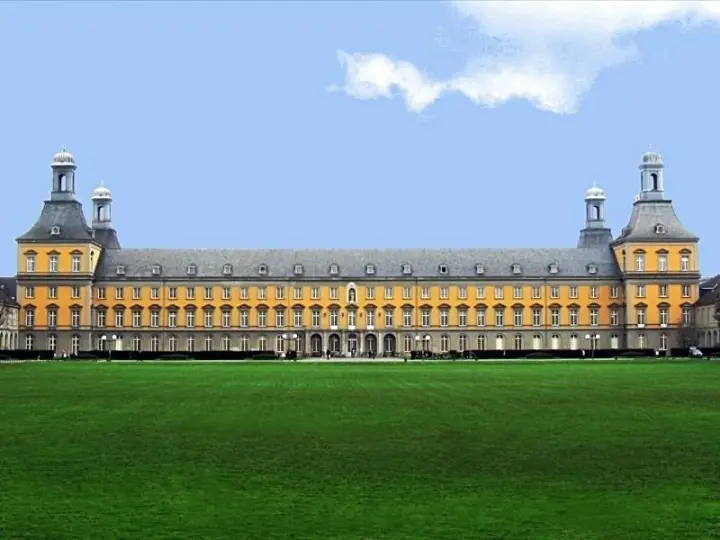
Rheinische Friedrich-Wilhelms-Universität Bonn · Bonn, Europe
Duration
24 mo
Tuition
No tuition fee
sourcedIntake
Winter semester
English
—
Winter semester intake. Most universities admit on a rolling basis — we confirm the exact application deadline for your profile, free.
Course details verified 10 Sep 2026 — intakes, entry requirements and course facts · official source
Fee sourced Taken from the university's published fees page, not re-checked since — confirm it before you budget. See the university fees page.
About this programme
The Master of Science programme in Economics at the University of Bonn prepares graduates for academic careers as well as for leading positions in institutions and companies that demand advanced analytical skills. This quantitative and research-focused programme offers a great combination of rigorous training in core areas of economics with the opportunity for individual specialisations. Students also benefit from the chance to conduct research under the guidance of internationally renowned experts in the field. The programme familiarises students with current topics and debates in economic research, enabling them to understand complex economic models and to critically evaluate the relevance and limitations of economic theories. Students develop advanced mathematical, statistical and econometric skills alongside practical programming techniques relevant for economic analysis. Through intensive coursework and research opportunities, students gain the ability to critically analyse economic research and pursue their own research interests. They collaborate with a highly motivated and diverse cohort of peers from more than 20 countries, making the programme an enriching international experience. Furthermore, Bonn’s numerous research institutes offer valuable job opportunities, allowing students to gain practical, hands-on experience in economic research. Various German federal offices, agencies and ministries, as well as international organisations, such as the UN, and well-known companies, such as Deutsche Telekom and Deutsche Post offer additional job opportunities. The programme includes both research-oriented and more applied courses, helping students make informed decisions about the study fields they want to specialise in. Students can choose from a broad range of advanced courses in the following areas: Microeconomic Theory Macroeconomics and Public Economics Management and Applied Microeconomics Financial Economics Econometrics and Statistics Economic Research Examples of advanced modules include Dynamic Methods and Applications, Economics of Contracts and Information, Game Theory, Growth and Development Economics, International Economics and Finance, Behavioural Economics, Environmental Economics, Asset Pricing, Banking and Securitisation, Computational Statistics and Effective Programming Practices for Economists. In the MSc programme in Economics, students acquire a total of 120 ECTS – with 30 credits earned from basic modules, 60 from advanced modules (including a research seminar of 15 ECTS) and 30 from the Master's thesis. Both basic and advanced modules are taught as lectures and are worth 7.5 ECTS each. In the first semester, students attend the mandatory course "Mathematics for Economists" and select three (out of four) basic modules in Microeconomics, Macroeconomics, Finance and Econometrics, depending on their preferences. These basic modules are designed to strengthen the knowledge gained during students' Bachelor's studies, while at the same time laying a strong groundwork for the more specialised courses that follow. Mathematics for Economists provides students with a solid foundation in real analysis, difference and differential equations, dynamic optimisation, and formal proof writing. The other basic modules deepen students' understanding of the core concepts and models that underpin modern economics, with an emphasis on the mathematical and econometric techniques and tools that are needed in order to deal with them effectively. In the second and third semesters, students shape their individual academic profile by selecting advanced modules across at least two and up to four different areas of economics. Depending on the course choice, they will further deepen their theoretical knowledge, apply familiar concepts to current real-world issues and/or gain hands-on experience with software tools such as MATLAB, R, Python, and Stata. A key element of the third semester is the Research Module, in which student
Intakes & deadlines
Winter semester
Dates confirmed for your profile · Open
Entry requirements
-
English
E.G. TOEFL iBT (since 2026): 4.5 TOEFL iBT Home Edition (before 2026): 87 TOEFL iBT Home Edition (since 2026): 4.5 Cambridge English Qualifications: B2 First IELTS Academic: 6 UNIcert® English: UNIcert® II
-
Prerequisites
Bachelor of Science (BSc) degree in economics or an equivalent degree with a final grade that converts into the German grade "good" (2.3) or better a solid background in mathematics (differential and integral calculus, linear algebra), statistics (descriptive and inferential statistics) and econometrics
-
Documents
SOP, LOR & Resume — generate them free in 2 minutes.
Fees & scholarships
No tuition fee tuition (sourced). We confirm the exact costs and the scholarships you qualify for at Rheinische Friedrich-Wilhelms-Universität Bonn — free, for your profile.
Other programmes at Rheinische Friedrich-Wilhelms-Universität Bonn
Agricultural and Food Economics (AFECO)
No tuition fee Tuition · sourced 2 years Duration View details RFW Rheinische Friedrich-Wilhelms-Universität BonnAgricultural Sciences and Resource Management in the Tropics and Subtropics (ARTS)
No tuition fee Tuition · sourced 2 years Duration View details RFW Rheinische Friedrich-Wilhelms-Universität BonnAnthropology of the Americas
No tuition fee Tuition · sourced 2 years Duration View details RFW Rheinische Friedrich-Wilhelms-Universität BonnApplied Linguistics
No tuition fee Tuition · sourced 2 years Duration View detailsCampus photos on this page: Daniel Tibi (Dti) | daniel-tibi.de (Public domain) — via Wikimedia Commons.
Economics — FAQs
5 questions
Tuition is No tuition fee. Taken from the university's published fees page, not re-checked since — confirm it before you budget. We confirm the current fee and the scholarships you qualify for — free.
The main intake is Winter semester. Most universities admit on a rolling basis — we confirm the exact deadline for your profile, free.
Bachelor of Science (BSc) degree in economics or an equivalent degree with a final grade that converts into the German grade "good" (2.3) or better a solid background in mathematics (differential and integral calculus, linear algebra), statistics (descriptive and inferential statistics) and econometrics English: E.G. TOEFL iBT (since 2026): 4.5 TOEFL iBT Home Edition (before 2026): 87 TOEFL iBT Home Edition (since 2026): 4.5 Cambridge English Qualifications: B2 First IELTS Academic: 6 UNIcert® English: UNIcert® II.
The programme runs about 24 months full-time.
Yes — shortlisting, SOP, LOR, Resume, application, scholarships and visa guidance are all free. We're paid by partner universities, not by you.
Apply to Economics — free help
A counsellor calls you back during office hours — 9am to 8pm IST, Mon to Sat. We are open now.