
Bonn-Cologne Graduate School of Physics and Astronomy: MSc in Astrophysics
Rheinische Friedrich-Wilhelms-Universität Bonn · Bonn, Europe
Duration
24 mo
Tuition
No tuition fee
sourcedIntake
Winter semester
English
—
Winter semester intake. Most universities admit on a rolling basis — we confirm the exact application deadline for your profile, free.
Course details verified 10 Sep 2026 — intakes, entry requirements and course facts · official source
Fee sourced Taken from the university's published fees page, not re-checked since — confirm it before you budget. See the university fees page.
About this programme
The Bonn-Cologne Graduate School of Physics and Astronomy (BCGS) is a joint programme of graduate studies between the Universities of Bonn and Cologne. It was funded through the Excellence Initiative from 2007 to 2019. The Master's programme provides a thorough research-oriented scientific education in the field of astrophysics and cosmology. The students learn how to tackle astrophysical problems and solve them using scientific methods, possibly going beyond the current state of knowledge. In addition, courses broadening their expertise into neighbouring, related fields enable the students to understand interdisciplinary contexts. All graduate studies (for Master and PhD) at our department are coordinated by the Bonn-Cologne Graduate School of Physics and Astronomy (BCGS). The Bonn-Cologne Graduate School of Physics and Astronomy, a joint programme of graduate studies between the Universities of Bonn and Cologne, leads students with a Bachelor's degree in physics (or a related subject) through an MSc phase and for the most successful students, to doctoral studies. The Master's programme includes one year of coursework: compulsory theoretical and experimental lecture courses and laboratory work, specialisation courses, elective advanced lectures and seminars in the fields of theoretical or experimental particle physics, condensed matter and photonics. During the second year, work on a research-oriented thesis is required, including project planning.
Intakes & deadlines
Winter semester
Dates confirmed for your profile · Open
Entry requirements
-
English
E.G. TOEFL iBT (since 2026): 4 Reading: 4 Listening: 4 Speaking: 4 Writing: 4 TOEFL iBT (before 2026): 72 Reading: 18 Listening: 17 Speaking: 20 Writing: 17 IELTS Academic: 5 Cambridge English Qualifications: B2 First
-
Prerequisites
A qualified BSc degree (or equivalent) in physics (or related fields) is required, including 15 ECTS from experimental physics (atomic, molecular, solid-state, nuclear and/or particle physics) and 15 ECTS from theoretical physics (quantum mechanics and statistical physics) as well as 15 ECTS from lab courses. For the MSc programme in Astrophysics, it is certainly helpful, but not mandatory, to have taken an introductory course in astronomy and/or astrophysics.
-
Documents
SOP, LOR & Resume — generate them free in 2 minutes.
Fees & scholarships
No tuition fee tuition (sourced). We confirm the exact costs and the scholarships you qualify for at Rheinische Friedrich-Wilhelms-Universität Bonn — free, for your profile.
Other programmes at Rheinische Friedrich-Wilhelms-Universität Bonn
Agricultural and Food Economics (AFECO)
No tuition fee Tuition · sourced 2 years Duration View details RFW Rheinische Friedrich-Wilhelms-Universität BonnAgricultural Sciences and Resource Management in the Tropics and Subtropics (ARTS)
No tuition fee Tuition · sourced 2 years Duration View details RFW Rheinische Friedrich-Wilhelms-Universität BonnAnthropology of the Americas
No tuition fee Tuition · sourced 2 years Duration View details RFW Rheinische Friedrich-Wilhelms-Universität BonnApplied Linguistics
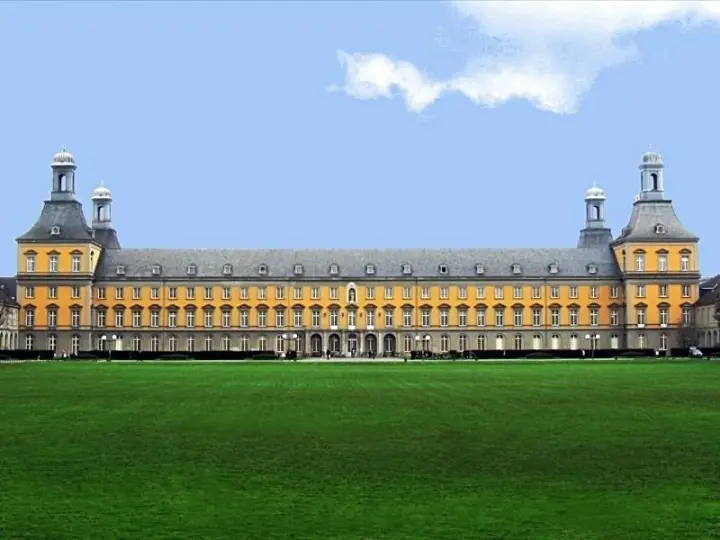
No tuition fee Tuition · sourced 2 years Duration View detailsCampus photos on this page: Daniel Tibi (Dti) | daniel-tibi.de (Public domain) — via Wikimedia Commons.
Bonn-Cologne Graduate School of Physics and Astronomy: MSc in Astrophysics — FAQs
5 questions
Tuition is No tuition fee. Taken from the university's published fees page, not re-checked since — confirm it before you budget. We confirm the current fee and the scholarships you qualify for — free.
The main intake is Winter semester. Most universities admit on a rolling basis — we confirm the exact deadline for your profile, free.
A qualified BSc degree (or equivalent) in physics (or related fields) is required, including 15 ECTS from experimental physics (atomic, molecular, solid-state, nuclear and/or particle physics) and 15 ECTS from theoretical physics (quantum mechanics and statistical physics) as well as 15 ECTS from lab courses. For the MSc programme in Astrophysics, it is certainly helpful, but not mandatory, to have taken an introductory course in astronomy and/or astrophysics. English: E.G. TOEFL iBT (since 2026): 4 Reading: 4 Listening: 4 Speaking: 4 Writing: 4 TOEFL iBT (before 2026): 72 Reading: 18 Listening: 17 Speaking: 20 Writing: 17 IELTS Academic: 5 Cambridge English Qualifications: B2 First.
The programme runs about 24 months full-time.
Yes — shortlisting, SOP, LOR, Resume, application, scholarships and visa guidance are all free. We're paid by partner universities, not by you.
Apply to Bonn-Cologne Graduate School of Physics and Astronomy: MSc in Astrophysics — free help
A counsellor calls you back during office hours — 9am to 8pm IST, Mon to Sat. We are open now.