
Manuscript Cultures
Universität Hamburg · Hamburg, Europe
Duration
24 mo
Tuition
No tuition fee
sourcedIntake
Winter semester
English
—
Winter semester intake. Most universities admit on a rolling basis — we confirm the exact application deadline for your profile, free.
Course details verified 10 Sep 2026 — intakes, entry requirements and course facts · official source
Fee sourced Taken from the university's published fees page, not re-checked since — confirm it before you budget. See the university fees page.
About this programme
The two-year MA programme in "Manuscript Cultures" is taught by a broad range of faculty and has two distinct characteristics. First, it spans regions and periods: Students will explore manuscript cultures across Asia, Africa, and Europe from the dawn of writing to the present day. Second, the programme is highly interdisciplinary, and students will be introduced to the study of manuscripts according to the highest and latest standards with courses in the Humanities, Natural Sciences and Computer Science. In addition to this global and interdisciplinary curriculum, students pursue discipline-specific courses to enhance their skills in specific fields. The programme is aimed at promoting the independent, analytical handling of manuscripts and other written artefacts (such as inscriptions and graffiti), the cultural examination of the texts, images, notes and diagrams contained in them, the scientific material analysis of the written artefacts and the development of creative approaches for solving complex questions. The Master's programme is offered at the Centre for the Study of Manuscript Cultures (CSMC) with its Cluster of Excellence "Understanding Written Artefacts". Students benefit from the extensive range of guest lectures, conferences, and workshops offered in this research environment. The MA programme "Manuscript Cultures" takes four semesters to complete and consists of core modules worth 50 credit points (CP) and an elective area of 40 CP that allows students to focus on their areas of interest. The elective area is further divided into a subject-specific and a general elective area, with 20 CP each. In the first semester, students take the core module "Global Written Artefacts I" (MC-H1, 10 CP), which provides an overview of interdisciplinary research on written artefacts. In addition, fundamental methodological knowledge is taught in the fields of computer science with "Information Systems and Natural Language Processing" (MC-CS1, 6 CP) and the natural sciences (MC-NSC1, 6 CP) with "Scientific Material Analysis". Parallel to these core modules, students can begin to take modules in the elective track. In the second semester, the humanities modules continue with "Global Written Artefacts II" (MC-H2, 10 CP). In the natural science track, the module "Archaeometric Methods" (MC-NSC2, 6 CP) offers in-depth insights into analytical methods for the examination of manuscripts. The elective area is filled in parallel. In the third semester, the focus is on the module "Cultural Heritage and Ethics in Manuscript Research". It is complemented by the module "Computer-Assisted Analysis of Manuscript Visuals" (MC-CS2, 6 CP), in which image-processing methods are applied to manuscripts. This semester, too, allows for further specialisation in the elective areas. In the fourth semester, students take the final module (MC-F, 30 CP), which consists of writing the Master's thesis (28 CP) and an accompanying research colloquium (2 CP). With both, students demonstrate that they are capable of addressing a scholarly research question in the field of manuscript studies using appropriate methodological approaches. Assessments in all modules include the following exam types: giving oral presentations writing seminar papers oral and written exams writing reports on selected research activities PDF Download
Intakes & deadlines
Winter semester
Dates confirmed for your profile · Open
Entry requirements
-
English
E.G. UNIcert® English: UNIcert® II onSET English: B2 TOEFL iBT (since 2026): 4 Reading: 4 Listening: 4 Speaking: 4 Writing: 4 telc English: telc English B2-C1 University Cambridge English Qualifications: B2 First IELTS Academic: 5.5
-
Prerequisites
A first qualifying degree (BA/Magister Artium/Diplom) from a German or recognised foreign university in one of the subjects taught in the programme, e.g.: African Studies Ethiopian Studies Ancient History Art History Assyriology Austronesian Studies Classical Archaeology Greek Studies Historical Musicology Indology Iranian Studies Islamic Studies Japanese Studies Jewish Philosophy and Religion Medieval and Modern History Sinology Thai Studies Turkology or a related discipline We also welcome applications from candidates with a background in the natural sciences or computer sciences and an interest in manuscripts/inscriptions. Please see this website for further information.
-
Documents
SOP, LOR & Resume — generate them free in 2 minutes.
This is an indicative early-career range for the whole Computer Science / IT field in Europe, from official graduate-outcome data — not a figure for this programme or university, and not a guarantee of what you will earn. What you actually earn depends on the role, employer, city and your visa.
Source: get in IT (Gehaltsstatistik Informatik 2026), 2026. Market job-board data — less official than a government survey; treat as indicative.
Rupee figure converted at the 18 Aug 2026 mid-market rate; your bank's rate will be worse and currencies move, so use it for planning, not as the amount you will receive.
Fees & scholarships
No tuition fee tuition (sourced). We confirm the exact costs and the scholarships you qualify for at Universität Hamburg — free, for your profile.
Other programmes at Universität Hamburg
Atmospheric Science
No tuition fee Tuition · sourced 2 years Duration View details HA Universität HamburgBiomedical Engineering (MSc)
No tuition fee Tuition · sourced 18 months Duration View details HA Universität HamburgBritish and American Cultures: Texts and Media
No tuition fee Tuition · sourced 2 years Duration View details HA Universität HamburgChemical and Bioprocess Engineering
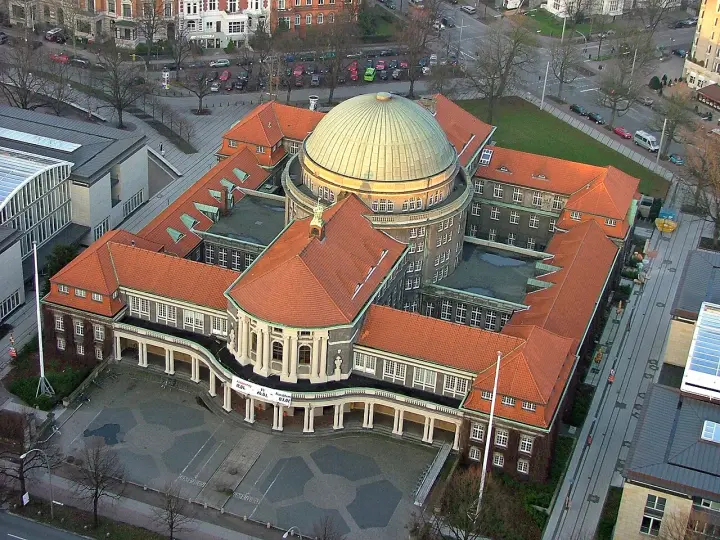
No tuition fee Tuition · sourced 2 years Duration View detailsCampus photos on this page: Merlin Senger (CC BY-SA 3.0) — via Wikimedia Commons.
Manuscript Cultures — FAQs
5 questions
Tuition is No tuition fee. Taken from the university's published fees page, not re-checked since — confirm it before you budget. We confirm the current fee and the scholarships you qualify for — free.
The main intake is Winter semester. Most universities admit on a rolling basis — we confirm the exact deadline for your profile, free.
A first qualifying degree (BA/Magister Artium/Diplom) from a German or recognised foreign university in one of the subjects taught in the programme, e.g.: African Studies Ethiopian Studies Ancient History Art History Assyriology Austronesian Studies Classical Archaeology Greek Studies Historical Musicology Indology Iranian Studies Islamic Studies Japanese Studies Jewish Philosophy and Religion Medieval and Modern History Sinology Thai Studies Turkology or a related discipline We also welcome applications from candidates with a background in the natural sciences or computer sciences and an interest in manuscripts/inscriptions. Please see this website for further information. English: E.G. UNIcert® English: UNIcert® II onSET English: B2 TOEFL iBT (since 2026): 4 Reading: 4 Listening: 4 Speaking: 4 Writing: 4 telc English: telc English B2-C1 University Cambridge English Qualifications: B2 First IELTS Academic: 5.5.
The programme runs about 24 months full-time.
Yes — shortlisting, SOP, LOR, Resume, application, scholarships and visa guidance are all free. We're paid by partner universities, not by you.
Apply to Manuscript Cultures — free help
A counsellor calls you back during office hours — 9am to 8pm IST, Mon to Sat. We are closed right now, so your request is first in line when we reopen.