
Master of Science in Physics
Technische Universität Berlin · Berlin, Europe
Duration
24 mo
Tuition
No tuition fee
sourcedIntake
Winter semester
English
—
Winter semester intake. Most universities admit on a rolling basis — we confirm the exact application deadline for your profile, free.
Course details verified 10 Sep 2026 — intakes, entry requirements and course facts · official source
Fee sourced Taken from the university's published fees page, not re-checked since — confirm it before you budget. See the university fees page.
About this programme
Free the Scientist Within You This graduate programme, taught entirely in English, prepares you for international careers in advanced research and research-intensive industries. You will gain specialised knowledge in various fields of physics, deepen your understanding of scientific methods and strengthen your expertise in theoretical and experimental physics. As a Master’s student, you will join our scientific community, take part in research projects, and receive support from instructors and professors. Key Facts about the Master's Programme no tuition fees consecutive and research-oriented two years (four semesters, 120 credit points) provides access to doctoral programmes Become a Part of an Excellent Scientific Community well-equipped laboratories and advanced technology access to a strong international network of physicists mentoring programme supporting new students and fostering a caring academic community Master's programme in Physics Benefit: Master’s students have the opportunity to earn a French-German Master's Double-Degree in Physics in cooperation with the Institut Polytechnique de Paris. Fundamental Physics at Freie Universität Berlin Physicists at Freie Universität Berlin continue the tradition of pioneers such as Albert Einstein, Max Planck, and Lise Meitner, who once worked in Berlin-Dahlem—now home to our university. Creating Fundamentals for Future Innovations Researchers at Freie Universität Berlin conduct cutting-edge fundamental research in biophysics, quantum physics, ultrafast physics, nanophysics and surface science. The department hosts several collaborative research centres and scientific consortia, where physicists work in large international and interdisciplinary teams. The Master's programme in Physics consists of two phases. First Year — Study Phase During the study phase, students deepen and broaden their knowledge of physics and related disciplines. Module content is closely aligned with the research activities of our working groups, integrating the latest research topics and methods into the curriculum. Some modules are mandatory, while others can be selected and combined according to individual interests and career goals. Second Year – Research Phase During the research phase, students join one of the department’s research groups. Within these groups, they develop expertise in a specific field of physics. Students gain access to advanced research facilities, acquire specialised methodological skills, and complete their Master’s thesis in their chosen field. Throughout the research phase, each student is supervised by a professor from the department, who serves as their research adviser. Modules As a mandatory component of the programme, advanced foundations of modern experimental and theoretical physics are covered. The following modules must be completed: Advanced Laboratory Course Selected Topics: Scientific Presentations Additionally, students must choose up to two of the following modules: Advanced Quantum Mechanics Statistical Physics and Thermodynamics Advanced Statistical Physics Quantum Field Theory and Many-Body Physics If only one of the above modules is chosen, one of the following modules must also be selected: Advanced Solid State Physics Advanced Atomic and Molecular Physics Advanced Biophysics As part of the elective component, students can choose from a wide range of specialised modules, including: Theoretical Condensed Matter Physics Nanophysics Magnetism and Spin Electronics Surface Science Theory of Light-Matter Interaction Advanced Optics Ultrafast Spectroscopy and Nonlinear Optics Photobiophysics Special Topics in Molecular Biophysics Advanced Biospectroscopy Semiconductor Physics Advanced Astronomy and Astrophysics Quantum Information Theory Advanced Computational Physics Signal Analysis for Physicists Physics and Chemistry of Sustainability I — Renewable Energy and many others PDF Download
Intakes & deadlines
Winter semester
Dates confirmed for your profile · Open
Summer semester
Dates confirmed for your profile · Open
Entry requirements
-
English
E.G. IELTS Academic: 5.5 Cambridge English Qualifications: B2 First TOEFL iBT (since 2026): 4 Reading: 4 Listening: 4 Speaking: 4 Writing: 4 UNIcert® English: UNIcert® II telc English: telc English B2 PTE Academic: 59 TOEIC: 785 Reading: 385 Listening: 400 Speaking: 160 Writing: 170
-
Prerequisites
A Bachelor of Science in Physics or a similar degree from a German or any international university is required. Your degree must be equivalent to the Bachelor's degree in physics awarded by Freie Universität Berlin.
-
Documents
SOP, LOR & Resume — generate them free in 2 minutes.
Fees & scholarships
No tuition fee tuition (sourced). We confirm the exact costs and the scholarships you qualify for at Technische Universität Berlin — free, for your profile.
Other programmes at Technische Universität Berlin
Ancient Worlds — Interdisciplinary Ancient Studies / Antike Welten — Interdisziplinäre Altertumswissenschaften
No tuition fee Tuition · sourced 2 years Duration View details TB Technische Universität BerlinBerlin MBA (full-time)
€9,950/yr Tuition · sourced 1 year Duration View details TB Technische Universität BerlinBerlin MBA (part-time)
€5,600/yr Tuition · sourced 2 years Duration View details TB Technische Universität BerlinBuilding Sustainability in Urban Futures (MBA)
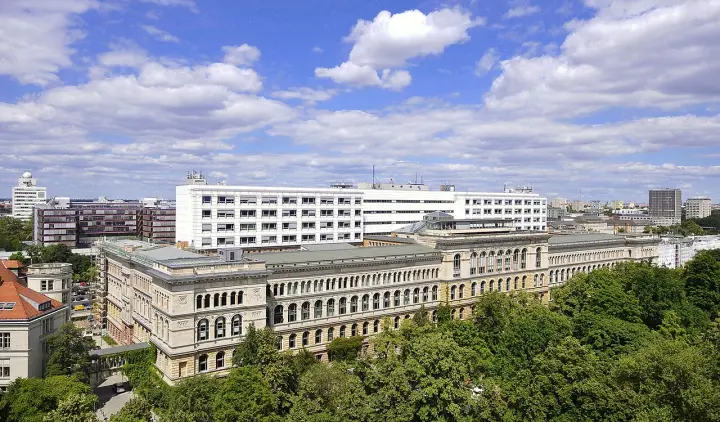
€6,600/yr Tuition · sourced 18 months Duration View detailsCampus photos on this page: TU Berlin/Pressestelle/Ulrich Dahl (Copyrighted free use) — via Wikimedia Commons.
Master of Science in Physics — FAQs
5 questions
Tuition is No tuition fee. Taken from the university's published fees page, not re-checked since — confirm it before you budget. We confirm the current fee and the scholarships you qualify for — free.
The main intake is Winter semester. Most universities admit on a rolling basis — we confirm the exact deadline for your profile, free.
A Bachelor of Science in Physics or a similar degree from a German or any international university is required. Your degree must be equivalent to the Bachelor's degree in physics awarded by Freie Universität Berlin. English: E.G. IELTS Academic: 5.5 Cambridge English Qualifications: B2 First TOEFL iBT (since 2026): 4 Reading: 4 Listening: 4 Speaking: 4 Writing: 4 UNIcert® English: UNIcert® II telc English: telc English B2 PTE Academic: 59 TOEIC: 785 Reading: 385 Listening: 400 Speaking: 160 Writing: 170.
The programme runs about 24 months full-time.
Yes — shortlisting, SOP, LOR, Resume, application, scholarships and visa guidance are all free. We're paid by partner universities, not by you.
Apply to Master of Science in Physics — free help
A counsellor calls you back during office hours — 9am to 8pm IST, Mon to Sat. We are closed right now, so your request is first in line when we reopen.