Quantum Science and Technology
Technical University of Munich · Munich, Germany, Europe
Duration
24 mo
Tuition
No tuition fee
sourcedIntake
Winter semester
English
—
Winter semester intake. Most universities admit on a rolling basis — we confirm the exact application deadline for your profile, free.
Course details verified 09 Sep 2026 — intakes, entry requirements and course facts · official source
Fee sourced Taken from the university's published fees page, not re-checked since — confirm it before you budget. See the university fees page.
About this programme
Quantum Science & Technology is a broad, interdisciplinary field of contemporary science spanning a wide range of scientific areas with a high potential for the development of future information, sensing and computing technologies. Major research thrusts are, for example, quantum computing, quantum sensing, quantum simulation, quantum materials, and quantum cryptography, to name but a few. The research field is firmly grounded on the basic understanding of the principles of quantum mechanics, but it also relies on developments in neighbouring research areas such as mathematics, information technology, electrical engineering and chemistry. It is for this reason that the two Munich universities – Technical University of Munich and Ludwig-Maximilians Universität – have joined forces to establish the “Quantum Science & Technology“ interdisciplinary Master’s study programme (QST). Students particularly benefit from the research environment provided by the Excellence cluster Munich Center for Quantum Science and Technology (MCQST). The QST study programme goes significantly beyond the standard teaching programme of quantum mechanics as in modern application of quantum technologies (Quantum 2.0), the concepts of superposition and entanglement are of central importance. Owing to the complexity of the field, the QST study programme is aimed at students who will work at the forefront of quantum science and who will expand the existing research areas in natural sciences (e.g. physics and chemistry), mathematics, and engineering (e.g. computer science and electrical engineering). Students learn to directly translate current results from research and development in science (e.g. physics, chemistry), mathematics and engineering (e. g. informatics, electrical engineering) into applications, such as quantum sensors, quantum algorithms, and quantum computers, which exploit quantum phenomena – especially superposition and entanglement. The courses available within the QST Master’s programme cover the basics and the skills required to successfully carry out research or industrial projects across interdisciplinary boundaries. In addition to the necessary background knowledge and practical know-how, the social skills required in the academic or industrial environment will be promoted. This profile is intended to enable graduates to be deployed in a wide range of research as well as in industrial and service industries. Typical fields of application for the graduates of the QST Master’s programme include experimental and theoretical research activities, in the planning and documentation of research projects, and in adjacent fields of activity of the computer science and technology industry, for example, in patenting, development, project planning, or in public institutions. The first year of this interdisciplinary Master’s programme focuses mainly on fundamental introductory lectures and lab courses, while the second year focuses on the research within the framework of the Master’s thesis. During the study phase, students attend mandatory courses, and additionally, they attend some courses chosen from the catalogue of elective courses. It is important to note that the two mandatory modules (PH1009 & PH1010) must be completed in the first semester. The elective subjects cover selected topics from the research area Quantum Science & Technology and prepare students for engaging in current research, uniquely reflecting the broad research activity of the cooperating universities, TUM and LMU. A scientifically-oriented lab course and a general-education subject round off the profile of this Master’s programme. During the research phase, the students will directly encounter current research topics in Quantum Science & Technology. After an initial familiarisation through the Master’s seminar and the Master’s practical training, each student will independently work on the Master’s thesis under the guidance of a thesis adviser. During the whole research pha
Intakes & deadlines
Winter semester
Dates confirmed for your profile · Open
Entry requirements
-
English
E.G. PTE Academic: 65 TOEFL iBT Home Edition (before 2026): 88 IELTS Academic: 6.5 Cambridge English Qualifications: C1 Advanced
-
Prerequisites
An important admission requirement is to have completed a Bachelor’s degree of at least six semesters in physics or another suitable subject area, or they should have a degree that is at least equivalent in an engineering or natural science-oriented degree programme at a German or foreign university. The suitability of the university degree will be judged by an admissions committee, which grants or declines acceptance based on the competencies acquired. In order to figure out whether your Bachelor's studies are sufficient for admission to our Master's programme, please find relevant information about the application and the prerequisites on our website https://academics.nat.tum.de/en/msc/qst/apply. Please be aware that you need to have passed a course in quantum mechanics providing competencies equivalent to PH0007 Theoretical Physics 3 (Quantum Mechanics). Furthermore, you need to have taken courses equivalent to the core modules at TUM listed on our website. International students are required to complete the curricular analysis form. One ECTS accounts for 30 hours of work within and outside the classroom; a conversion will depend on how credits are defined in your university. For your convenience, in order to avoid misunderstandings given the different structures of study programmes around the world, it is required that you attach the description of the contents of the courses you have taken at your university to your application.
-
Documents
SOP, LOR & Resume — generate them free in 2 minutes.
Fees & scholarships
No tuition fee tuition (sourced). We confirm the exact costs and the scholarships you qualify for at Technical University of Munich — free, for your profile.
Other programmes at Technical University of Munich
 Technical University of Munich
Executive MBA
€10,725/yr Tuition · sourced 2 years Duration View details
Technical University of Munich
Executive MBA in Business & IT
€10,725/yr Tuition · sourced 2 years Duration View details
Technical University of Munich
Information Engineering
No tuition fee Tuition · sourced 2 years Duration View details
Technical University of Munich
Land Management and Geospatial Science
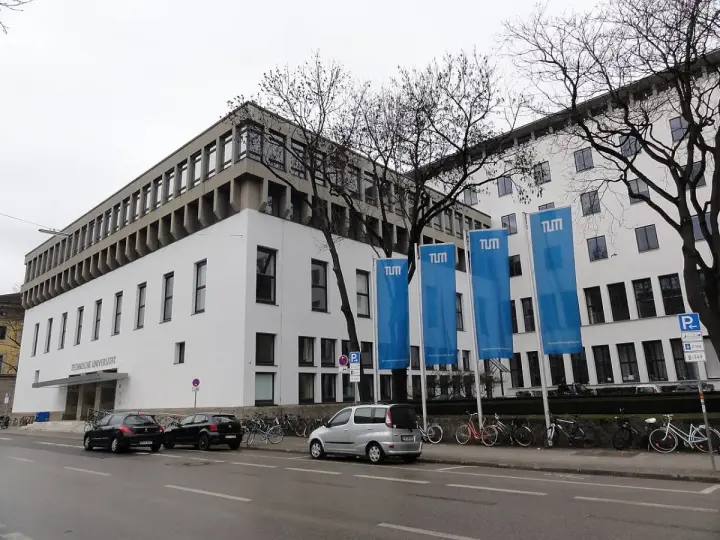
No tuition fee Tuition · sourced 2 years Duration View detailsCampus photos on this page: Mattes (CC BY-SA 2.0) — via Wikimedia Commons.
Quantum Science and Technology — FAQs
5 questions
Tuition is No tuition fee. Taken from the university's published fees page, not re-checked since — confirm it before you budget. We confirm the current fee and the scholarships you qualify for — free.
The main intake is Winter semester. Most universities admit on a rolling basis — we confirm the exact deadline for your profile, free.
An important admission requirement is to have completed a Bachelor’s degree of at least six semesters in physics or another suitable subject area, or they should have a degree that is at least equivalent in an engineering or natural science-oriented degree programme at a German or foreign university. The suitability of the university degree will be judged by an admissions committee, which grants or declines acceptance based on the competencies acquired. In order to figure out whether your Bachelor's studies are sufficient for admission to our Master's programme, please find relevant information about the application and the prerequisites on our website https://academics.nat.tum.de/en/msc/qst/apply. Please be aware that you need to have passed a course in quantum mechanics providing competencies equivalent to PH0007 Theoretical Physics 3 (Quantum Mechanics). Furthermore, you need to have taken courses equivalent to the core modules at TUM listed on our website. International students are required to complete the curricular analysis form. One ECTS accounts for 30 hours of work within and outside the classroom; a conversion will depend on how credits are defined in your university. For your convenience, in order to avoid misunderstandings given the different structures of study programmes around the world, it is required that you attach the description of the contents of the courses you have taken at your university to your application. English: E.G. PTE Academic: 65 TOEFL iBT Home Edition (before 2026): 88 IELTS Academic: 6.5 Cambridge English Qualifications: C1 Advanced.
The programme runs about 24 months full-time.
Yes — shortlisting, SOP, LOR, Resume, application, scholarships and visa guidance are all free. We're paid by partner universities, not by you.
Apply to Quantum Science and Technology — free help
A counsellor calls you back during office hours — 9am to 8pm IST, Mon to Sat. We are open now.