
Master of Science in Economics
Technical University of Berlin · Berlin, Germany
Duration
24 mo
Tuition
No tuition fee
sourcedIntake
Winter semester
English
—
Winter semester intake. Most universities admit on a rolling basis — we confirm the exact application deadline for your profile, free.
Course details verified 10 Sep 2026 — intakes, entry requirements and course facts · official source
Fee sourced Taken from the university's published fees page, not re-checked since — confirm it before you budget. See the university fees page.
About this programme
The Master of Science in Economics programme aims to convey the analytical skills and expertise that are indispensable for quantitative-oriented economists interested in practical solutions to economic problems in a world that is increasingly complex and difficult to classify. The Master's degree programme in Economics is designed to last two years. As a part of the Master's degree programme, it is possible to prepare for a doctoral degree programme by selecting suitable courses. The faculty places great value on ensuring that the offered programmes can be completed within the standard period of study and regularly evaluates the courses. The main features of the programme include the following: Quantitative focus: For Master's students who view economics as a "hard" subject, there is an academic ambition to understand economic phenomena with logical precision and clarity. It is just as important as letting the economic models and their quantitative relevance speak for themselves. The main focus is on dealing with quantitative data, statistical and econometric methods for data analysis, and computers to derive quantitative statements form the models and to check their plausibility. Theoretical foundation: You will learn to understand how economists think. Economists' tool kits are made up of models. They serve to organise their limitations and uncover possible contradictions in order to develop improvements and expansions, test alternative hypotheses and thus gradually come closer to mirroring reality. Research skills: Teaching at the School of Business and Economics at Humboldt-Universität is heavily research-oriented. This applies not only to the topics and focuses of the teaching programme but also to the results of students' theses, the very best of which aim to take science one step further. Internationality: Economics is a subject with an international outlook. This is why the metropolis of Berlin is an ideal location for studying economics. We have a large number of international students. Humboldt-Universität maintains relationships with partner universities all over the world, while both promoting and eagerly anticipating international student exchanges. All courses are offered in English. Self-initiative: Freedom of research and teaching also means freedom for students to choose their fields of study, among other things. With that in mind, our Master's degree programme offers students a great deal of flexibility, which, in turn, requires a great deal of initiative. Core modules (32 CP): Econometric Methods (12 CP) The compulsory module "Econometric Methods" provides students with the necessary tools not only to understand scientific work in modern economics, but also to be able to make a contribution to the scientific development of the discipline as part of their subsequent Master's thesis and in their subsequent professional activity. Master's thesis (20 CP) Catalogue of specialised electives (total 78 CP): From the catalogue of specialised electives, 58 CP of the highest-graded modules are included in the overall grade. Catalogue of specialised electives A, Micro- and Macroeconomics (12 CP): In this catalogue, we offer courses covering central and current areas of economics: Introduction to Advanced Microeconomic Analysis (6 CP) or Advanced Microeconomic Theory I (PhD-Level) (6 CP) Introduction to Advanced Macroeconomic Analysis (6 CP) or Advanced Macroeconomic Analysis I (PhD-Level) (6 CP) Catalogue of specialised electives B, Economics (18 CP): At least three elective modules from the following catalogue must be completed: Advanced Labour Economics Empirical Labour Economics Competition Policy Advanced Monetary Economics Decision-Making under Uncertainty Public Economics Catalogue of specialised electives C, Economics and Methodology (30 CP): At least 24 CP are to be selected from the Economic module offering. It is also possible to choose modules from catalogues A and B that have not already been completed. At
Intakes & deadlines
Winter semester
Dates confirmed for your profile · Open
Entry requirements
-
English
E.G. IELTS Academic: 7
-
Prerequisites
Applicants must have specialised knowledge in economic subjects amounting to at least 60 ECTS credits (excluding methodological subject areas of mathematics, statistics, econometrics, and final (Bachelor's) theses). If the degree is still outstanding at the time of application, proof must be provided that no more than 30 ECTS credits are yet to be acquired. At least 24 ECTS credits must have been earned in the methodological fields in mathematics, statistics, and econometrics. In addition to meeting the formal access and eligibility criteria, we also expect you to have an interest in economic subjects, enjoy scientific research, and possess strong quantitative and analytical skills. Additionally, it is important to have sufficient computer skills, possess the ability to organise yourself effectively, and demonstrate commitment to the programme. https://www.wiwi.hu-berlin.de/en/study/bewerbung/standardseite Official admission rules (in German): https://www.hu-berlin.de/fileadmin/Dokumentenpool/Studium/202504_WiSe2025-26_zzr/2.2.3.24.-2025-Volkswirtschaftslehre.pdf
-
Documents
SOP, LOR & Resume — generate them free in 2 minutes.
Fees & scholarships
No tuition fee tuition (sourced). We confirm the exact costs and the scholarships you qualify for at Technical University of Berlin — free, for your profile.
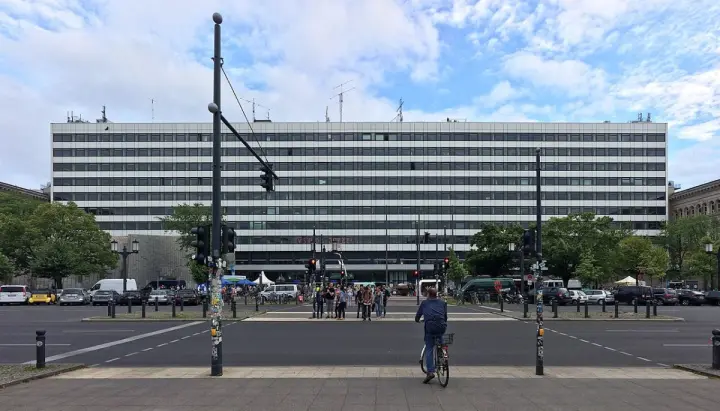
Other programmes at Technical University of Berlin
Ancient Worlds — Interdisciplinary Ancient Studies / Antike Welten — Interdisziplinäre Altertumswissenschaften
No tuition fee Tuition · sourced 2 years Duration View details TB Technical University of BerlinBerlin MBA (full-time)
€9,950/yr Tuition · sourced 1 year Duration View details TB Technical University of BerlinBerlin MBA (part-time)
€5,600/yr Tuition · sourced 2 years Duration View details TB Technical University of BerlinBuilding Sustainability in Urban Futures (MBA)
€6,600/yr Tuition · sourced 18 months Duration View detailsCampus photos on this page: Gunnar Klack (CC BY-SA 4.0) — via Wikimedia Commons.
Master of Science in Economics — FAQs
5 questions
Tuition is No tuition fee. Taken from the university's published fees page, not re-checked since — confirm it before you budget. We confirm the current fee and the scholarships you qualify for — free.
The main intake is Winter semester. Most universities admit on a rolling basis — we confirm the exact deadline for your profile, free.
Applicants must have specialised knowledge in economic subjects amounting to at least 60 ECTS credits (excluding methodological subject areas of mathematics, statistics, econometrics, and final (Bachelor's) theses). If the degree is still outstanding at the time of application, proof must be provided that no more than 30 ECTS credits are yet to be acquired. At least 24 ECTS credits must have been earned in the methodological fields in mathematics, statistics, and econometrics. In addition to meeting the formal access and eligibility criteria, we also expect you to have an interest in economic subjects, enjoy scientific research, and possess strong quantitative and analytical skills. Additionally, it is important to have sufficient computer skills, possess the ability to organise yourself effectively, and demonstrate commitment to the programme. https://www.wiwi.hu-berlin.de/en/study/bewerbung/standardseite Official admission rules (in German): https://www.hu-berlin.de/fileadmin/Dokumentenpool/Studium/202504_WiSe2025-26_zzr/2.2.3.24.-2025-Volkswirtschaftslehre.pdf English: E.G. IELTS Academic: 7.
The programme runs about 24 months full-time.
Yes — shortlisting, SOP, LOR, Resume, application, scholarships and visa guidance are all free. We're paid by partner universities, not by you.
Apply to Master of Science in Economics — free help
A counsellor calls you back during office hours — 9am to 8pm IST, Mon to Sat. We are open now.