
Biochemistry
Rheinische Friedrich-Wilhelms-Universität Bonn · Bonn, Europe
Duration
24 mo
Tuition
No tuition fee
sourcedIntake
Winter semester
English
—
Winter semester intake. Most universities admit on a rolling basis — we confirm the exact application deadline for your profile, free.
Course details verified 10 Sep 2026 — intakes, entry requirements and course facts · official source
Fee sourced Taken from the university's published fees page, not re-checked since — confirm it before you budget. See the university fees page.
About this programme
Modern life sciences bring new and unexpected insight into highly complex processes in cells, organs and organisms. But whatever the process is, it will have a molecular basis that will be revealed using biochemical methods. On the one hand, biochemistry is the basis of life sciences and linking chemistry, biology, physiology and biophysics. With a strong education in biochemistry, all fields of life sciences are open to you. On the other hand, as it is the study of the molecules of life, biochemistry is a fascinating subject on its own. Biochemistry covers both the analysis of biochemical systems and the reconstruction of biological systems by synthetic biochemistry with close relation to chemistry in a field that we call chemical biology. In addition, modern biochemistry is inspired by technological breakthroughs: High resolution light microscopy allows tracing of single proteins and molecules in general. Latest high resolution mass spectrometers separate, identify and quantify minute amounts of biomolecules with extreme precision. New chemical methods allow labelling and tracing of biomolecules in single cells. Robotics enables handling large sample sets with unprecedented speed and precision. Biochemistry is the basis of life sciences and a fascinating subject linking chemistry, biology, physiology and biophysics. Building on a century of state-of-the-art biochemical research in Germany, our Master's course of study in Biochemistry offers theoretical and practical education in the major fields of biochemistry in lecture series, a method-oriented course and lab rotations at LIMES and related laboratories in Bonn. You can learn in depth about chemical biology of nucleic acids, about lipids, lipidomics and metabolomics, about membrane protein biophysics and about the biochemical basis of neurophysiology. You will use state-of-the-art instrumentation and methods and will be supervised by experienced and internationally renowned scientists. And last but not least, the course offers bridges to the strong research environment both at the LIMES itself with its strong focus on immunology and metabolism and to the other science institutions in Bonn. The Master's programme comprises lectures, practical courses, workshops, excursions and independent research projects. It is an interdisciplinary hands-on training programme that prepares students to solve scientific problems independently. Lectures Cellular biochemistry Biophysics Chemical biology Physiology Methods in life sciences and statistics Introduction in experimental animals and bioethics Good scientific practice Additionally, the Master's programme starts with two elective lectures. These lectures provide a detailed overview of a particular field and are intended to give the students the opportunity to overcome a lack of basic knowledge in that field. Elective lectures are not graded. Students should attend at least two of the following lectures: Biochemistry and organic chemistry Cell biology and immunology Genetics and molecular biology Inorganic chemistry and physical chemistry Method Courses All students participate in two introductory methods courses. In these practical courses, students are able to learn and become familiarised with fundamental techniques applied in current research. The methods courses comprise a few weeks of experimental work in total. Lab Rotations Every student conducts two individual research projects (lab rotations), which each involve seven weeks of experimental work, followed by one week of data analysis and a written lab report in the format of a scientific research publication. Lab rotations can be performed in the LIMES Institute, in partner institutions (German Centre for Neurodegenerative Diseases, Centre of Advanced European Studies and Research or Bayer Pharma) or in any another university in Germany or abroad. Biochemistry Oral Examination This oral examination will cover all topics from the lectures in cellular biochemistry, biophysics,
Intakes & deadlines
Winter semester
Dates confirmed for your profile · Open
Entry requirements
-
English
E.G. IELTS Academic: 6 TOEFL iBT (before 2026): 76 Reading: 19 Listening: 18 Speaking: 21 Writing: 18 Cambridge English Qualifications: B2 First
-
Prerequisites
Admission requirements 1. Bachelor's degree with a minimum GPA of 2.5 (German grading system) in Molecular Biomedicine Chemistry Biology Biotechnology Molecular life sciences Pharmacy or related fields 2. Additionally, applicants must have conducted an experimental Bachelor's thesis. 3. In their previous Bachelor’s studies, applicants should have passed a minimum of three modules (equivalent to at least 30 ECTS credit points in total) in the following areas: Chemical Biology Developmental Biology Immunology Genetics Biochemistry 4. All courses are held in English. Applicants who are not native speakers of English should demonstrate adequate competence of the English language by acceptable results on an internationally recognised test. See the "Language requirements" section for more information on accepted certificates.
-
Documents
SOP, LOR & Resume — generate them free in 2 minutes.
Fees & scholarships
No tuition fee tuition (sourced). We confirm the exact costs and the scholarships you qualify for at Rheinische Friedrich-Wilhelms-Universität Bonn — free, for your profile.
Other programmes at Rheinische Friedrich-Wilhelms-Universität Bonn
Agricultural and Food Economics (AFECO)
No tuition fee Tuition · sourced 2 years Duration View details RFW Rheinische Friedrich-Wilhelms-Universität BonnAgricultural Sciences and Resource Management in the Tropics and Subtropics (ARTS)
No tuition fee Tuition · sourced 2 years Duration View details RFW Rheinische Friedrich-Wilhelms-Universität BonnAnthropology of the Americas
No tuition fee Tuition · sourced 2 years Duration View details RFW Rheinische Friedrich-Wilhelms-Universität BonnApplied Linguistics
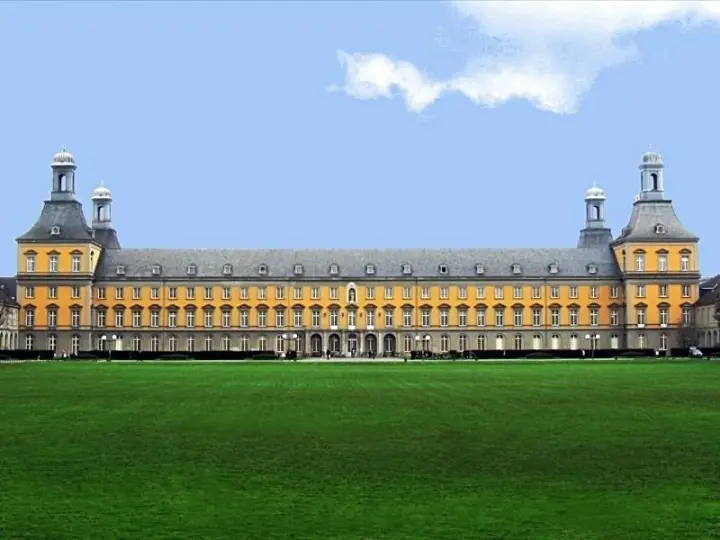
No tuition fee Tuition · sourced 2 years Duration View detailsCampus photos on this page: Daniel Tibi (Dti) | daniel-tibi.de (Public domain) — via Wikimedia Commons.
Biochemistry — FAQs
5 questions
Tuition is No tuition fee. Taken from the university's published fees page, not re-checked since — confirm it before you budget. We confirm the current fee and the scholarships you qualify for — free.
The main intake is Winter semester. Most universities admit on a rolling basis — we confirm the exact deadline for your profile, free.
Admission requirements 1. Bachelor's degree with a minimum GPA of 2.5 (German grading system) in Molecular Biomedicine Chemistry Biology Biotechnology Molecular life sciences Pharmacy or related fields 2. Additionally, applicants must have conducted an experimental Bachelor's thesis. 3. In their previous Bachelor’s studies, applicants should have passed a minimum of three modules (equivalent to at least 30 ECTS credit points in total) in the following areas: Chemical Biology Developmental Biology Immunology Genetics Biochemistry 4. All courses are held in English. Applicants who are not native speakers of English should demonstrate adequate competence of the English language by acceptable results on an internationally recognised test. See the "Language requirements" section for more information on accepted certificates. English: E.G. IELTS Academic: 6 TOEFL iBT (before 2026): 76 Reading: 19 Listening: 18 Speaking: 21 Writing: 18 Cambridge English Qualifications: B2 First.
The programme runs about 24 months full-time.
Yes — shortlisting, SOP, LOR, Resume, application, scholarships and visa guidance are all free. We're paid by partner universities, not by you.
Apply to Biochemistry — free help
A counsellor calls you back during office hours — 9am to 8pm IST, Mon to Sat. We are open now.