Master of Science in Photonics
Ludwig-Maximilians-Universität München · Munich, Europe
Duration
18 mo
Tuition
No tuition fee
sourcedIntake
Winter semester
English
—
Winter semester intake. Most universities admit on a rolling basis — we confirm the exact application deadline for your profile, free.
Course details verified 10 Sep 2026 — intakes, entry requirements and course facts · official source
Fee sourced Taken from the university's published fees page, not re-checked since — confirm it before you budget. See the university fees page.
About this programme
Photonics – the technology and science of light The innovative power of photonics is transforming our daily lives. Brilliant laser sources, quantum computers and quantum communication, powerful fibre optic networks and light-based therapy, and diagnostics in medicine as well as energy-efficient solid-state lighting characterise the current technical progress that will shape our future. The Master’s degree programme in Photonics provides you with sound and comprehensive knowledge to help shape this journey into the future. The course content ranges from the physical fundamentals of electrodynamics, quantum theory, semiconductor and laser physics to application-related topics such as laser materials processing and optical communication technology. In addition, you have the opportunity to choose further elective courses from the wide range of courses offered by Hochschule München University of Applied Sciences. Theoretical knowledge is applied and deepened through a high proportion of practical laboratory assignments. In the project and Master’s thesis, research and engineering skills are developed and creativity is encouraged. The Master’s thesis can be completed either in the university’s research laboratories or in industry. The Munich region represents an international centre for the photonics industry and research. The degree programme involves close cooperation with local industry; it is advised by an industrial advisory board (see partners), and joint seminars are held with industrial companies. Master of Science in Photonics programme has modern, well-equipped research laboratories in which numerous research projects are conducted in collaboration with national and international industrial and academic partners. Research focuses include multiphoton microscopy for biological and medical applications, ultrashort pulse laser material processing, photoacoustics, and optical fibre sensor technology. Master of Science in Photonics programme has gained a strong reputation in both industrial and academic circles. After completing this programme, you will be well prepared for a career as a high-tech expert in the industry. You will have excellent employment prospects and possess valuable intercultural skills and international experience. You may also choose to pursue doctoral studies. Further information: https://sci.hm.edu/studierende/studiengaenge/master/photonics/index.en.html Examples of educational organisation: Full-time study (three semesters): First semester: two compulsory modules (Electrodynamics-Quantum Theory, Semiconductor Optics), two elective modules, and one interdisciplinary module Second semester: two compulsory modules (Laser Physics, Optics Design), two elective modules, and project study Third semester: Master's thesis and colloquium Part-time study (six semesters): First semester: Electrodynamics – Quantum Theory compulsory module, one elective module, and one interdisciplinary module Second semester: Laser Physics compulsory module, one elective module, and project study Third semester: Semiconductor Optics compulsory module and one elective module Fourth semester: Optics Design compulsory module and one elective module Fifth semester: Master's thesis Sixth semester: Master's thesis and colloquium Examples of compulsory elective modules: Quantum Information; Biophotonics, Micro and Fibre Optics; Laser in Production; Photoacoustics; Optical Communication Technology; Optical Measurement Technology; Physical Modelling and Simulation; Quantum Sensing Examples of interdisciplinary elective modules: Project Management, Quality Management, Technology and Innovation Management Further Information: https://sci-intern.hm.edu/fk/fachthemen2.php?studgang=pom&lang=de
Intakes & deadlines
Winter semester
Dates confirmed for your profile · Open
Summer semester
Dates confirmed for your profile · Open
Entry requirements
-
Prerequisites
In order to enrol in the programme, you must meet the following qualifications as well as other requirements which may apply: You possess a Bachelor's degree or a comparable degree from a natural science or engineering degree programme with a final grade better than the equivalent German grade of "good". In these degree programmes, you acquired solid basic knowledge in physics, optics, and/or laser technology, amounting to at least 10 credit points in accordance with the ECTS or equivalent. In your cover letter, please describe the courses you have successfully completed in these fields. Your degree work was attained either at a German university or at a foreign school that is properly accredited. The Bachelor's degree must cover at least 180 ECTS credit points and at least six theoretical semesters. The completion of a practical semester or an industrial internship of at least 18 weeks during the Bachelor's studies is required. If you have completed a Bachelor's degree with less than 210 ECTS credits (but at least 180 ECTS credits) or if you have not yet completed an 18-week industrial internship, you can make up for this during the Master's degree programme. In this case, the Master's programme is extended to four semesters. If some applicants do not meet the final grade of "good" or better, or if there is uncertainty about their other qualifications. These applicants must prove their qualifications in an oral entrance examination. This examination is offered following the correct and timely application to the programme. This examination has a duration of 20 to 30 minutes and serves as proof of sufficient basic skills in mathematics, physics, optics, and laser technology. The examination is held by two professors.
-
Documents
SOP, LOR & Resume — generate them free in 2 minutes.
Fees & scholarships
No tuition fee tuition (sourced). We confirm the exact costs and the scholarships you qualify for at Ludwig-Maximilians-Universität München — free, for your profile.
Other programmes at Ludwig-Maximilians-Universität München
Digital Media Manager
€3,840/yr Tuition · sourced 18 months Duration View details LMM Ludwig-Maximilians-Universität MünchenElite Master's Programme: Theoretical and Mathematical Physics
No tuition fee Tuition · sourced 2 years Duration View details LMM Ludwig-Maximilians-Universität MünchenEntrepreneurship and Digital Transformation
No tuition fee Tuition · sourced 18 months Duration View details LMM Ludwig-Maximilians-Universität MünchenEvolution, Ecology and Systematics (Master of Science)
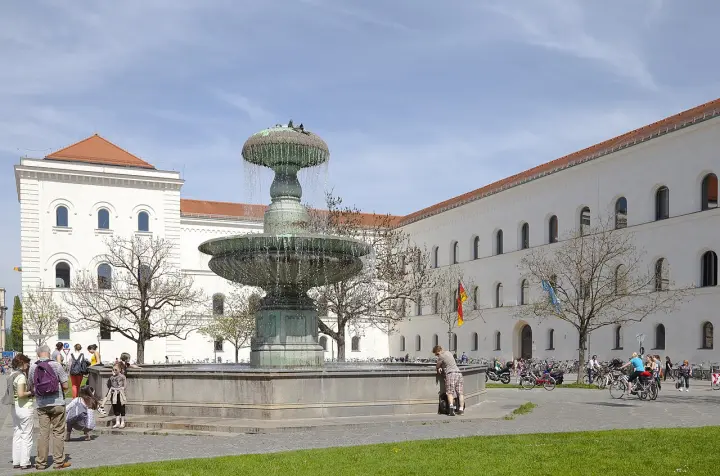
No tuition fee Tuition · sourced 2 years Duration View detailsCampus photos on this page: Diego Delso (CC BY-SA 3.0) — via Wikimedia Commons.
Master of Science in Photonics — FAQs
5 questions
Tuition is No tuition fee. Taken from the university's published fees page, not re-checked since — confirm it before you budget. We confirm the current fee and the scholarships you qualify for — free.
The main intake is Winter semester. Most universities admit on a rolling basis — we confirm the exact deadline for your profile, free.
In order to enrol in the programme, you must meet the following qualifications as well as other requirements which may apply: You possess a Bachelor's degree or a comparable degree from a natural science or engineering degree programme with a final grade better than the equivalent German grade of "good". In these degree programmes, you acquired solid basic knowledge in physics, optics, and/or laser technology, amounting to at least 10 credit points in accordance with the ECTS or equivalent. In your cover letter, please describe the courses you have successfully completed in these fields. Your degree work was attained either at a German university or at a foreign school that is properly accredited. The Bachelor's degree must cover at least 180 ECTS credit points and at least six theoretical semesters. The completion of a practical semester or an industrial internship of at least 18 weeks during the Bachelor's studies is required. If you have completed a Bachelor's degree with less than 210 ECTS credits (but at least 180 ECTS credits) or if you have not yet completed an 18-week industrial internship, you can make up for this during the Master's degree programme. In this case, the Master's programme is extended to four semesters. If some applicants do not meet the final grade of "good" or better, or if there is uncertainty about their other qualifications. These applicants must prove their qualifications in an oral entrance examination. This examination is offered following the correct and timely application to the programme. This examination has a duration of 20 to 30 minutes and serves as proof of sufficient basic skills in mathematics, physics, optics, and laser technology. The examination is held by two professors.
The programme runs about 18 months full-time.
Yes — shortlisting, SOP, LOR, Resume, application, scholarships and visa guidance are all free. We're paid by partner universities, not by you.
Apply to Master of Science in Photonics — free help
A counsellor calls you back during office hours — 9am to 8pm IST, Mon to Sat. We are closed right now, so your request is first in line when we reopen.