Master of Science in Economics
Ludwig-Maximilians-Universität München · Munich, Europe
Duration
24 mo
Tuition
No tuition fee
sourcedIntake
Winter semester
English
—
Winter semester intake. Most universities admit on a rolling basis — we confirm the exact application deadline for your profile, free.
Course details verified 09 Sep 2026 — intakes, entry requirements and course facts · official source
Fee sourced Taken from the university's published fees page, not re-checked since — confirm it before you budget. See the university fees page.
About this programme
The Master of Science in Economics programme provides students with analytical and logical problem-solving skills as well as a deepening of their knowledge in economics, introducing them to topics of current research. Master's students are offered rigorous training in applied economics and are prepared for high-profile professional careers. Students choose from a diverse selection of application-oriented courses, in which they may delve into one of the field's many subtopics. An outstanding feature of the programme is the academic excellence of the teaching faculty. A number of internationally-renowned researchers are part of our staff. The curriculum spans the full breadth of theoretical and applied economics. Master's students also benefit from the excellent academic networking opportunities; the department's excellent international reputation has enabled the establishment of partnerships with the visiting student programmes of top universities such as UC Berkeley, Wisconsin-Madison, Maastricht University, University of Copenhagen, and the University of Stockholm. Our close connection with the ifo Institute for Economic Research offers students first-hand experience in applied research and economic policy advising. Additionally, the Centre for Economic Studies (CES) promotes international academic exchange and welcomes more than thirty international researchers each year from all over the world. Committed and talented students also have the opportunity to establish contacts with selected partners in the private and public sectors by participating in our department's support programme ECONnect. The curriculum of the study programme is divided into modules, with a distinction made between compulsory modules (CM) and optional modules (OM). As a general rule, students should obtain 30 ECTS credits per semester. The credit points are based on the European Credit Transfer System (ECTS), which assigns points to lectures and tutorials according to the required workload. The following aspects are considered in the allocation of credits for academic work: the time spent in formal learning environments (e.g. lectures and tutorials), time spent in preparation and revision of the material (self-study), and the requirements for exam preparation. A failed course naturally results in 0 ECTS points awarded. In the first semester, students attend basic lectures and tutorials in the following: Mathematics for Economists, Econometrics, Microeconomics, Macroeconomics, and Public Economics. These compulsory modules (CM) provide students with indispensable theoretical background knowledge and the necessary tools to further pursue a specialisation in their desired sub-field of economics. In the second semester, students can start specialising in their desired field. They can choose from a wide array of courses and are subject to very few restrictions. 30 ECTS credits should be obtained per semester in OM courses. In at least one 12 ECTS course, students should work on an independently formulated research problem and present the results in a term paper. It is recommended that students take two courses worth 12 ECTS, one in the second and one in the third semester. Students have the opportunity to specialise and/or opt for research-oriented courses in one of the following fields: microeconomics and strategic interaction, applied econometrics, public sector economics, or macro and international economics. Students write the Master's thesis in the fourth semester. This should be an independently written, scientific work in a specific field of economics. The thesis is to be completed over a period of 22 weeks. The Master's thesis is a compulsory module of its own. In the Master's thesis, students demonstrate their ability to apply scientific methods of economics independently and to write an original piece of research. PDF Download
Intakes & deadlines
Winter semester
Dates confirmed for your profile · Open
Entry requirements
-
English
E.G. TOEFL iBT (before 2026): 80 Reading: 20 Listening: 20 Speaking: 20 Writing: 20 IELTS Academic: 6.5
-
Prerequisites
The entry requirement for the Master of Science in Economics programme is the completion of the Bachelor of Science in Economics programme at Ludwig-Maximilians-Universität München or an equivalent qualification and the overall average grade of at least "good" (2.50). Applicants who have graduated with a degree in economics at another university can be admitted into the Master's programme as long as it can be established that this qualification, in terms of content and method, is equivalent to the Bachelor's degree in economics at LMU. A selection committee will determine whether the qualification can be established as being equivalent to a LMU Bachelor's degree in economics on the basis of the provided application documents. If the equivalence of the qualification is unclear (for example, a degree in business administration is not equivalent to our Bachelor's degree in economics) or the GPA is not better than 2.50, the applicant will receive an invitation to the admissions test, which only takes place in Munich. This written test examines whether the applicant's knowledge of microeconomics, macroeconomics, empirical economics, mathematics, and public economics is sufficient for the admission to the Master's programme.
-
Documents
SOP, LOR & Resume — generate them free in 2 minutes.
Fees & scholarships
No tuition fee tuition (sourced). We confirm the exact costs and the scholarships you qualify for at Ludwig-Maximilians-Universität München — free, for your profile.
Other programmes at Ludwig-Maximilians-Universität München
Digital Media Manager
€3,840/yr Tuition · sourced 18 months Duration View details LMM Ludwig-Maximilians-Universität MünchenElite Master's Programme: Theoretical and Mathematical Physics
No tuition fee Tuition · sourced 2 years Duration View details LMM Ludwig-Maximilians-Universität MünchenEntrepreneurship and Digital Transformation
No tuition fee Tuition · sourced 18 months Duration View details LMM Ludwig-Maximilians-Universität MünchenEvolution, Ecology and Systematics (Master of Science)
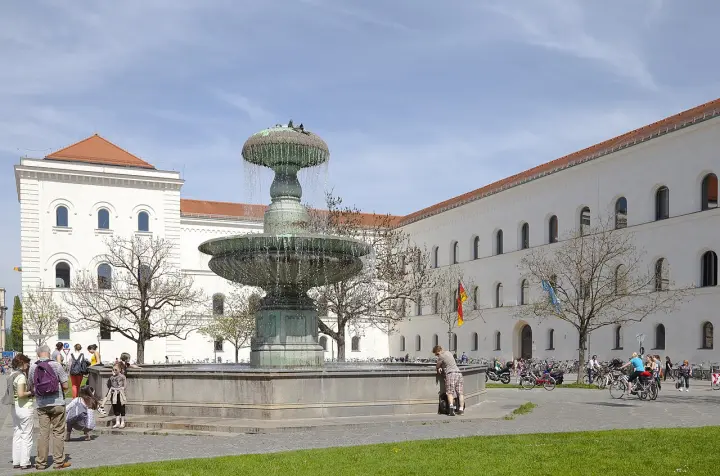
No tuition fee Tuition · sourced 2 years Duration View detailsCampus photos on this page: Diego Delso (CC BY-SA 3.0) — via Wikimedia Commons.
Master of Science in Economics — FAQs
5 questions
Tuition is No tuition fee. Taken from the university's published fees page, not re-checked since — confirm it before you budget. We confirm the current fee and the scholarships you qualify for — free.
The main intake is Winter semester. Most universities admit on a rolling basis — we confirm the exact deadline for your profile, free.
The entry requirement for the Master of Science in Economics programme is the completion of the Bachelor of Science in Economics programme at Ludwig-Maximilians-Universität München or an equivalent qualification and the overall average grade of at least "good" (2.50). Applicants who have graduated with a degree in economics at another university can be admitted into the Master's programme as long as it can be established that this qualification, in terms of content and method, is equivalent to the Bachelor's degree in economics at LMU. A selection committee will determine whether the qualification can be established as being equivalent to a LMU Bachelor's degree in economics on the basis of the provided application documents. If the equivalence of the qualification is unclear (for example, a degree in business administration is not equivalent to our Bachelor's degree in economics) or the GPA is not better than 2.50, the applicant will receive an invitation to the admissions test, which only takes place in Munich. This written test examines whether the applicant's knowledge of microeconomics, macroeconomics, empirical economics, mathematics, and public economics is sufficient for the admission to the Master's programme. English: E.G. TOEFL iBT (before 2026): 80 Reading: 20 Listening: 20 Speaking: 20 Writing: 20 IELTS Academic: 6.5.
The programme runs about 24 months full-time.
Yes — shortlisting, SOP, LOR, Resume, application, scholarships and visa guidance are all free. We're paid by partner universities, not by you.
Apply to Master of Science in Economics — free help
A counsellor calls you back during office hours — 9am to 8pm IST, Mon to Sat. We are closed right now, so your request is first in line when we reopen.