Master of Physics
Leibniz University Hannover · Hanover, Europe
Duration
24 mo
Tuition
No tuition fee
sourcedIntake
Winter semester
English
—
Winter semester intake. Most universities admit on a rolling basis — we confirm the exact application deadline for your profile, free.
Course details verified 09 Sep 2026 — intakes, entry requirements and course facts · official source
Fee sourced Taken from the university's published fees page, not re-checked since — confirm it before you budget. See the university fees page.
About this programme
The Master of Science in Physics is awarded after the completion of a research-oriented study programme, which introduces students to the frontier of research in physics. The main goal of this programme is to develop the ability to work efficiently and independently at the forefront of research and technology development in the academic world and the business sector. This requires both an introduction to the general practice of scientific work and a professional specialisation in a field of physics. Students are taught knowledge and skills in several areas of physics and are trained in independent scientific work. In particular, they acquire in-depth knowledge in three basic research areas (solid state physics, quantum optics, and gravitational physics) and carry out a research project in one of these areas. Six experimental groups and four theory oriented groups work in quantum optics, covering a broad spectrum of topics, including: atom optics and quantum sensors, ultra-cold quantum gases, optomechanics, quantum dynamics in external light fields, ultrafast laser optics, quantum computing, quantum metrology, applied laser physics, trapped-ion quantum engineering, and optical clocks. Four experimental groups and three theoretical groups work in solid-state physics. The research topics include low-dimensional solids (graphene, atomic wires, thin films), nanostructures (quantum dots), solar energy, strongly correlated electrons, exactly solvable quantum systems, and quantum transport. Several experimental and theoretical groups conduct research related to gravitational physics at our faculty and at the associated Max Planck Institute for Gravitational Physics (Albert Einstein Institute). The research topics include laser interferometry and gravitational wave astronomy on ground, and in space, quantum control, string theory, general relativity, cosmology. Additional research fields for Master's theses are radioecology and quantum information theory. In addition, a Master's research project can be carried out in several collaborating research centres such as the Laser Zentrum Hannover e.V. The Master's programme is divided into a one-year specialisation phase and a one-year research phase. In the first year, students acquire the basic knowledge and skills which are necessary for independent research work in physics as well as advanced knowledge in the three major research fields of our faculty: solid state physics, quantum optics, and gravitation physics. The study programme is rounded off by an elective course from another scientific field (e.g. mathematics, chemistry, electrical engineering, philosophy, computer science, etc.). The central element of the research phase (second year) is the Master's thesis. This is based on an independent research project on a current issue of modern physics. It is intended to last six months and is preceded by a preparatory research training of six months. The study programme is divided into modules. To earn the Master's degree, students must complete all required modules. Each module covers a thematic subject area. It can therefore include more than one course and extend over more than one semester. To each module, credit points are assigned, according to the expected workload. To earn credits for a module, students must complete various coursework (homework, labs, seminars) and pass an examination. Coursework may be repeated several times and does not have an impact on the final grade. Some credit points can also be earned by doing an industry internship. The official examination regulations list the required modules, the coursework, the forms of examinations, and the possible elective courses. PDF Download
Intakes & deadlines
Winter semester
Dates confirmed for your profile · Open
Summer semester
Dates confirmed for your profile · Open
Entry requirements
-
English
E.G. UNIcert® English: UNIcert® II telc English: telc English B2-C1 University PTE Academic: 59 IELTS Academic: 5.5 TOEFL iBT Home Edition (since 2026): 4 Reading: 4 Listening: 4 Speaking: 4 Writing: 4 TOEFL iBT (since 2026): 4 Reading: 4 Listening: 4 Speaking: 4 Writing: 4
-
Prerequisites
Bachelor's degree (or equivalent) in Physics Proof of English or German skills
-
Documents
SOP, LOR & Resume — generate them free in 2 minutes.
Fees & scholarships
No tuition fee tuition (sourced). We confirm the exact costs and the scholarships you qualify for at Leibniz University Hannover — free, for your profile.
Other programmes at Leibniz University Hannover
AI-Driven Mechatronics and Robotics (Mechatronics and Robotics Study Track)
No tuition fee Tuition · sourced 2 years Duration View details LH Leibniz University HannoverComputational Methods in Engineering (CME)
No tuition fee Tuition · sourced 2 years Duration View details LH Leibniz University HannoverComputer Science – Master of Science
No tuition fee Tuition · sourced 2 years Duration View details LH Leibniz University HannoverDouble Degree Master's Programme in Renewable Energy and Electrical Power Engineering
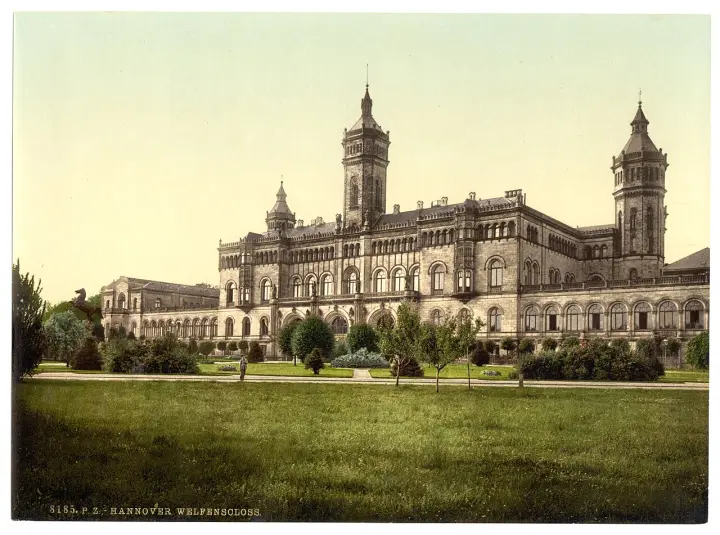
No tuition fee Tuition · sourced 2 years Duration View detailsCampus photos on this page: Unknown authorUnknown author (Public domain) — via Wikimedia Commons.
Master of Physics — FAQs
5 questions
Tuition is No tuition fee. Taken from the university's published fees page, not re-checked since — confirm it before you budget. We confirm the current fee and the scholarships you qualify for — free.
The main intake is Winter semester. Most universities admit on a rolling basis — we confirm the exact deadline for your profile, free.
Bachelor's degree (or equivalent) in Physics Proof of English or German skills English: E.G. UNIcert® English: UNIcert® II telc English: telc English B2-C1 University PTE Academic: 59 IELTS Academic: 5.5 TOEFL iBT Home Edition (since 2026): 4 Reading: 4 Listening: 4 Speaking: 4 Writing: 4 TOEFL iBT (since 2026): 4 Reading: 4 Listening: 4 Speaking: 4 Writing: 4.
The programme runs about 24 months full-time.
Yes — shortlisting, SOP, LOR, Resume, application, scholarships and visa guidance are all free. We're paid by partner universities, not by you.
Apply to Master of Physics — free help
A counsellor calls you back during office hours — 9am to 8pm IST, Mon to Sat. We are closed right now, so your request is first in line when we reopen.