
ERASMUS Mundus Master's Programme EUROPHOTONICS
KIT, Karlsruhe Institute of Technology · Karlsruhe, Europe
Duration
24 mo
Tuition
No tuition fee
sourcedIntake
Winter semester
English
—
Winter semester intake. Most universities admit on a rolling basis — we confirm the exact application deadline for your profile, free.
Course details verified 10 Sep 2026 — intakes, entry requirements and course facts · official source
Fee sourced Taken from the university's published fees page, not re-checked since — confirm it before you budget. See the university fees page.
About this programme
The Master's programme covers some of the most rapidly expanding fields in physics and material sciences, dealing with the control, manipulation, and monitoring of light and its interaction with matter. It aims at providing an extensive, two-year programme from fundamentals to advanced research topics in photonics and its interdisciplinary applications. Master's students benefiting from this programme will be able to work on today's new challenges in their academic or applied research careers: understanding and controlling matter and optical phenomena at the ultimate nanometric scale, providing new imaging tools for the most complex biological processes from cells and tissues to clinical applications, and bringing original tools into line with future optical devices. This two-year Master's programme (120 ECTS credits) is organised by five groups of institutions: Paul Cézanne Aix-Marseille III University (France), Karlsruhe Institute of Technology (KIT) / Karlsruhe School of Optics & Photonics (Germany), Universitat Politecnica de Catalunya / Universitat Autonoma de Barcelona / University of Barcelona / ICFO (Institute of Photonic Sciences) (Spain), Tampere University of Technology (Finland), and Vilnius University (Lithuania). These institutions are recognised for their high-quality training and research centres in the field of optics and photonics and their applications, with the unique opportunity to benefit from the presence of excellent and interdisciplinary research institutes, high-level advice from professors and administrative staff as well as local companies and international cooperation networking. Along with the organising universities, there are five non-European universities that are partners of the programme: University of Rochester (USA), University of Gondar (Ethiopia), University of Shanghai Jiao Tong (China), University of Sydney (Australia), and Universidad Nacional Autonoma de Mexico (Mexico). Selected based on their scientific and English language levels, students will follow the first semester of fundamental lectures in optics and its applications in Marseille. The second semester on core subjects will be spent in Karlsruhe. The third specialisation semester is proposed as a choice (restricted by conditions based on the marks obtained during the first semester) between the five institutions. The last semester is dedicated to the Master's thesis and the summer school. This programme is dedicated to students with backgrounds in physics or engineering, who will receive a multiple Master's degree awarded from the universities where they spent their semesters. The teaching language is English. Erasmus Mundus Scholarship: Per academic year, several Erasmus Mundus scholarships are available for EMMP EU students (category B) and non-EU students (category A). Programme & mobility structure: First semester: fundamentals Second semester: core subjects & industry internship Third semester: specialisation Fourth semester: Master's thesis Depending on the personal mobility structure, graduates receive a Master of Science degree awarded by at least two universities. For the two-year Master of Science (MSc) programme, 120 ECTS points are awarded. The language of instruction is English.
Intakes & deadlines
Winter semester
Dates confirmed for your profile · Open
Entry requirements
-
English
E.G. TOEIC: 785 Reading: 385 Listening: 400 Speaking: 160 Writing: 150 IELTS Academic: 6.5
-
Prerequisites
For application to the Erasmus Mundus Europhotonics programme, you must hand in the following documents: Officially certified copies and translations of your diplomas into English (first university degree and others – do not send secondary school diploma). Selected students will be asked to bring the original diplomas upon arrival. In case your current degree has not yet been achieved, please upload a letter from your university declaring the expected completion date, as well as available transcripts. Certified English translation of transcripts (BSc or equivalent, and MSc, if available) Clear copy of passport Documentation for language tests (copy of the TOEIC score/IELTS report sheet) Letter of motivation Two letters of reference/recommendation Up-to-date curriculum vitae (two pages maximum) with photo
-
Documents
SOP, LOR & Resume — generate them free in 2 minutes.
This is an indicative early-career range for the whole Engineering (general) field in Europe, from official graduate-outcome data — not a figure for this programme or university, and not a guarantee of what you will earn. What you actually earn depends on the role, employer, city and your visa.
Source: Profiling Institut - Gehaltsranking nach Studienfach 2026 (StepStone Gehaltsreport 2026), 2026. Market job-board data — less official than a government survey; treat as indicative.
Rupee figure converted at the 18 Aug 2026 mid-market rate; your bank's rate will be worse and currencies move, so use it for planning, not as the amount you will receive.
Fees & scholarships
No tuition fee tuition (sourced). We confirm the exact costs and the scholarships you qualify for at KIT, Karlsruhe Institute of Technology — free, for your profile.
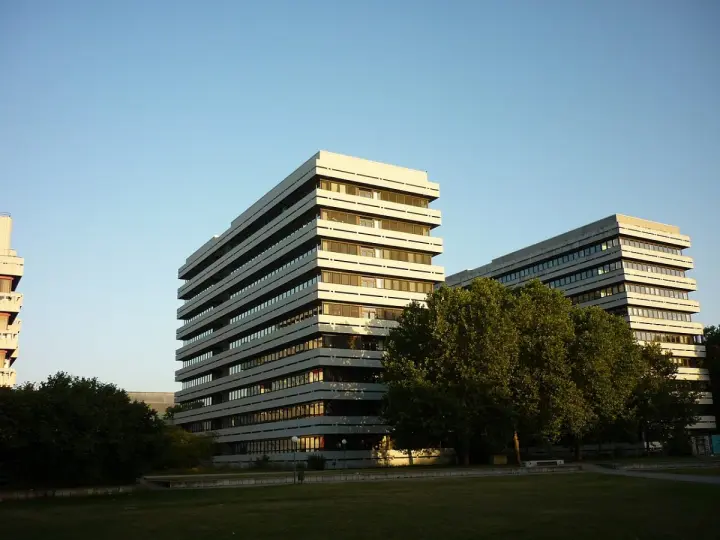
Other programmes at KIT, Karlsruhe Institute of Technology
 KIT, Karlsruhe Institute of Technology
Energy Engineering & Management (MSc, Executive) at HECTOR School
€9,000/yr Tuition · sourced 2 years Duration View details
KIT, Karlsruhe Institute of Technology
Financial Engineering (MSc, Executive) at HECTOR School
€9,000/yr Tuition · sourced 2 years Duration View details
KIT, Karlsruhe Institute of Technology
Information Systems Engineering and Management (MSc, Executive) at HECTOR School
€9,000/yr Tuition · sourced 2 years Duration View details
KIT, Karlsruhe Institute of Technology
Management of Product Development (MSc, Executive) at HECTOR School
€9,000/yr Tuition · sourced 2 years Duration View detailsCampus photos on this page: David M. (CC BY 3.0) — via Wikimedia Commons.
ERASMUS Mundus Master's Programme EUROPHOTONICS — FAQs
5 questions
Tuition is No tuition fee. Taken from the university's published fees page, not re-checked since — confirm it before you budget. We confirm the current fee and the scholarships you qualify for — free.
The main intake is Winter semester. Most universities admit on a rolling basis — we confirm the exact deadline for your profile, free.
For application to the Erasmus Mundus Europhotonics programme, you must hand in the following documents: Officially certified copies and translations of your diplomas into English (first university degree and others – do not send secondary school diploma). Selected students will be asked to bring the original diplomas upon arrival. In case your current degree has not yet been achieved, please upload a letter from your university declaring the expected completion date, as well as available transcripts. Certified English translation of transcripts (BSc or equivalent, and MSc, if available) Clear copy of passport Documentation for language tests (copy of the TOEIC score/IELTS report sheet) Letter of motivation Two letters of reference/recommendation Up-to-date curriculum vitae (two pages maximum) with photo English: E.G. TOEIC: 785 Reading: 385 Listening: 400 Speaking: 160 Writing: 150 IELTS Academic: 6.5.
The programme runs about 24 months full-time.
Yes — shortlisting, SOP, LOR, Resume, application, scholarships and visa guidance are all free. We're paid by partner universities, not by you.
Apply to ERASMUS Mundus Master's Programme EUROPHOTONICS — free help
A counsellor calls you back during office hours — 9am to 8pm IST, Mon to Sat. We are open now.