MSc vs MBA: Which Degree is Right for You? (2026 Guide)
MSc vs MBA: Which Degree is Right for You? (2026 Guide)
For Indian students planning study abroad in 2026, the choice between an MSc (Master of Science) and an MBA (Master of Business Administration) can define career trajectories and long-term earning potential. Both degrees promise business acumen and career acceleration, but they serve entirely different purposes in the talent pipeline [citation:10]. An MBA is a post-experience degree designed for leadership development, commanding median base salaries of $125,000–$190,000 in top U.S. programs [citation:10]. An MSc in Management or specialised fields accepts fresh graduates, costs significantly less, and delivers starting salaries around $65,000–$85,000 [citation:10]. This comprehensive guide provides an msc vs mba comparison 2026 to help you decide which is better msc or mba based on your career stage, goals, and investment capacity.
📘 Table of Contents: MSc vs MBA 2026
🔍 Core Differences: MSc vs MBA at a Glance
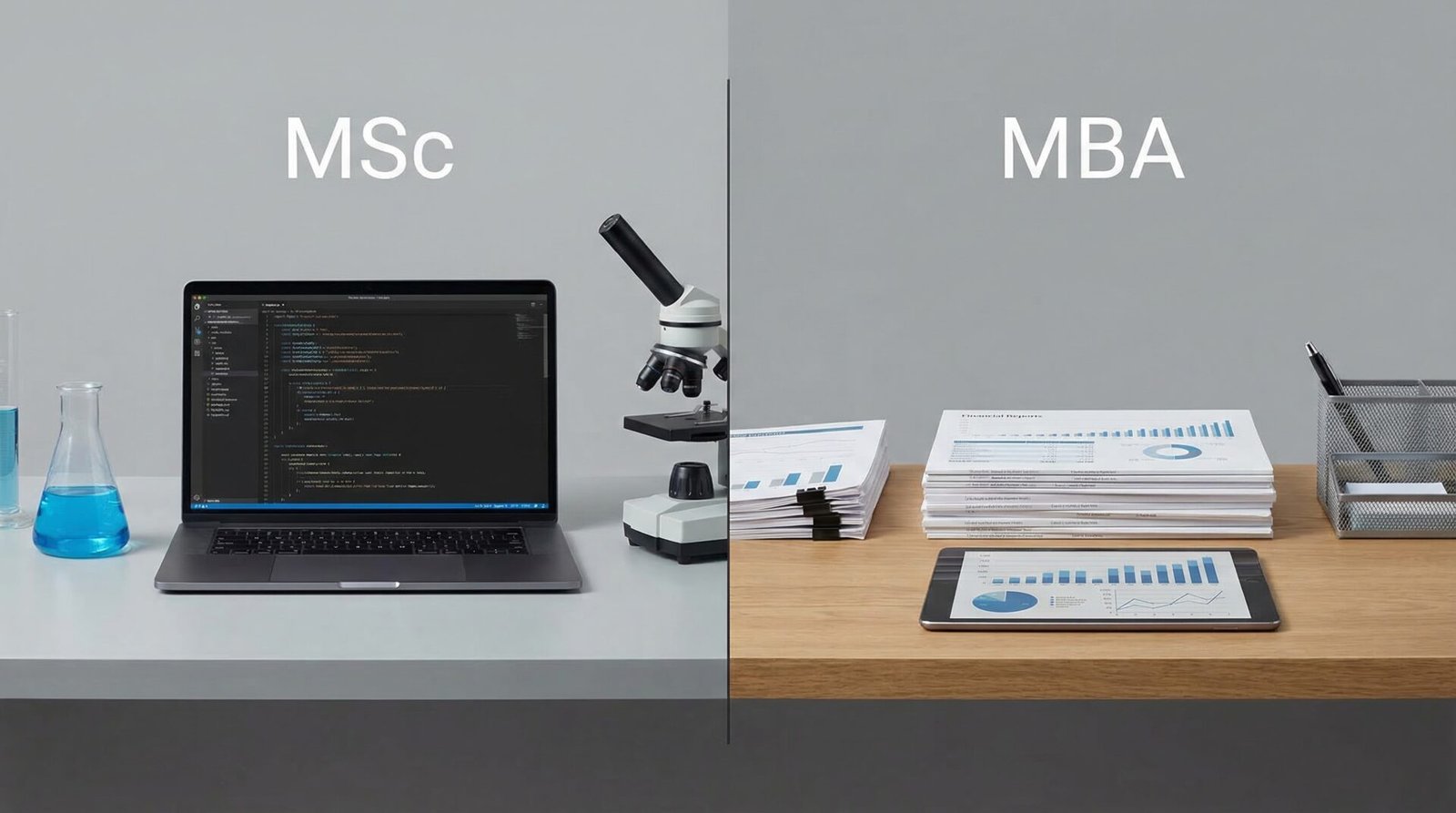
The fundamental distinction lies in candidate experience and career purpose. MBA programs require 3–6 years of professional experience and aim to develop senior leaders. MSc in Management or specialised business programmes accept recent graduates and build foundational expertise [citation:5][citation:10].
| Dimension | MSc (in Management/Business) | MBA (Master of Business Administration) |
|---|---|---|
| Work Experience Required | 0–2 years (fresh graduates accepted) [citation:5] | 3–6 years (top schools require 4–6 years) [citation:10] |
| Program Duration | 12–24 months [citation:10] | 24 months (full-time) / executive options [citation:8][citation:10] |
| Average Age | 22–24 years [citation:10] | 28–30 years [citation:10] |
| Typical Cost (Top Schools) | $30,000–$60,000 [citation:10] | $150,000–$200,000+ (tuition only) [citation:10] |
| Starting Salary (U.S.) | $65,000–$85,000 [citation:10] | $125,000–$190,000 [citation:10] |
| Career Purpose | First professional role, functional specialisation | Career switching, leadership acceleration [citation:5] |
| Teaching Style | Theoretical frameworks, lectures, internships [citation:10] | Case-based learning, peer discussion, practical application [citation:9][citation:10] |
🎓 Eligibility & Work Experience Requirements
MSc (Management/Business) – For Recent Graduates
MSc in Management or specialised business programmes are designed for candidates with little to no professional experience. They accept students from any undergraduate discipline, including humanities, science, and engineering [citation:1][citation:6]. A strong undergraduate degree (typically 50%+ aggregate for Indian students) is sufficient [citation:2]. Some programmes offer foundational courses for non-business backgrounds [citation:4].
MBA – For Experienced Professionals
MBA programmes require significant work experience – typically 3–6 years in professional roles [citation:8][citation:10]. Top schools like UNC Wilmington require two years minimum and prefer candidates with supervisory experience [citation:8]. The degree leverages peer learning: a former investment banker, a military officer, and a product manager in the same classroom create applied learning [citation:10]. Candidates with less than 3 years are unlikely to be admitted to top MBA programmes [citation:4].
Top Universities: Entry Requirements Guide (nofollow) | Vibedu Eligibility Counselling (dofollow)
📚 Curriculum & Specialisations: Depth vs Breadth
MSc programmes provide specialised, in-depth knowledge in a specific field. Common specialisations include [citation:5][citation:6]:
- MSc Finance – Investment banking, financial analysis
- MSc Marketing – Digital marketing, brand management
- MSc Business Analytics – Data science, AI for business
- MSc International Business – Global strategy
- MSc Human Resource Management – Talent development
- MSc Project Management – Operations leadership
Curriculum leans theoretical with lectures, group projects, and often a research dissertation [citation:4][citation:10]. It builds technical expertise for entry-level roles.
MBA programmes offer a broad, general management education covering accounting, economics, marketing, strategy, operations, and leadership [citation:1][citation:8]. Students can pursue concentrations in areas like finance, marketing, cybersecurity, or healthcare management [citation:1][citation:8]. Teaching is case-based, emphasising real-world business problems and peer discussion [citation:9]. The goal is to develop versatile leaders, not narrow specialists.
💰 Salary & Career Outcomes: MSc vs MBA
Let's cut through marketing brochures and look at actual employment data. According to 2025 employment reports, top MBA graduates earn significantly more, reflecting the value of recruiting experienced professionals [citation:10].
| School / Program | Median Starting Salary | Role Entry Level |
|---|---|---|
| Harvard / Wharton / MIT Sloan (MBA) | $169,000–$190,000 base [citation:10] | Consultant, Associate, Product Manager |
| Duke Fuqua (MBA) | $170,000 median [citation:10] | Associate-level roles |
| London Business School (MiM) | ~£48,000 ($61,000) [citation:10] | Analyst, entry-level |
| HEC Paris (MiM) | €45,000–€70,000 ($60,000–$75,000) [citation:10] | Analyst |
| Duke Fuqua (MMS – MiM equivalent) | $80,000 median [citation:10] | Entry-level business roles |
| Top Indian B-Schools (MBA) | ₹20–30 lakhs ($24,000–$36,000) | Management trainee, associate |
Source: Financial Times, GMAC 2025, MBA Insights 2026 [citation:10]
The salary differential isn't about school quality – it's about the roles these degrees unlock. An MBA positions you for associate roles at McKinsey or product management at Google; a MiM positions you for analyst roles at the same firms, one or two rungs lower on the ladder [citation:10].
📈 ROI Analysis: Which Degree Pays Back Faster?
MBA Investment: $150,000–$200,000 tuition + $50,000–$80,000 living + $200,000 opportunity cost (2 years foregone salary) = $400,000–$480,000 total. Post-MBA salary bump of $70,000/year → breakeven in 5–7 years [citation:10].
MSc Investment: $40,000–$60,000 tuition + $30,000 opportunity cost = $70,000–$90,000 total. Salary bump of $25,000/year → breakeven in 3–4 years [citation:10].
But trajectory matters. MBA graduates reach director-level roles ($250,000+) within 8–10 years post-graduation. MiM graduates follow a more traditional climb, taking 10–15 years to equivalent levels. The MBA's higher cost buys faster seniority progression [citation:10]. A 2024 analysis found top MBA graduates out-earn MiM graduates by $2–3 million over a career [citation:10].
🏢 What Recruiters Value More: MBA vs MSc
GMAC's 2024 Corporate Recruiters Survey found that 92% of companies plan to hire MBA graduates, compared to 64% actively recruiting from MiM programs [citation:10]. Consulting firms hire both, but for different roles:
- MBA graduates: Enter as consultants/associate consultants. MBB starting salary: $190,000 base + bonus [citation:10].
- MiM graduates: Enter as business analysts (same as undergrads). Starting salary: $95,000–$110,000 [citation:10].
Investment banking follows a similar pattern: MBAs as associates, MiMs as analysts. Tech companies hire MiMs for product marketing and operations, but MBAs dominate product management and senior IC roles [citation:10].
In specialised fields like HR, employers often prefer a specialised MSc. "If HR is really what you want to do, then the master's is your best option. A master's degree can set you apart in the industry," says an HR professional [citation:9].
GMAC Recruiters Survey (nofollow)
🇮🇳 MSc vs MBA for Indian Students: Key Considerations
For Indian students, several factors influence this decision:
- Cost sensitivity: MSc programmes abroad (especially in Europe) offer lower tuition and one-year durations, reducing financial burden. Germany and France have affordable public options.
- Post-study work visas: Countries like Canada (3 years PGWP), Germany (18 months job-seeker), and Ireland (1–2 years) favour specialised MSc graduates with in-demand skills (data, analytics, finance).
- Indian MBA entrance: CAT, XAT, and GMAT scores are required for top Indian B-schools [citation:2]. Many Indian students target MBA after 2–5 years of work experience in India.
- ROI focus: Indian students increasingly prioritise employability over prestige. An MSc in Business Analytics from a Canadian university may offer faster PR and job placement than a mid-tier US MBA.
🧭 Decision Framework: Which Degree Fits You?
Choose an MSc (in Management or specialised field) if:
- You are a recent graduate with 0–2 years of experience [citation:1][citation:5]
- You want deep expertise in a specific area (finance, marketing, data analytics, HR) [citation:4][citation:9]
- You prefer a shorter, more affordable programme ($30,000–$60,000) [citation:10]
- Your goal is an entry-level professional role with clear technical skills [citation:10]
- You come from a non-business background and need fundamental business knowledge [citation:1]
Choose an MBA if:
- You have 3–6 years of professional work experience [citation:8][citation:10]
- You seek leadership roles, career switching, or accelerated advancement [citation:5]
- You want a broad general management education with networking opportunities [citation:9]
- You are targeting senior roles in consulting, investment banking, or product management [citation:10]
- You can invest $150,000+ and forgo salary for 2 years, understanding the long-term payoff [citation:10]
As one expert summarises: "If you are clear on the type of career or specialism you hope to develop, the advantages of a master's degree often outweigh the more generic, business-focused approach of many MBA curricula" [citation:9]. But for experienced professionals, the MBA's network and leadership development are unmatched.
❓ FAQs: MSc vs MBA Comparison 2026
Which is better for Indian students: MSc or MBA?
It depends on your career stage. Fresh graduates benefit more from specialised MSc programmes (lower cost, faster entry, in-demand skills). Professionals with 3+ years of experience gain leadership acceleration and higher salary potential from an MBA [citation:4][citation:10].
Can I do an MBA without work experience?
Top MBA programmes require 3–6 years of experience [citation:8][citation:10]. Some lower-ranked schools may admit candidates with less, but the value of an MBA without experience is questionable – you miss peer learning and leadership context [citation:4]. Consider a MiM or MSc instead.
What is the salary difference between MBA and MSc graduates?
Top U.S. MBA graduates earn $125,000–$190,000 starting; MiM graduates earn $65,000–$85,000 [citation:10]. Over a career, top MBAs out-earn MiMs by $2–3 million, but the investment is also much higher [citation:10].
Is an MSc in Management equivalent to an MBA?
No. An MSc in Management is a pre-experience degree for recent graduates. An MBA is a post-experience degree for professionals. They lead to different job levels and salary bands [citation:10].
Which degree has better career opportunities abroad?
Both have strong opportunities. MSc graduates are hired for analyst roles in consulting, finance, and tech. MBA graduates enter at associate or manager levels. For Indian students seeking post-study work visas, specialised MSc in STEM or business analytics often align with in-demand occupation lists [citation:6][citation:10].
What are the top specialisations for MSc in 2026?
Business Analytics, Data Science & AI for Business, Finance, Marketing, and International Business are highly sought after [citation:5][citation:6]. These align with growing demand in tech and financial services.
How can Vibedu help me choose between MSc and MBA?
Vibedu provides personalised counselling on career goals, country selection, application strategies, and scholarship guidance. Our experts assess your profile to recommend the best path. Visit Vibedu (dofollow) for a free consultation.
🌐 Outbound resources (dofollow + nofollow): Top Universities MBA vs Masters (nofollow) · GMAC Recruiters Survey (nofollow) · MBA Insights 2026 (dofollow) · EDHEC Guide (dofollow) · Vibedu (dofollow)
🌍 Plan your study abroad journey with the latest msc vs mba which degree is right for you 2026 guide. Vibedu helps you navigate applications, career pathways, and degree selection.