Step-by-Step Study Abroad Process for Indian Students in 2026 – From Application to Visa
Step-by-Step Study Abroad Process for Indian Students in 2026 – From Application to Visa
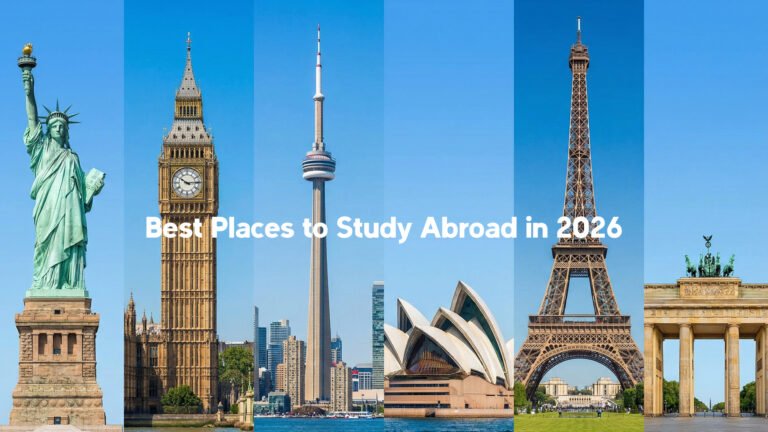
The year 2026 brings significant changes to the global education landscape. With stricter visa regulations in popular destinations like Canada, the UK, Australia, and the USA, Indian students need a clear, updated roadmap [citation:7]. This comprehensive guide walks you through the Step-by-Step Study Abroad Process for Indian Students in 2026, covering everything from university shortlisting to visa approval. Whether you're aiming for North America, Europe, or Asia, understanding the Study Abroad Process 2026 is crucial for a successful journey.
📘 Table of Contents: Your 2026 Study Abroad Journey
- 1. Self-Assessment & Course Selection
- 2. University Shortlisting & Entrance Exams
- 3. Application Process & Documentation
- 4. Offer Letters & Scholarship Applications
- 5. Student Visa Process 2026 – Country Wise
- 🇨🇦 Canada Study Permit 2026
- 🇦🇺 Australia Student Visa (Subclass 500)
- 🇬🇧 UK Student Visa 2026
- 🇺🇸 USA F-1 Visa 2026
- 🇩🇪 Germany & Europe
- 6. Pre-Departure & Arrival
- ❓ FAQs
Step 1: Self-Assessment & Course Selection – How to Study Abroad from India
The first question in the Study Abroad Application Process is "what and where to study?" Evaluate your academic background, interests, career goals, and budget. Research countries based on tuition fees, living costs, and post-study work opportunities. For 2026, while traditional hubs tighten rules, Germany and New Zealand offer more stability [citation:7]. Make a list of courses that align with your profile.
Step 2: University Shortlisting & Entrance Exams
Shortlist 8-10 universities across safe, moderate, and ambitious categories. Check specific requirements: IELTS/TOEFL (if applicable), GRE/GMAT for postgraduate, or entrance exams like SAT. Some universities waive IELTS with MOI (Medium of Instruction) [citation:2]. For example, the University of Southampton Delhi accepts English proficiency from CBSE/CISCE students with 4 years of English-medium study [citation:2].
Step 3: Application Process & Documentation
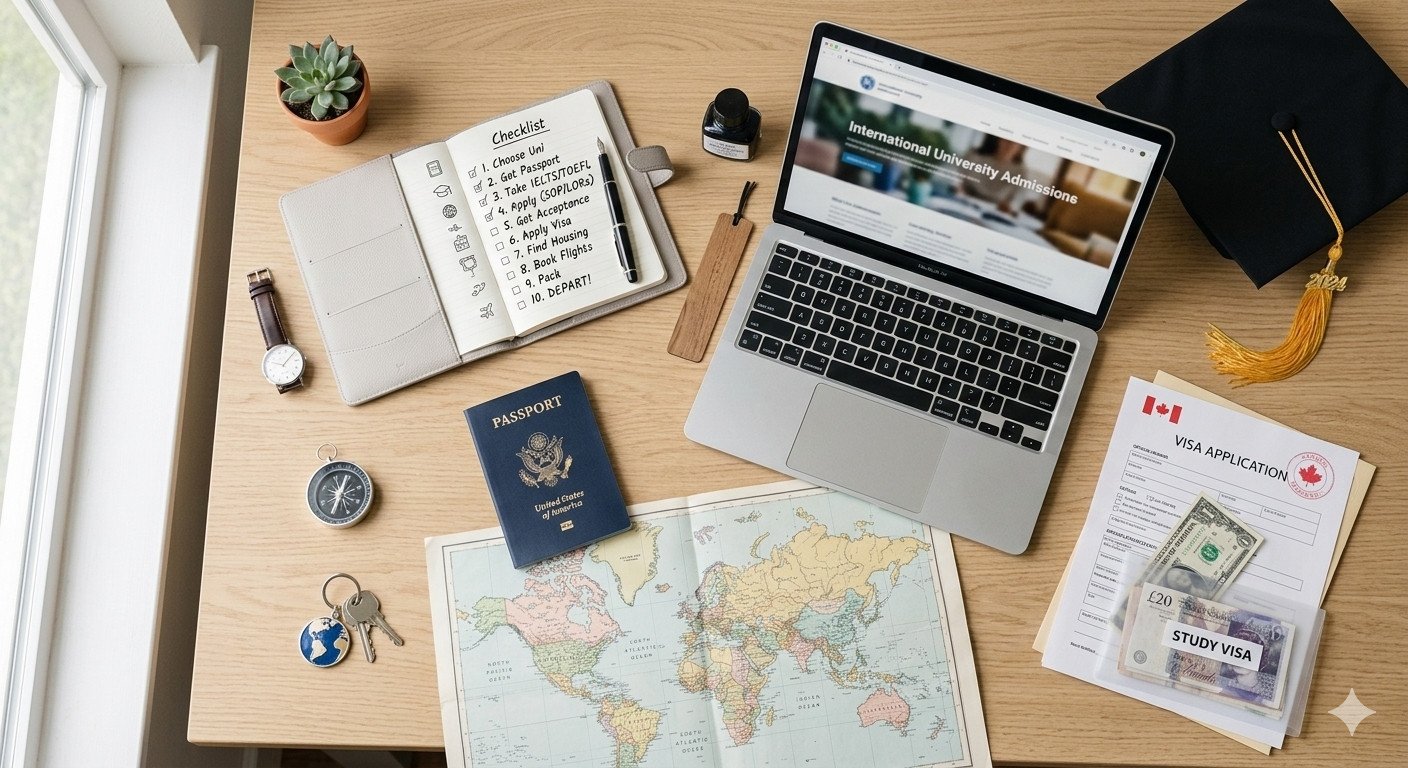
Most universities open applications for 2026 intakes between September 2025 and March 2026 [citation:4][citation:9]. Prepare a checklist:
- Academic transcripts and certificates (Class X, XII, graduation) [citation:2]
- Proof of English proficiency or MOI certificate [citation:2]
- Statement of Purpose (SOP) – 250-500 words explaining your motivation [citation:2]
- Letters of Recommendation (usually 2-3) [citation:2]
- Resume/CV (for master's applicants) [citation:2]
- Passport and photo-id (Aadhaar/passport) [citation:2]
Some universities charge an application fee (e.g., 2,000 INR for Southampton Delhi) [citation:2]. Submit well before deadlines. Use online portals and track each application.
Step 4: Offer Letters & Scholarship Applications
After submitting, universities will review and issue offer letters (conditional or unconditional). Conditional offers may require meeting English scores or final exam results. Simultaneously, apply for scholarships: GREAT Scholarships (UK), DAAD (Germany), or university-specific awards. Vibedu (dofollow) provides expert guidance on scholarship matching.
Step 5: Student Visa Process for Study Abroad – 2026 Updates
The Student Visa Process for Study Abroad has become more stringent in 2026. Below we break down country-wise procedures and new rules.
🇨🇦 Canada Study Permit 2026 – Step-by-Step
Canada remains a top choice, but with changes: the study-permit target for 2026 is 408,000, with master's and PhD exempt from the cap [citation:7][citation:8].
- Step 1: Get admission from a Designated Learning Institution (DLI). You'll receive a Letter of Acceptance (LoA) [citation:1][citation:8].
- Step 2: Gather documents: valid passport, proof of funds (minimum CAD 10,000/year + tuition), SOP, IELTS/PTE scores (if required), medical exam, police certificate [citation:1][citation:8].
- Step 3: Apply online via IRCC portal. Pay application fee (CAD 150) and biometrics fee [citation:1].
- Step 4: Provide biometrics at a Visa Application Centre (VAC) in India [citation:1].
- Step 5: Wait for decision. SDS applications typically process faster (20 days) but require upfront GIC and IELTS [citation:1].
Approved students receive a Port of Entry (POE) letter. The actual study permit is issued at the Canadian airport [citation:8]. Work hours increased to 24 hours/week during sessions [citation:7]. IRCC official site (nofollow).
🇦🇺 Australia Student Visa (Subclass 500) – 2026 Guide
Australia has raised its visa cap to 295,000 for 2026, but fees increased to AUD 2,000 [citation:7][citation:10].
- Step 1: Secure admission and receive Confirmation of Enrolment (CoE) [citation:10].
- Step 2: Meet Genuine Student (GS) criteria, replacing the old GTE [citation:7][citation:10].
- Step 3: Prepare documents: CoE, passport, English test scores (IELTS min 6.0), proof of funds (tuition + living + travel), Overseas Student Health Cover (OSHC) [citation:10].
- Step 4: Apply online via ImmiAccount, pay AUD 2,000 fee [citation:10].
- Step 5: Attend biometrics and medicals if requested.
Post-study work: Temporary Graduate Visa (subclass 485) allows 2-6 years of work rights [citation:10]. India is now in the highest risk category, so stronger documentation is essential [citation:7]. Australia Home Affairs (dofollow).
🇬🇧 UK Student Visa 2026 – New Financial & English Rules
The UK has tightened post-study work and financial thresholds. Key updates for 2026 [citation:7]:
- Financial proof increased to £1,529/month in London, £1,171 outside (for up to 9 months).
- English proficiency now requires CEFR B2 level (up from B1) from January 2026 [citation:7].
- Graduate route shortened: Bachelor's/Master's holders get 18 months (from 2 years). PhD remains 3 years [citation:7].
Application steps:
- Receive Confirmation of Acceptance for Studies (CAS) from a licensed sponsor.
- Provide financial evidence and English test scores (if not exempt).
- Apply online, pay visa fee (approx £490) and Immigration Health Surcharge.
- Attend biometrics at VFS centre.
UK Government visa (nofollow).
🇺🇸 USA F-1 Student Visa 2026 – Stricter Environment
The US has introduced several changes for 2026 [citation:7]:
- New $250 Visa Integrity Fee for F-1 visas.
- Mandatory in-person interviews for most renewals (dropbox removed).
- Fixed duration of stay (up to 4 years) replacing flexible D/S; extensions require USCIS filing.
- Social media history review for all applicants.
- Pressure to reduce OPT periods, especially for non-STEM.
Process:
- Get I-20 form from SEVP-approved university.
- Pay SEVIS I-901 fee.
- Complete DS-160 online, pay visa fee (MRV).
- Schedule and attend visa interview at US Embassy/Consulate.
- Bring I-20, financial documents, academic records.
🇩🇪 Germany & Europe – Stable Alternatives in 2026
While anglophone countries tighten rules, Germany remains open with low tuition and clear post-study pathways [citation:7]. Student visa process for Germany:
- University admission letter.
- Proof of funds (blocked account €11,208 as of 2026).
- APS certificate (mandatory for Indian students).
- Health insurance.
- Visa application at German Embassy/Consulate.
New Zealand also expanded work rights and simplified degree recognition [citation:7].
Step 6: Pre-Departure & Arrival – Final Checklist
Once your visa is approved, prepare for departure:
- Arrange accommodation and travel insurance.
- Book flights, keeping arrival date within visa window.
- Carry originals of all documents: passport with visa, LoA/CoE/CAS/I-20, proof of funds, medical reports, academic certificates [citation:8].
- Inform bank about international travel.
- Attend pre-departure orientations (Vibedu offers these).
On arrival, complete registration (FRRO in India for incoming students, but for outgoing, follow local rules). At Canadian airport, present POE letter and receive study permit [citation:8].
❓ FAQs: Study Abroad Process 2026 for Indian Students
When should I start my study abroad application for 2026?
Ideally, begin 12-18 months before your intended intake. For Fall 2026, start research by mid-2025, exams by late 2025, and applications between September 2025 and March 2026 [citation:1][citation:4][citation:9].
Is IELTS mandatory for study abroad in 2026?
Not always. Many universities accept MOI certificates, Duolingo, or internal interviews [citation:2]. Check specific university requirements.
What is the minimum bank balance for a Canada student visa in 2026?
You need to show at least CAD 10,000 for living expenses (outside tuition) plus first-year tuition. GIC of CAD 20,635 is recommended under SDS [citation:1].
Can I work in Australia on a student visa in 2026?
Yes, student visa holders can work up to 48 hours per fortnight during sessions [citation:10]. Post-study work visas (subclass 485) allow 2-6 years of work [citation:10].
What is the new Genuine Student (GS) requirement for Australia?
The GS test replaced GTE from 2026. It requires applicants to demonstrate genuine intent to study with detailed evidence of educational plans and ties to home country [citation:7].
How can Vibedu help with my study abroad journey?
Vibedu provides end-to-end counselling: university selection, application support, SOP editing, scholarship guidance, and visa assistance. Visit Vibedu (dofollow) for free resources.
🌐 Outbound resources (dofollow + nofollow): IRCC Canada (nofollow) · Australia Home Affairs (dofollow) · UK Visas (nofollow) · US Student Visa (dofollow) · DAAD Germany (dofollow) · Vibedu (dofollow)
🎓 Plan your study abroad journey with the latest Step-by-Step Study Abroad Process for Indian Students in 2026. Vibedu helps you navigate applications and visas.