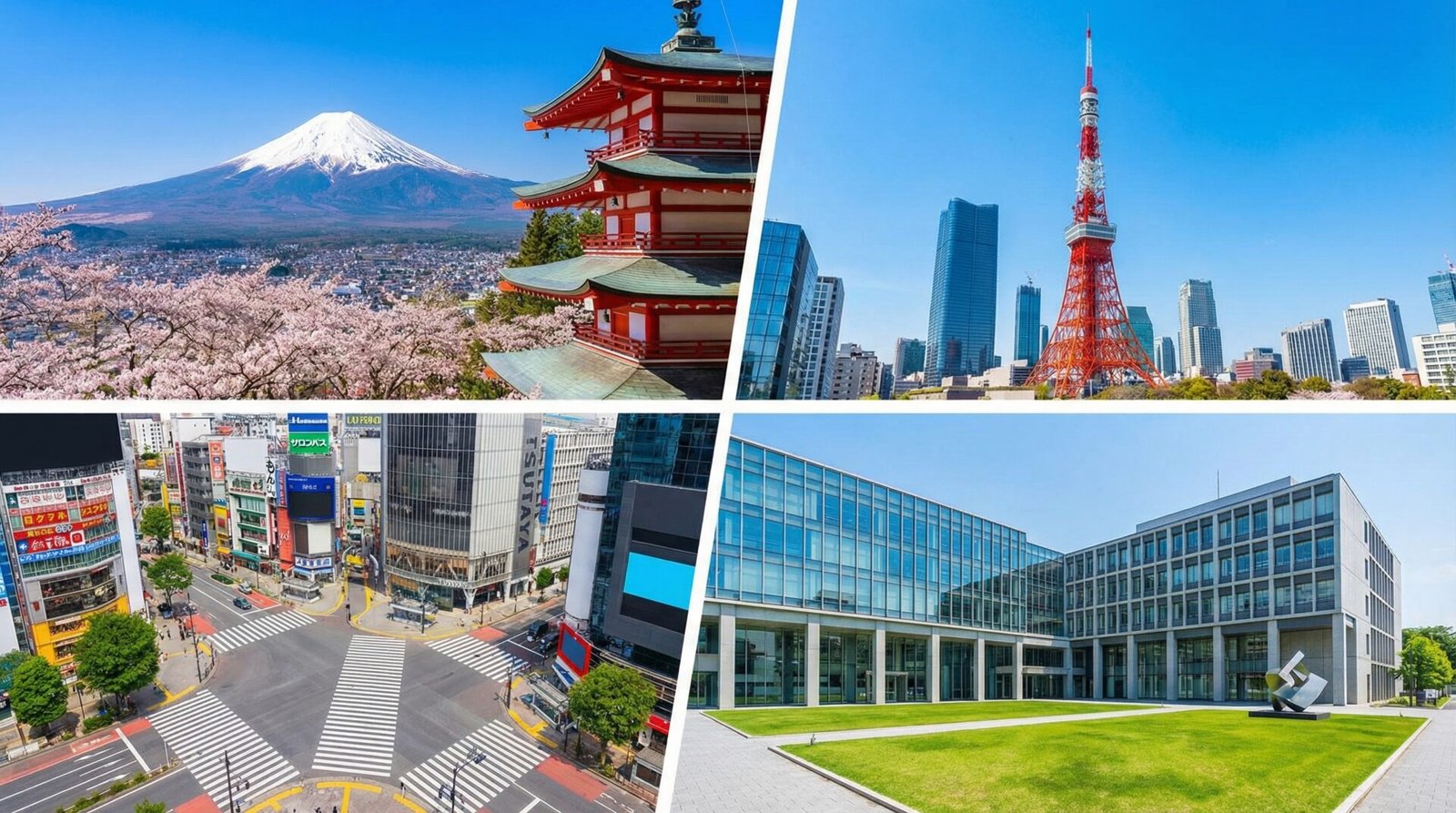
Why Japan Is Emerging as a Top Study Destination in 2026 – Costs, Courses & Visa Opportunities
Why Japan Is Emerging as a Top Study Destination in 2026
Costs, Courses & Visa Opportunities for Indian Students and Beyond
Table of Contents
- 1. Japan‘s 2026 Breakthrough: Why Now?
- 2. Top Universities in Japan for International Students (2026)
- 3. Cost of Studying in Japan 2026: Tuition & Living
- 4. Popular Courses & English-Taught Programs
- 5. Japan Student Visa Process 2026 — Step by Step
- 6. Scholarships & Financial Aid for Indian Students
- 7. Work While You Study & Post-Study Stay
- 8. Frequently Asked Questions (FAQ)
Why Japan Is Emerging as a Top Study Destination in 2026 is a question on the minds of thousands of Indian students and global aspirants. In early 2026, Japan surpassed its target of 400,000 international students—eight years ahead of schedule—with a record 180,000 first-time students arriving in 2025 [citation:1]. With new enrolment flexibility, tuition reforms, and a booming job market for STEM graduates, Japan offers an irresistible mix of quality and affordability.
For Indian students, Study in Japan 2026 for Indian Students has become easier thanks to streamlined visa processes, more English-taught degrees, and cultural familiarity. This guide covers everything from updated university rankings to the exact Japan Student Visa Process 2026, plus real costs and scholarship opportunities. Let’s dive deep.
1. Japan‘s 2026 Breakthrough: Why Now?
The Japanese government has actively loosened enrolment caps. From April 2026, selected faculties at Tohoku University, University of Tsukuba, and Hiroshima University can exceed international student quotas by up to 5% [citation:1][citation:6]. This move is designed to attract global talent and internationalise campuses. Additionally, the restriction that national universities could only charge international students 1.2 times domestic tuition was removed in 2024, giving universities more financial flexibility [citation:1].
According to the OECD, international students make up only 3.3% of Japanese enrolment (far below the UK's 13.4%), so there’s huge room for growth [citation:1]. The message is clear: Japan wants you in 2026.
2. Top Universities in Japan for International Students (2026)
Japan boasts 47 universities in the QS 2026 rankings, with four in the global top 100 [citation:2][citation:8]. Below are the highest-ranked institutions and their approximate acceptance rates. Most offer dedicated support for international students.
| University | QS World Rank 2026 | Acceptance Rate (approx.) |
|---|---|---|
| University of Tokyo | #36 | 32–36% |
| Kyoto University | #57 | 5.9–11% |
| Tokyo Institute of Technology | #85 | 3–10% |
| Osaka University | #91 | 41–60% |
| Tohoku University | #109 | 30–41% |
| Nagoya University | #164 | 2–40% |
| Waseda University | #196 | 20–40% |
| Keio University | #215 | 23–24% |
For a complete list, check the official QS World University Rankings 2026. Many universities now have dedicated offices for Indian students. Study in Japan official portal provides detailed admission guides.
3. Cost of Studying in Japan 2026: Tuition & Living
Cost of Studying in Japan 2026 remains attractive compared to other G7 nations. National university annual fees are approximately ¥535,800 – ¥820,000 (INR 3–4.6 lakhs) [citation:2]. However, some top universities have announced increases: Tohoku University will raise international tuition to ¥900,000 from 2027, and Tsukuba to ¥608,800 [citation:1][citation:6]. Private universities like Keio or Waseda can range from ¥800,000 to ¥1.5 million.
Living costs (including accommodation, food, transport) average around ¥1.2–1.5 million per year (approx. INR 6.9–8.6 lakhs) [citation:7]. Tokyo is more expensive, while smaller cities like Sendai or Fukuoka are cheaper. Students often work part-time (see section 7).
| Expense type | Annual estimate (¥) | Annual estimate (INR) |
|---|---|---|
| National University tuition | 535,800 – 820,000 | 3,05,000 – 4,70,000 |
| Private University tuition | 800,000 – 1,600,000 | 4,60,000 – 9,20,000 |
| Living expenses (incl. rent) | 1,200,000 – 1,500,000 | 6,90,000 – 8,60,000 |
| Health insurance + misc | 40,000 – 60,000 | 23,000 – 34,000 |
*Exchange rate: 1¥ ≈ ₹0.57 (indicative).
4. Popular Courses & English-Taught Programs
Japan excels in Robotics, AI, Mechanical Engineering, Automotive Technology, and Life Sciences. There are over 1,500 English-taught courses across universities [citation:2]. Popular choices include:
Engineering & Technology: Mechanical, Electrical, Computer Science, Robotics (4 years bachelor / 2 years master).
Business & Management: International Business, MBA, Economics.
Medicine & Healthcare: Medicine (6 years), Nursing, Pharmacy.
Social Sciences & International Relations: Many programs at Waseda, Keio, and Sophia University taught in English.
For a comprehensive list, visit the JASSO website which updates English-taught degree databases.
5. Japan Student Visa Process 2026 — Step by Step
The Japan Student Visa Process 2026 remains straightforward, with a ~95% approval rate for Indian students when documents are correct [citation:7]. The golden rule: obtain a Certificate of Eligibility (COE) sponsored by your university.
Step 1 – University admission & COE application: After acceptance, the university applies for your COE at the regional immigration bureau. Processing takes 1–3 months [citation:7]. For 2026, deadlines vary: e.g., Temple University Japan’s COE application closes April 28, 2026 [citation:9]; Keio GIGA program required documents by May 12, 2026 [citation:4]. Apply 6–8 months before intake.
Step 2 – Receive COE & pay fees: University sends COE (by email or post) after fee confirmation.
Step 3 – Visa application at Japanese embassy/consulate in India: Submit COE, passport, photo, visa form, and proof of financials. Fee approx. ¥3,000 (single entry) [citation:7]. Processing: 5–10 working days.
Financial proof: You need to show savings/balance of around ¥2,000,000 – ¥2,500,000 (INR 11.4L–14.4L) [citation:7].
External resource: Read the official Japan MOFA visa guidelines for the latest updates.
6. Scholarships & Financial Aid for Indian Students
Several generous scholarships exist for 2026. The MEXT (Japanese government) scholarship covers full tuition, monthly allowance (approx. ¥144,000 for graduates), and airfare [citation:10]. University-specific scholarships: Waseda, Tohoku, and Kyushu offer tuition reductions (30%–100%) for high-achieving students. The JASSO scholarship provides monthly stipend around ¥48,000. Also, private foundations like Honjo International offer graduate-level funding.
Note: Doshisha Business School offers MEXT University Recommendation for 2026 entry, covering full tuition and monthly allowance [citation:10]. Always check with your university.
7. Work While You Study & Post-Study Stay
International students on a student visa can work up to 28 hours per week (during holidays: 8 hours/day) after receiving permission from immigration [citation:7]. Typical part-time jobs: convenience stores, tutoring, cafés, or translation. Average monthly earnings around ¥59,000 (INR 34k) [citation:7].
After graduation, students can switch to a “Highly Skilled Professional” or “Work” visa if they secure a job in Japan. The government is actively promoting start-up visas and longer job-hunting periods. Japan's low unemployment rate (2.5%) favours fresh graduates, especially in tech.
For personalized guidance, explore our resources at Vibedu (dofollow) or read independent reviews on Hotcourses Abroad (nofollow) to verify experiences. You can also check the MEXT official page (dofollow) for policy updates.
Frequently Asked Questions (FAQ)
*Click to get expert guidance for your Japan study journey
Additional resources: Study in Japan Official (dofollow) | Japan Travel Guide (nofollow) | Vibedu Japan Section (dofollow) | Visa info (nofollow).
Published: March 2026 — Data verified from multiple 2026 sources. Always confirm with official websites.